
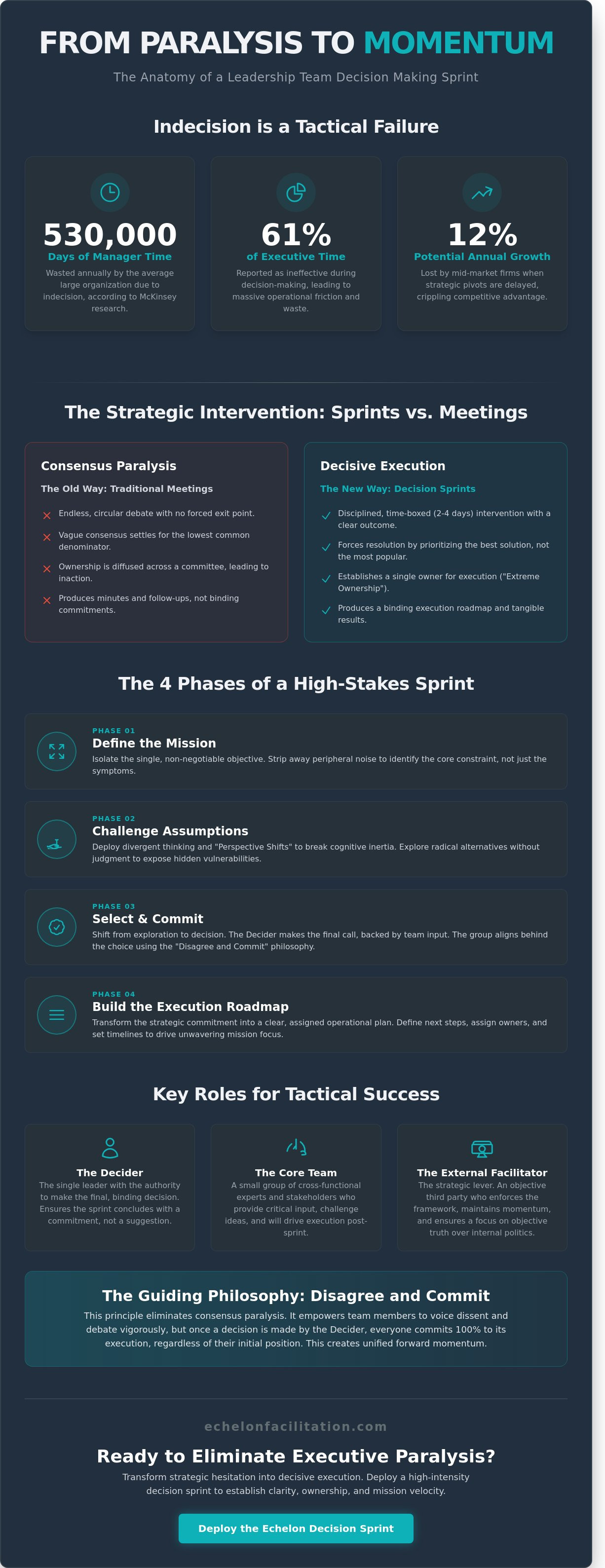
Indecision is not a neutral state; it is a tactical failure that costs the average large organization 530,000 days of manager time annually according to McKinsey research. You've likely experienced the friction of an executive session that concludes with high-level agreement but zero operational momentum. Without a disciplined framework, these gaps in ownership lead to mission drift and wasted capital. This is why we utilize the leadership team decision making sprint. It's a high-intensity, results-driven process that replaces vague consensus with binding strategic commitments and absolute clarity.
You already know that your team's success depends entirely on the speed and quality of your execution. It's frustrating to watch critical objectives stall because nobody clearly owns the outcome. This article provides the tactical roadmap you need to eliminate executive paralysis and establish a culture of extreme ownership. We'll examine the specific phases of the sprint and show you how to transform abstract goals into a clear, assigned execution plan that drives the mission forward with unwavering focus.
Key Takeaways
- Learn how a leadership team decision making sprint transforms strategic hesitation into a high-intensity intervention that resolves high-stakes constraints.
- Master the "Disagree and Commit" philosophy to eliminate consensus paralysis and drive decisive execution across your executive team.
- Discover the two-phase anatomy of a tactical sprint, from pinpointing the mission-critical constraint to exploring radical strategic alternatives.
- Identify the essential roles of the 'Decider' and 'Core Team' to ensure every tactical move is backed by extreme ownership and clear accountability.
- Understand why an external facilitator is the strategic lever needed to maintain objective truth and move your mission toward a state of victory.
What is a Leadership Team Decision Making Sprint?
A leadership team decision making sprint is a disciplined, time-boxed intervention designed to resolve high-stakes strategic bottlenecks. It isn't a standard board meeting or a brainstorming retreat. Those formats often prioritize consensus over clarity. A sprint prioritizes the mission. It forces executive teams to move from passive observation to tactical execution within a compressed timeframe, typically lasting between two and four days. This format is essential when the cost of inaction exceeds the risk of a focused strike.
In a standard corporate environment, a 2019 McKinsey study found that 61% of executives report at least half the time they spend making decisions is ineffective. This waste occurs because standard meetings lack the structural intensity required for complex trade-offs. The sprint model replaces collaboration for its own sake with facilitation for strategic victory. It's a tool for organizations facing 15% market shifts or internal friction that threatens operational readiness. We don't aim for comfort; we aim for alignment and speed.
The Core Objectives of the Sprint
- Mission-Critical Clarity: Sprints strip away peripheral noise to define the exact problem. Without this, teams solve symptoms while the root cause remains. We identify the "commander's intent" so every subsequent move aligns with the primary objective.
- Eliminating Indecision Costs: Every day of delay has a price. Indecision is a silent drain on executive energy and capital. The sprint stops the bleed. A 2023 industry report suggests that delayed strategic pivots can cost mid-market firms up to 12% in potential annual growth.
- Establishing Extreme Ownership: By the end of the intervention, the team identifies a single point of failure. One leader owns the execution. No more hiding behind the committee or vague group responsibilities.
Why Traditional Meetings Fail Where Sprints Succeed
Standard meetings are often victims of circular logic. They allow for endless debate without a forced exit point. Sprints enforce a linear path. They acknowledge that the human element of leadership often introduces ego and cognitive bias into the process. These factors complicate group decision-making, leading to compromise rather than the optimal choice. When teams seek consensus, they often settle for the lowest common denominator. Sprints demand the best solution, not the most popular one.
A leadership team decision making sprint bypasses these hurdles by applying a rigid framework to the dialogue. It moves the team through discovery, friction, and resolution with surgical precision. This approach is essential for those committed to the principles outlined in our Leadership Team Decision Making pillar. Where meetings produce minutes, sprints produce results. We value objective truth over comfortable narratives because the mission doesn't care about feelings; it cares about execution.
The Anatomy of a High-Stakes Decision Sprint
A leadership team decision making sprint operates as a high-intensity tactical maneuver. It's designed to bypass the friction of traditional corporate consensus. This framework consists of four distinct phases that transform strategic ambiguity into operational momentum. Success depends on disciplined adherence to the process and a commitment to radical transparency. It's about moving from a state of hesitation to a state of decisive action.
Phase 1 & 2: Defining the Mission and Challenging Assumptions
Phase 1 demands the identification of the core constraint. Leaders often mistake symptoms for root causes. We define the 'Mission' as the non-negotiable objective of the sprint that overrides all departmental silos. Without this singular focus, efforts fragment and resources are wasted on secondary issues. Once the mission is set, Phase 2 introduces divergent thinking to break cognitive inertia. We utilize a Perspective Shift to view the business through the lens of an aggressive competitor or a dissatisfied client. This outside-in approach exposes vulnerabilities that internal narratives often ignore. Teams must challenge every assumption that led to the current bottleneck. It's during this phase that radical alternatives are explored without the fear of internal judgment. This structured exploration prevents the groupthink that typically plagues executive boardrooms.
Phase 3 & 4: Selection and the Execution Roadmap
Phase 3 shifts from expansion to surgical precision. Tactical selection focuses on narrowing options based on objective truth and resource reality. High-stakes trade-offs are navigated by prioritizing the long-term mission over short-term comfort. This process relies on a robust Decision-Making Framework for Leadership Teams to mitigate individual biases and emotional attachments to failing projects. The facilitator ensures the 'Decider' remains insulated from internal politics; they provide the clarity needed to make the final call. Clarity is the precursor to ownership. In Phase 4, the team builds the Execution Mapping. The primary output is a 30-Day Execution Plan that outlines specific, measurable actions. This isn't a theoretical roadmap. It's a tactical directive. Every task is assigned to a specific owner with a clear deadline. Organizations that implement this level of granular accountability often see a 40% increase in project completion rates within the first quarter. To see how these phases integrate into a live environment, consider exploring our leadership team decision making sprint workshops. This structured approach ensures that the leadership team doesn't just reach a decision, but initiates a movement.
Decisive Execution vs. Consensus Paralysis
Consensus is a slow poison for strategic momentum. Many executive teams operate under the delusion that every leader must agree with every nuance of a plan before moving forward. This pursuit of 100% agreement results in diluted strategies that lack the edge required for market victory. A leadership team decision making sprint rejects this passive approach. It replaces the need for total consensus with the "Disagree and Commit" philosophy. This pillar of high-performing teams allows for rigorous debate followed by unified action. Once a decision is made, the time for dissent ends and the era of execution begins.
The structure of a sprint prevents the loudest voice from dominating the strategic direction. In traditional meetings, the most senior or aggressive personality often steers the outcome through sheer persistence. The sprint framework uses blind voting and silent ideation to neutralize these power dynamics. Decisions rest on objective data rather than subjective narratives or internal politics. When a team prioritizes evidence over ego, they achieve a level of tactical clarity that is impossible in standard boardroom settings. This objective approach ensures that the mission remains the focus, not the individual preferences of the participants.
Breaking the Consensus Trap
Seeking total consensus often leads to a "middle of the road" strategy that fails to move the needle. When every stakeholder must be satisfied, the resulting plan is usually stripped of its most innovative and decisive elements. The facilitator acts as a tactical controller during these sessions. Their job is to maintain disciplined focus and cut through circular arguments. They ensure that alignment is treated as a state of readiness. It's not a feeling of warmth among colleagues; it's a collective agreement to execute the chosen path with extreme ownership. Success depends on the team's ability to move as a single unit once the sprint concludes.
Maintaining Stability Under Pressure
The sprint framework functions as a safe container for radical honesty. Leadership teams often face existential threats that can trigger emotional volatility and defensive posturing. A structured process keeps the team composed. It allows for high-stakes debates without the risk of personal fallout or organizational fracture. By utilizing high-stakes workshop facilitation, organizations can navigate these crises with tactical clarity. This methodology ensures that even when the stakes are at their peak, the team remains focused on the mission objective. A 2022 survey by Gartner indicated that 65% of executive decisions are significantly more complex than those made just two years ago. This complexity requires a stable, repeatable system to ensure the leadership team decision making sprint produces results rather than more questions.
Preparing for the Sprint: Logistics and Ownership
Execution starts long before the team enters the room. A leadership team decision making sprint requires meticulous preparation to avoid the friction of indecision. If you fail to set the stage, you'll spend your first four hours debating the agenda rather than solving the mission. We begin with a pre-sprint diagnostic. This assessment identifies the specific bottlenecks, such as resource scarcity or misaligned incentives, that have stalled progress over the previous 90 days. Pinpointing these constraints ensures the team addresses the root cause of stagnation immediately.
Environment dictates behavior. Tactical focus requires physical separation from the daily grind. Offsite locations are superior because they remove the pull of operational fires. When the team is offsite, the mission at hand becomes the sole priority. This physical shift signals that the sprint isn't just another meeting; it's a high-stakes strategic intervention.
Choosing the Right Participants
Meeting bloat kills momentum. Research from the University of North Carolina indicates that senior managers spend an average of 23 hours a week in meetings. You can't afford that waste. Limit your core team to seven people. You need three distinct roles to maintain velocity. The Decider holds the ultimate authority to greenlight the mission. The Facilitator maintains the process and keeps the group on track. The Experts provide the technical data required to validate assumptions. For teams struggling with internal dynamics, external Echelon Workshops provide the neutral ground necessary for objective execution.
Establishing the Rules of Engagement
Success depends on a psychological contract of extreme ownership. Every participant must leave their rank at the door. Hierarchy creates bottlenecks and stifles the truth. In a leadership team decision making sprint, the best idea wins regardless of who voiced it. We enforce a strict "no distractions" policy. This means zero laptops and zero phones. If a leader can't step away from their inbox for six hours, they aren't leading; they're reacting.
Don't rely on intuition or gut feelings. Gather your KPIs, market reports, and customer feedback 14 days before the start date. Decisions grounded in raw data survive the transition from the boardroom to the field. When everyone arrives with the same facts, you eliminate the time wasted on debating reality. You move straight to the solution. This disciplined approach ensures the sprint produces actionable results rather than vague suggestions.
Ready to align your executive team and accelerate your mission success? Book a strategic alignment workshop today.
Deploying the Echelon Decision Sprint for Your Team
High-stakes leadership requires more than just consensus; it demands a clear path to execution. When your executive team faces a strategic crossroads, the cost of delay often outweighs the risk of a wrong turn. Echelon Facilitation acts as a structured, neutral partner for these critical moments, providing the structure needed to convert friction into momentum. Implementing a leadership team decision making sprint isn't about hosting another meeting. It's about a disciplined intervention that forces objective truth to the surface.
An external facilitator provides the unbiased perspective that internal leaders cannot maintain. Research from the Harvard Business Review indicates that 67% of strategies fail due to poor execution, often rooted in lack of alignment at the top. We work to close this gap by acting as a neutral arbiter. We don't have a stake in your office politics; we only have a stake in your mission success. Within the first 48 hours after the sprint concludes, your team will possess a finalized execution roadmap. This document outlines specific accountabilities, timelines, and communication protocols, ensuring the energy generated during the sprint doesn't dissipate once the room empties.
The Echelon Advantage: Disciplined Authority
Dr Andrew Greenland leads Echelon with a focus on operational reality. His years running large, high-stakes working sessions for senior expert groups shape how every session is designed. We've stripped away the corporate jargon that often masks indecision. Instead, we use a framework built on clarity and decentralized command. Echelon prioritises the human element of leadership. We understand that a plan is only as good as the team's willingness to own it. Our strategic workshops are designed to build that ownership through rigorous, honest dialogue.
Next Steps: Moving Toward Strategic Victory
If your team is currently stalled by a complex hurdle, the time for passive observation has passed. We don't offer off-the-shelf solutions. Every leadership team decision making sprint is tailored to your specific organizational challenges. The process begins with a diagnostic call to assess your team's readiness and define the primary mission objective. During this call, we determine if your current friction is a matter of strategy, personnel, or process. We then build the sprint architecture to address that specific bottleneck.
- Identify the primary strategic blocker within your executive tier.
- Schedule a diagnostic session to evaluate team alignment and mission clarity.
- Execute the sprint to secure commitment to a single course of action.
- Deploy the 48-hour post-sprint roadmap to begin immediate execution.
Indecision is a choice, and it's one that your competitors are happy to see you make. Ownership is a victory that starts with a single, disciplined step. Contact Echelon Facilitation today to give your next mission the best chance of success.
Secure Mission Success Through Decisive Alignment
Strategic stagnation costs organizations momentum and resources. By implementing a leadership team decision making sprint, your executive body moves past the friction of consensus paralysis into a state of tactical readiness. This framework demands extreme ownership from every participant. It replaces vague discussions with a structured protocol designed for high-stakes environments. You've learned how to prepare logistics and establish clear ownership to ensure every decision translates into immediate operational impact.
Dr Andrew Greenland, founder of Echelon Facilitation, is a medical doctor who has spent years running large, high-stakes working sessions for senior expert groups, and he brings that experience to guide teams through these high-pressure cycles. Our frameworks focus on full alignment and disciplined execution. We don't settle for comfortable narratives; we pursue objective truth to secure your mission. When your team operates with this level of clarity, execution becomes the standard rather than the exception. It's time to eliminate the ambiguity that slows your progress and adopt a disciplined approach to executive leadership.
Book your Leadership Team Decision Making Sprint with Echelon today and prepare your organization for its next major victory.
Frequently Asked Questions
How long does a leadership team decision making sprint typically take?
A leadership team decision making sprint typically takes 2 consecutive days, totaling 16 hours of focused strategic work. This condensed timeline forces the team to prioritize objective truth over circular debate. This pace ensures momentum stays high and prevents the stagnation common in traditional monthly board meetings.
What is the difference between a Design Sprint and a Decision Sprint?
Design Sprints focus on creating and testing product prototypes over a 5 day cycle, while a Decision Sprint centers on executive alignment and strategic commitment. Design Sprints often follow the Google Ventures 2010 framework to validate ideas with users. In contrast, a Decision Sprint uses tactical frameworks to resolve internal friction and establish clear ownership. It moves 60% faster because it targets leadership behavior rather than user testing.
Does the whole leadership team need to be present for the entire sprint?
Every member of the core leadership team must be present for 100% of the session. Tactical gaps occur when key stakeholders miss even 1 hour of the process. Effective leadership requires total presence to ensure decentralized command works. We limit groups to 10 participants to maintain maximum efficiency. If a leader can't commit to the full schedule, the team's alignment remains compromised and execution will likely fail.
What happens if the team cannot reach an agreement by the end of the sprint?
The designated Decider makes the final call if the team doesn't reach a consensus by the end of the session. This prevents the 50/50 deadlocks that paralyze most organizations. We prioritize a 70% confidence level to maintain momentum. Execution doesn't require 100% agreement, but it does require 100% commitment once the leader sets the course. This approach ensures the mission moves forward despite lingering individual doubts.
How do we ensure the decisions made during the sprint are actually executed?
You ensure execution by assigning extreme ownership of each task to a single individual. Use a 30, 60, and 90 day roadmap to track progress and hold leaders accountable. Statistics show that execution success drops by 40% when more than one person is responsible for a single metric. Clear ownership eliminates the ambiguity that often kills strategic initiatives after the meeting ends. We focus on results, not just ideas.
Can a decision-making sprint be conducted virtually or must it be in-person?
A leadership team decision making sprint can be conducted virtually, though in-person sessions often result in 25% higher engagement levels. Virtual sprints should be broken into 4 hour blocks over 4 days to prevent digital fatigue. We use digital whiteboards like Miro to maintain tactical clarity and track progress. Whether remote or local, the requirement for disciplined focus and zero distractions remains the same for every participant.
What kind of strategic problems are best suited for this sprint format?
This format is best for high-stakes problems with a 12 month impact or significant resource requirements. Use it for market entry strategies, organizational restructuring, or annual mission planning. If a decision affects 3 or more departments, the sprint framework is the most efficient path to clarity. It removes the friction from complex choices that usually take 6 months to resolve through standard corporate channels.
How much preparation is required from the leadership team before the sprint begins?
Each leader must complete 3 to 5 hours of individual preparation before the leadership team decision making sprint begins. This involves reviewing internal data and drafting a 1 page summary of their department's current state. Arriving with objective facts prevents the session from devolving into emotional narratives. Preparation is the foundation of tactical success. Without it, the team wastes the first 4 hours just getting up to speed on basic information.