
You sit at the head of the boardroom table, watching two senior directors argue over a minor operational detail whilst the quarterly strategic agenda remains untouched. It is a common failure of leadership, yet few executives understand how to stop meetings from going off track before the session dissolves into a series of irrelevant tangents.
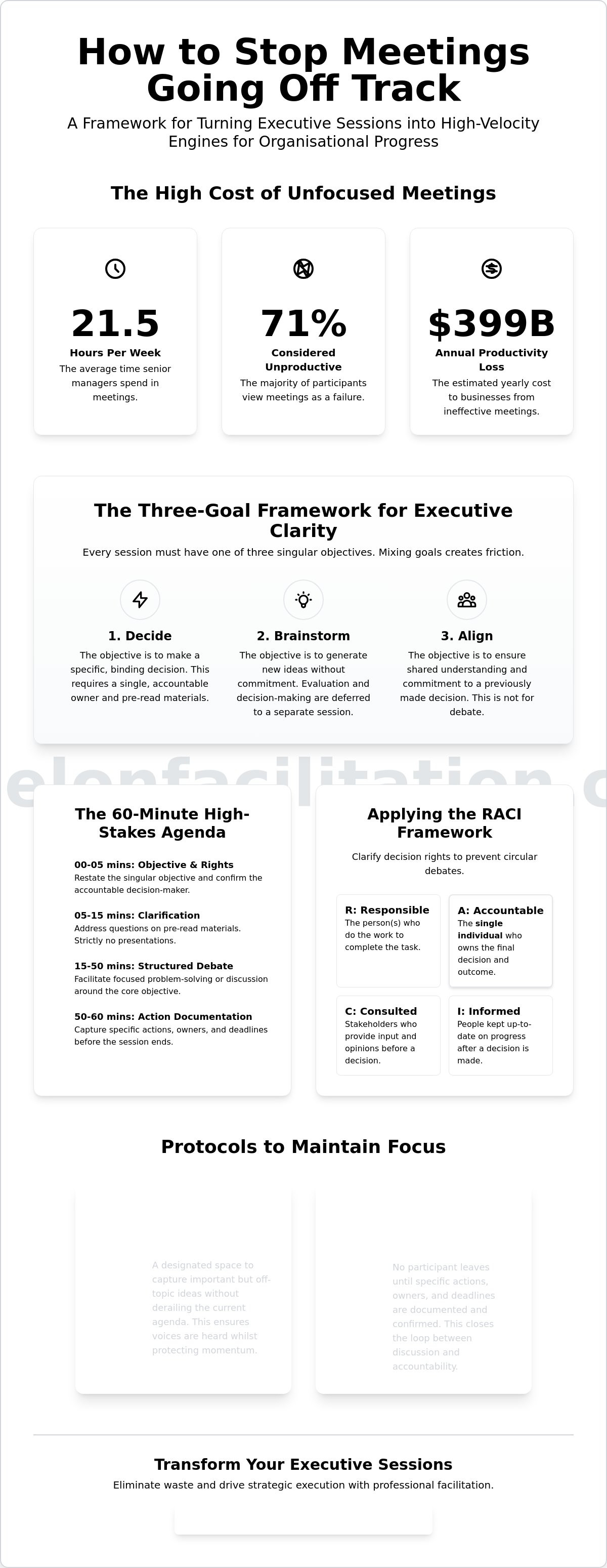
This lack of discipline is more than a simple frustration; it is a significant drain on organisational resources. Senior managers and employees now spend an average of 21.5 hours per week in meetings, yet 71% of them consider these sessions unproductive. The financial impact is severe, costing businesses an estimated $399 billion annually in lost productivity. These wasted hours represent a direct failure to execute high-level strategy and a loss of momentum that your competitors will certainly exploit.
This article outlines the structural frameworks required to maintain focus and ensure every executive session delivers measurable strategic value. You will learn to apply rigorous facilitation techniques and clarify decision rights to eliminate circular debates and silence dominant personalities. Establishing these boundaries transforms meetings from time-sinks into high-velocity engines for organisational progress.
Key Takeaways
- Establish a singular objective for every session to ensure time is spent on decision-making rather than passive information sharing.
- Apply the RACI framework to clarify decision rights and identify the single individual accountable for the final outcome.
- Learn how to stop meetings from going off track by adopting a neutral facilitation stance that prioritises process over personal bias.
- Enforce the "Immediate Output" rule to capture specific actions, owners, and deadlines before any participant leaves the room.
Establishing Structural Boundaries to Stop Meetings from Going Off Track
Discipline in the boardroom is not a matter of etiquette; it is a matter of strategic survival. Most executive sessions fail because they lack a defined perimeter. To understand how to stop meetings from going off track, you must first categorise the session's intent. Ambiguity is the catalyst for tangents. When participants don't know if they are there to approve a budget or brainstorm a product launch, they will naturally drift into irrelevant territory. Establishing structural boundaries ensures that the collective intellect of the leadership team remains focused on the highest-value objectives.
The Three-Goal Framework for Executive Clarity
Every session must have one of three singular objectives: to decide, to brainstorm, or to align. Mixing these goals leads to collaborative friction and wasted time. An "update" meeting should never morph into a "decision" meeting without prior notice. Adopt this 60-minute high-stakes agenda, often utilised in a Strategy Sprint, to maintain focus:
- 00-05: Objective restatement and decision-rights confirmation.
- 05-15: Clarification on pre-read materials (strictly no presentations).
- 15-50: Structured debate or problem-solving.
- 50-60: Documentation of owners, specific actions, and deadlines.
Protecting the Strategic Focus Area
Information sharing belongs in a pre-read document, not the meeting room. Protecting space for active debate requires a "Parking Lot" protocol for capturing off-topic ideas without losing momentum. This is a critical component of how to stop meetings from going off track during intense debates. It ensures every voice is heard without allowing a single director to hijack the timeline. Consider a UK tech firm that bans 'status update' slides, forcing executives to read reports beforehand. A change like this can free up hours each week and let the team focus on high-stakes problem-solving. Implementing professional meeting facilitation techniques ensures these boundaries remain firm, treating the organisation's time as its most valuable asset. Setting a hard stop is the final boundary. Respecting the clock is a proxy for respecting the organisation’s resources and acts as a forcing function for those wondering how to stop meetings from going off track when time is limited.
Applying RACI to Prevent Collaborative Derailment
Meetings often dissolve into circular debates because the participants operate under the illusion of a democracy. High-stakes sessions require a different architecture. Applying the RACI framework (Responsible, Accountable, Consulted, Informed) is a prerequisite for anyone learning how to stop meetings from going off track. Without this clarity, every agenda item becomes a battleground for influence rather than a path to execution. Every item on your agenda must name its "Accountable" owner before the session begins. This ensures that designing a clear agenda includes a map of decision rights rather than just a list of topics.
The "Accountable" individual is the single person who owns the final decision. Circular debates occur when multiple people believe they have a veto. By identifying the "A" in the RACI matrix, you provide the group with a clear terminal point for the discussion. Those in the "Consulted" role must understand their boundaries; their input is valued, but it is not a vote. This distinction prevents "Consulted" creep, where too many voices lead to consensus-seeking paralysis. If your team consistently struggles with these boundaries, a formal Decision-Rights Reset can restore organisational focus.
Using Decision Rights to Silence the "Dominator"
Dominant personalities often hijack topics they do not own, pulling the group into irrelevant details. A clear RACI matrix gives the facilitator the authority to intervene. If a director begins to derail a topic owned by another, the facilitator can redirect the energy by reminding the group of the established decision rights. This process-driven approach is explored further in our guide on Leadership Team Decision Making. It shifts the dynamic from a personality clash to a matter of procedural adherence.
The Cost of "Consulted" Creep
Inviting too many people to the table is a common leadership error that invites distraction. Research from McKinsey indicates that small, empowered decision-making groups are significantly more effective than large, inclusive committees. When the "Consulted" list grows too long, the meeting naturally drifts toward the lowest common denominator of agreement. This dilution of focus is a primary reason why sessions lose momentum. Restricting attendance to those strictly necessary for the decision is a fundamental step in how to stop meetings from going off track whilst protecting the leadership team's time.
Professional Facilitation: Moving Beyond Passive Chairing
Passive chairing is the enemy of executive productivity. When the person leading the debate also holds the final decision rights, they cannot objectively manage the group dynamics. This conflict of interest is a primary reason why leaders fail to understand how to stop meetings from going off track. A facilitator must remain neutral, focusing entirely on the process whilst the participants focus on the content. This separation of powers allows for a more rigorous examination of strategic options without the lead director’s bias stifling the room.
Skilled intervention is the mechanic that maintains this boundary. It requires moving away from polite interruptions and toward process-driven redirection. By referencing the agreed-upon framework, a facilitator can shut down tangents without causing personal offence. For a deeper understanding of this disciplined approach, review how we work to ensure every session delivers tactical clarity.
The Mechanics of Skilled Intervention
Use these specific redirect scripts to maintain focus:
- "That is a vital point for our Strategy Sprint, but it sits outside our current Decision Right. Shall we park it?"
- "We've drifted into implementation details; let's return to the strategic objective defined in our agenda."
- "I'm pausing this thread to ensure we hear from the Consulted parties before the Accountable owner makes the final call."
Facilitating for Alignment, Not Just Agreement
True alignment requires productive friction, not false harmony. A facilitator's role isn't to make everyone happy; it's to ensure all relevant perspectives are stress-tested against the objective. This requires a level of third-party neutrality that internal leaders rarely possess. External facilitators can challenge senior egos safely, asking the difficult questions that subordinates might avoid. This is a critical lever for those looking for how to stop meetings from going off track whilst maintaining high-level psychological safety. If your leadership team is trapped in circular debates, our Facilitation Services provide the objective oversight needed to restore momentum.
Closing the Loop: From Discussion to Documented Accountability
A meeting that concludes without documented outcomes is a failure of leadership. To understand how to stop meetings from going off track, you must view the final ten minutes as the most critical phase of the session. The "Immediate Output" rule dictates that all decisions and actions must be recorded and agreed upon whilst every participant is still in the room. This prevents the common drift that occurs when individuals leave with conflicting interpretations of what was actually decided.
Every action item requires a specific owner and a hard deadline. Group ownership is a euphemism for no ownership. By defining the "Who, What, and When" before the session adjourns, you create a culture of personal accountability. This rigorous approach is a core element of our Strategy Sprint Services, where we prioritise execution over mere ideation. Post-meeting discipline also requires the leader to refuse any "meeting after the meeting" where participants attempt to relitigate decisions in private. If a decision is made in the room, it stands.
The 5-Minute Alignment Audit
Reserve the final five minutes for a structured audit. Ask each participant to state their primary takeaway and their specific action items. This creates a verbal contract amongst the leadership team. Industry data indicates that 47% of action items discussed in meetings are never captured or documented. Sending minutes hours or days later is a recipe for strategic drift; the capture must be instantaneous and visible to all participants to ensure total alignment.
Ensuring Long-Term Execution
Documented outcomes must feed directly into your broader Strategic Planning Process. A facilitated session is not an isolated event but a lever for organisational change. The leader’s role is to enforce these decisions and hold the "Accountable" owners to their deadlines. This ensures that the time invested in learning how to stop meetings from going off track results in measurable progress rather than just a cleaner calendar.
Restore Strategic Momentum to the Boardroom
Efficient leadership requires more than a shared vision; it demands the structural discipline to protect the organisation's most expensive resource: executive time. Mastering how to stop meetings from going off track is not an administrative skill but a strategic necessity. By enforcing the RACI framework and adopting a neutral facilitation stance, you eliminate the ambiguity that fuels circular debates and dominant tangents. Every session must conclude with documented accountability, ensuring that decisions made in the room translate into operational reality.
Echelon specialises in high-stakes executive alignment and board-level facilitation across the UK. Led by founder Dr Andrew Greenland, a medical doctor who has spent years running large, high-stakes working sessions for senior expert groups, we provide the objective oversight required to resolve friction and accelerate decision-making. If your leadership team is struggling to maintain focus during critical sessions, it's time to implement a rigorous framework for success. Book a Leadership Team Decision Rights Reset with Echelon to align your senior directors and help every meeting deliver measurable strategic value. Transitioning from passive chairing to disciplined facilitation will transform your corporate culture into one of decisive action and total accountability.
Frequently Asked Questions
How do I politely stop a senior executive from going off on a tangent?
Redirect the conversation by referencing the process rather than the individual. Use the "Parking Lot" protocol to capture the tangent whilst immediately returning to the primary objective. This technique is essential for anyone learning how to stop meetings from going off track without undermining senior authority. It frames the intervention as a service to the agenda rather than a personal rebuke.
What is the best framework for keeping a strategy meeting on track?
The RACI framework is the most effective tool for maintaining strategic focus. By clearly defining who is Accountable for a decision and who is merely Consulted, you eliminate the consensus trap that leads to circular debates. Combined with a pre-read mandate, this framework ensures that meeting time is reserved for high-stakes debate rather than passive information sharing.
How much time should be spent on each agenda item in a leadership meeting?
Allocate duration based on the weight of the decision. High-stakes strategic items should occupy at least 40 minutes of a 60-minute session. Standard updates should be handled via pre-read documents to protect this time. If your team cannot reach a conclusion within the allotted block, the item must be deferred to a specialised session, such as a Problem-Solving Workshop.
Is an external facilitator necessary for every executive meeting?
No, but they are essential for high-stakes sessions where the leader has a vested interest in the outcome. An external facilitator provides the neutrality required to challenge senior egos and manage complex group dynamics safely. For routine operational updates, internal discipline is sufficient. However, for strategy offsites or transformation alignment, third-party oversight is a vital lever for organisational success.
What should I do if my meeting consistently runs over time?
Audit your attendee list and trim the agenda to a single, measurable objective. Meetings frequently exceed their time limits because they attempt to solve too many problems simultaneously. Enforce a strict "Hard Stop" policy to encourage concise communication. This discipline is a fundamental component of how to stop meetings from going off track and ensures that the most critical issues receive the focus they deserve.