
Most executive deadlocks aren't caused by a lack of intelligence, but by a refusal to define decision ownership.
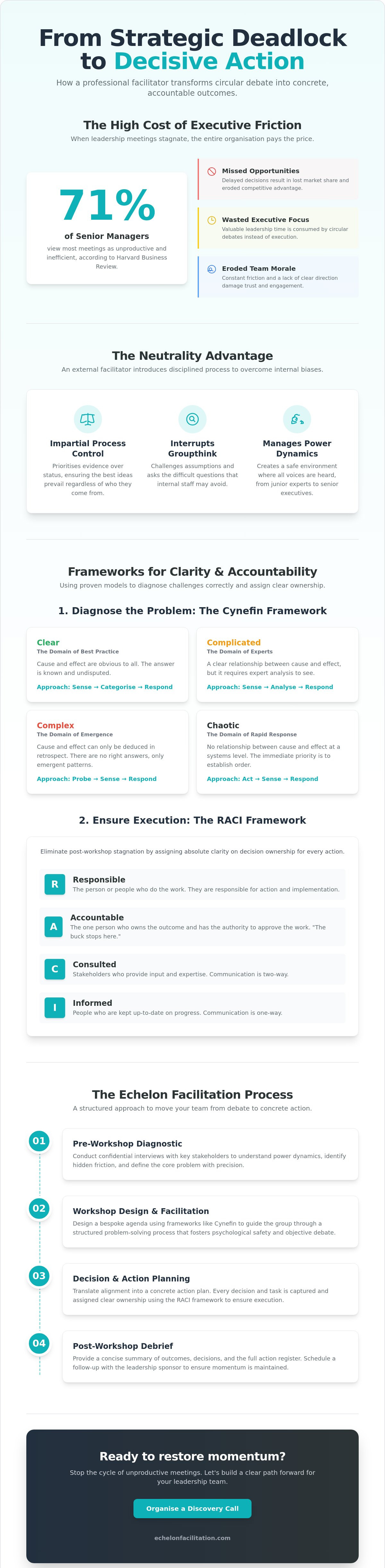
Stagnation carries a heavy price for the modern organisation. Research from Harvard Business Review suggests that 71% of senior managers view meetings as unproductive and inefficient, leading to a systemic drain on executive focus. When circular debate persists amongst leadership teams, the delay in execution often costs millions in missed market opportunities and eroded competitive advantage. This friction is rarely a failure of talent; it is a failure of process that a professional problem solving workshop facilitator corrects.
You likely recognise the pattern where meetings end in a vague sense of alignment that vanishes by Monday morning. This article explains how a facilitator identifies the root causes of executive friction and implements frameworks that move teams from circular debate to concrete accountability. We will examine the mechanics of decision rights and the specific tools required to restore trust through objective strategic focus.
Key Takeaways
- Identify why an external problem solving workshop facilitator provides the neutrality required to bypass organisational hierarchy and internal groupthink.
- Categorise complex business challenges using the Cynefin framework to apply the correct strategic response to specific organisational obstacles.
- Eliminate post-workshop stagnation by embedding the RACI framework into every outcome to ensure absolute clarity on decision ownership.
- Distinguish between interpersonal friction and structural strategic issues through a disciplined pre-workshop diagnostic process.
- Implement a four-step framework from diagnostic to debrief that transforms circular executive debate into concrete, accountable action.
Why an External Problem Solving Workshop Facilitator is Critical for Objective Resolution
A professional problem solving workshop facilitator acts as a neutral arbiter of process rather than a subject matter expert. Their primary function is to maintain the integrity of the methodology, ensuring the group follows a logical path to resolution. Internal facilitators often find themselves compromised by organisational hierarchy. It's difficult for a middle manager to challenge a senior executive's flawed logic without fear of professional reprisal. This dynamic creates an environment where groupthink thrives and critical strategic errors go uncorrected.
External facilitators bring a disciplined authority to the room. They possess the social capital required to pause a conversation and demand clarity, regardless of the seniority of the person speaking. This focus on objective truth over comfortable consensus separates a high-performing session from a standard meeting. By removing the influence of internal politics, the facilitator allows the leadership team to focus entirely on the tactical reality of the challenge at hand.
The Neutrality Advantage in High-Stakes Environments
Neutrality is a strategic lever. An external presence breaks circular arguments by prioritising evidence over status. When a team uses the Cynefin framework to categorise a problem, the facilitator ensures the classification is based on the nature of the system rather than the preferences of the most powerful person in the room. Remaining unattached to the eventual solution allows the facilitator to ask the difficult questions that internal staff might avoid.
Managing Leadership Dynamics and Power Imbalances
Power imbalances often mask technical constraints. Consider a hypothetical session in which a dominant Chief Technology Officer repeatedly silences concerns regarding a legacy system's scalability. A skilled problem solving workshop facilitator would identify this pattern and use a structured 'silent brainstorming' technique to allow junior engineers to document the specific risks. An intervention like this can reveal that the proposed strategy is technically impossible, saving the company months of wasted effort. Effective High-Stakes Workshop Facilitation requires this level of composure and a willingness to disrupt the status quo for the benefit of the collective team.
Applying the Cynefin Framework to High-Stakes Problem Solving
Strategic failure often stems from a fundamental misdiagnosis of the challenge. A professional problem solving workshop facilitator uses the Cynefin framework, developed by Dave Snowden, to categorise organisational issues before proposing a solution. This framework identifies five contexts: Clear, Complicated, Complex, Chaotic, and Disorder. Most leadership teams default to "best practice" or "expert analysis" regardless of the context. This mismatch between the problem's nature and the chosen response is the primary cause of strategic deadlock.
Executive challenges rarely exist in the "Clear" domain where cause and effect are obvious. They typically reside in the "Complex" domain, where patterns only become visible in hindsight. In this space, traditional planning fails because the system is constantly shifting. As outlined in the seminal A Leader's Framework for Decision Making, leaders must resist the urge to force order on complexity. Instead, the facilitator guides the team through a process of emergent discovery, ensuring the group doesn't waste resources on rigid plans that the market will inevitably invalidate.
Distinguishing Between Complicated and Complex Challenges
Complicated problems are the domain of experts. Tax law, structural engineering, and software architecture are complicated; they require deep analysis to find a "right" answer. In contrast, complex problems involve human behaviour and emergent market shifts where no single right answer exists. A strategy offsite often fails because it treats complex cultural or competitive issues as complicated mechanical ones. This error leads to "paralysis by analysis" as teams search for a level of certainty that the complex domain cannot provide.
The "Probe-Sense-Respond" Mechanism for Executive Teams
When facing complexity, a problem solving workshop facilitator implements a "probe-sense-respond" mechanism. This involves launching small, safe-to-fail experiments to see how the system reacts before committing significant capital. The facilitator ensures these experiments are disciplined and measurable. Use the following template to define a strategic probe:
- The Action: If we do X (specific intervention)...
- The Expectation: We expect Y (observable change in behaviour or data)...
- The Threshold: We will know we are wrong if Z happens (pre-defined failure criteria).
This disciplined approach replaces guesswork with empirical evidence. If you require a structured environment to test these hypotheses, a Strategy Sprint provides the framework necessary to move from theory to action without risking organisational stability.
Establishing Decision Rights to Eliminate Post-Workshop Friction
The most common objection to professional interventions is that decisions made during a session fail to translate into operational reality. This stagnation occurs because many facilitators focus on the democratic generation of ideas rather than the rigid assignment of decision rights. A problem solving workshop facilitator ensures that the session concludes not with a list of suggestions, but with a binding commitment to action. Without this level of discipline, the workshop becomes a mere intellectual exercise that wastes executive time and resources.
A problem is only solved when a single name is attached to the "Accountable" slot for the next 90 days. This clarity prevents the collective avoidance of responsibility that often plagues leadership teams. Whilst maintaining team cohesion is necessary, the facilitator must prioritise the objective truth of who owns the outcome. This ensures that when the team leaves the room, there is no ambiguity regarding the next steps.
The RACI Framework: Assigning Absolute Accountability
The RACI framework (Responsible, Accountable, Consulted, Informed) is a non-negotiable output of an effective workshop. It's vital to distinguish between "Responsible" and "Accountable". The Responsible party performs the task, but the Accountable person is the one whose reputation is tied to the result. Executive teams often resist this transparency because it removes the safety of consensus. However, assigning one person the "A" for each strategic objective is the only way to guarantee progress. There can only be one name in the Accountable column; any more than that, and accountability evaporates.
Defining Decision Rights for Strategic Execution
Decision drift occurs when the logic established in a workshop is eroded by daily operational pressures. To prevent this, the facilitator must document not just the decision, but the specific rights of the owner to execute that decision without further committee approval. This approach aligns with the principles of Leadership Team Decision Making, where execution is prioritised over endless consultation. If your team struggles with fragmented ownership, a Decision-Rights Reset will provide the structural clarity required to restore momentum.
The Echelon Approach to Problem Solving Workshop Facilitation
Echelon’s methodology rejects the notion that a successful workshop is measured by participant enjoyment. A professional problem solving workshop facilitator prioritises output over atmosphere. Our four-step process is designed so that every intervention produces a measurable strategic shift. This structured approach moves the leadership team from the ambiguity of the diagnostic phase to the rigid clarity of execution.
The sequence begins with a Pre-Workshop Diagnostic. We conduct individual interviews to identify the structural issues often masked by interpersonal friction. This phase ensures we solve the correct problem rather than the stated one. Following this, we Design the session specifically around the Cynefin domain identified during the diagnostic. A session focused on a complex market shift requires a different architectural approach than one addressing a complicated technical bottleneck.
Delivery centres on disciplined momentum. We eliminate circular debate by enforcing strict time-boxing and objective decision frameworks. Finally, the Debrief phase converts workshop insights into a 30-day execution roadmap. This ensures that the problem solving workshop facilitator remains a catalyst for progress rather than a one-time observer of the team's challenges.
The 30-Day Execution Plan: Ensuring Long-Term Impact
The primary legacy of an Echelon intervention is the Action Register. This document records every decision, the logic behind it, and the specific individual accountable for its fulfilment. We reject the generic task list in favour of a rigid accountability matrix. This focus on how we work ensures that the momentum generated in the room translates into operational reality. We track progress through a scheduled 30-day execution check-in to verify that the deadlock remains resolved.
Measuring Success Through Strategic Clarity
Standard industry practice relies on "smile sheets" or post-session feedback forms to measure success. We consider these vanity metrics. True success is defined by outcome verification. Did the team execute the strategic probe? Is the deadlock resolved? Our goal is the permanent restoration of momentum, not temporary consensus. If you require this level of operational rigour to move your leadership team forward, contact Echelon to schedule a diagnostic call.
Restoring Strategic Velocity through Disciplined Execution
Strategic deadlocks are rarely solved by increasing the volume of discussion. They require a rigid framework that addresses the underlying complexity of the organisational system and the absolute clarity of individual ownership. By moving beyond the trap of best practice and categorising challenges through the Cynefin lens, leadership teams stop guessing and start experimenting with precision. This shift from theory to empirical action is the only reliable way to navigate high-stakes environments where the cost of stagnation is measured in millions.
The role of a professional problem solving workshop facilitator is to enforce this rigour. This involves moving past the comfort of consensus to the clarity of the RACI framework, where a single name is attached to the accountability for every strategic objective. Echelon, led by founder Dr Andrew Greenland, a medical doctor who has spent years running large, high-stakes working sessions for senior expert groups, specialises in these high-stakes executive alignment sessions. We focus on establishing definitive decision-rights frameworks that ensure a workshop's legacy is measured in operational results rather than temporary agreement.
If your leadership team is currently trapped in circular debate, it's time to reset the process and restore your organisation's momentum. Disciplined guidance provides the stability required to transform friction into strategic focus. Book a Diagnostic Call to Resolve Your Strategic Deadlock and take the first step toward absolute operational clarity.
Frequently Asked Questions
What is the difference between a meeting chair and a problem solving workshop facilitator?
A meeting chair focuses on the administration of an agenda, whereas a problem solving workshop facilitator is responsible for the cognitive architecture of the session. The facilitator implements specific frameworks to extract objective truth from a group, whilst a chair simply ensures everyone has a turn to speak. This distinction is critical because managing the clock is not the same as managing the logic of a complex strategic resolution.
How long should an executive problem-solving workshop last?
Executive sessions typically require a single day of focused work, usually lasting between six and eight hours. This duration provides enough time to move through the diagnostic and design phases without causing cognitive fatigue amongst the leadership team. If a problem is too complex for a single day, we recommend a multi-session approach rather than an exhaustive marathon that erodes the quality of high-stakes decisions.
Can a problem solving workshop facilitator help with technical industry-specific issues?
A problem solving workshop facilitator does not need technical expertise in your specific industry to be effective. Their value lies in their ability to provide an objective process that allows your internal experts to categorise information correctly. By using neutral frameworks, the facilitator ensures that technical data is evaluated without the bias of internal politics or historical assumptions that often cloud internal judgement.
How do you handle a dominant CEO during a problem-solving session?
We manage dominant personalities by implementing structured protocols that equalise the weight of every contribution. Techniques such as silent ideation and blinded voting allow the team to evaluate ideas based on merit rather than the seniority of the proposer. This approach preserves the CEO's authority whilst ensuring that critical technical constraints are not ignored due to social pressure or the desire for comfortable consensus.
What happens if the team cannot reach a consensus during the workshop?
We prioritise the assignment of decision rights over the pursuit of unanimous consensus. If the team remains divided, the facilitator identifies the single individual who holds the Accountable status for that specific objective. That individual makes the final call based on the evidence gathered during the session. This ensures the organisation maintains its momentum rather than sinking into the circular debate that characterises unproductive meetings.

Article by
Andrew Greenland
Dr Andrew Greenland is the founder of Echelon Facilitation, a UK practice that designs and runs high-stakes leadership sessions for executive teams who need decisions, not more discussion.
A medical doctor and medical educator, Andrew brings a clinician's discipline to the messy, political work of leadership alignment - surfacing the real disagreement, forcing the real choices, and ensuring every session produces a documented decision log with named owners and deadlines.
He designs Echelon’s sessions for CEOs, executive teams, transformation leads and boards. Based in Twickenham.