
Your leadership team leaves the boardroom agreeing on the vision, yet the project stalls because your stakeholder engagement workshop plan failed to assign clear ownership. This disconnect turns high-stakes meetings into expensive exercises in passive observation rather than engines of strategic progress.
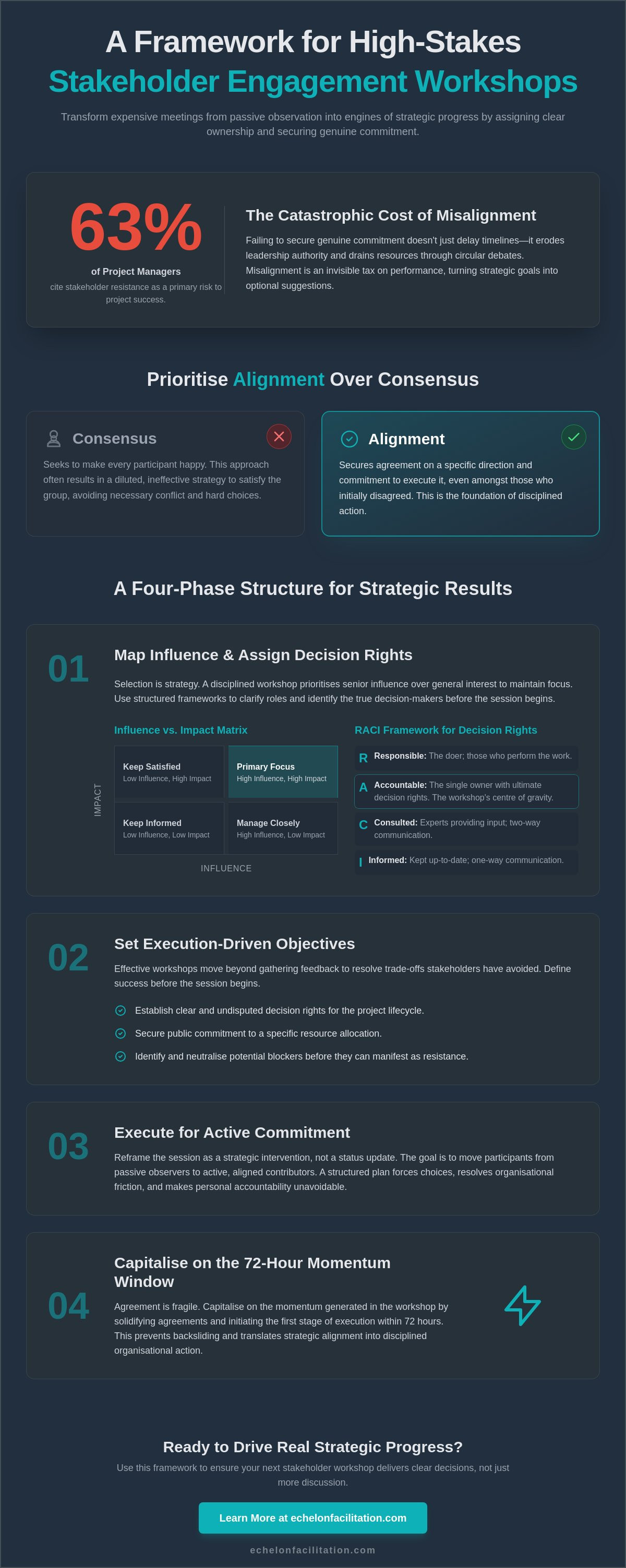
Sixty-three per cent of project managers cite stakeholder resistance as a primary risk to project success, a figure that highlights the catastrophic cost of failing to secure genuine commitment. Without a rigorous stakeholder engagement workshop plan, organisations waste hundreds of billable hours on circular debates that fail to define decision rights or establish accountability. This inefficiency does not delay timelines; it erodes leadership authority and creates a culture where strategic goals are viewed as optional suggestions rather than mandatory objectives.
Securing alignment requires moving beyond simple feedback loops and into a structure of disciplined decision rights. Establishing a framework for strategic focus ensures that every participant understands their specific responsibilities and the timeline for execution.
Key Takeaways
- Reframe the session as a strategic intervention that demands personal accountability and clear results rather than a routine status update.
- Apply the Influence vs. Impact matrix to ensure the right decision-makers are present whilst excluding unnecessary voices that dilute the quality of the outcome.
- Execute a structured stakeholder engagement workshop plan designed to move participants from passive observation to active strategic alignment.
- Establish precise decision rights during the session to prevent backsliding and ensure clear ownership of all post-workshop objectives.
- Capitalise on the 72-hour momentum window to solidify agreements and initiate the first stage of disciplined organisational execution.
Defining the High-Stakes Stakeholder Engagement Workshop Plan
A stakeholder engagement workshop plan is not a routine administrative task. It is a strategic intervention designed to extract commitment from a group that often holds conflicting interests. Most corporate meetings fail because they treat stakeholder engagement as a passive exercise in information sharing. This approach creates a vacuum where indecision thrives. True strategic alignment requires more than just hearing every voice; it demands a disciplined process that forces choices and resolves organisational friction.
Leadership teams often confuse consensus with alignment. Consensus seeks to make every participant happy, which usually results in a diluted, ineffective strategy. Alignment, conversely, secures an agreement on a specific direction and a commitment to execute it, even amongst those who initially disagreed. A professional stakeholder engagement workshop plan prioritises this hard-won alignment over the comfort of unanimous approval. It transforms the session into a forum for objective truth rather than comfortable narratives.
The Critical Cost of Stakeholder Misalignment
The price of failing to align is steep. Research from the Project Management Institute indicates that poor stakeholder management is a primary driver of project failure, whilst 63 per cent of project managers identify stakeholder resistance as a top risk. This misalignment acts as an invisible tax on corporate performance, slowing down execution and draining resources through constant re-litigation of decisions. Misalignment is a leadership failure disguised as a communication problem.
Setting Objectives That Drive Execution
Effective workshops move beyond gathering feedback. They focus on resolving trade-offs that stakeholders have avoided. To ensure a successful outcome, define what success looks like before the session begins. This might involve:
- Establishing clear decision rights for the project lifecycle.
- Securing public commitment to a specific resource allocation.
- Identifying and neutralising potential blockers before they manifest as active resistance.
By treating the workshop as a Facilitation Service rather than a social gathering, leaders can transform passive observation into disciplined organisational action.
Mapping Influence: The Core of a Stakeholder Engagement Workshop Plan
Selection is strategy. Including too many voices in a stakeholder engagement workshop plan is a frequent error that ensures mediocrity. When every party with a passing interest has a seat at the table, the resulting strategy is inevitably diluted to satisfy the group. This dilution is a form of organisational friction that prevents decisive action. A disciplined workshop must prioritise senior influence over general interest to maintain strategic focus.
Use an Influence vs. Impact matrix to filter your guest list. This tool categorises stakeholders based on their ability to affect the project and the degree to which the outcome affects them. High-influence individuals who are also high-impact are your primary focus. Understanding the psychological profile of these participants is essential. A "Blocker" often uses technical jargon to mask a fear of losing control, whilst a "Champion" provides the momentum necessary to overcome inertia. This level of interpersonal analysis is fundamental to how we work, ensuring the session remains focused on objective strategic goals.
Assigning Decision Rights with the RACI Framework
The RACI framework, which identifies those who are Responsible, Accountable, Consulted, and Informed, clarifies the hierarchy of contribution. This structure is a vital component of a stakeholder engagement workshop plan because the "Accountable" individual must be the centre of the session. They hold the ultimate decision rights. Learning how to create a stakeholder engagement plan requires this level of operational clarity. Use a table to map these roles before the session begins, identifying the stakeholder name, their influence level, and their specific decision rights.
The Pre-Workshop Interview: A Necessary Provocation
Never walk into a high-stakes session without preliminary insight. Conduct 1:1 interviews with key stakeholders to uncover hidden agendas and personal anxieties. These private provocations allow you to address resistance before it becomes public theatre. If you find that decision rights are currently muddled, consider a Decision-Rights Reset to re-establish clear lines of authority before the collective session begins. This preparation ensures that the live workshop is spent on alignment rather than discovery.
Workshop Execution: A Four-Phase Structure for Strategic Results
Execution is where a stakeholder engagement workshop plan either delivers strategic value or collapses into unproductive debate. A structured architecture is required to move a group from individual biases to collective action. This four-phase model ensures that the session remains focused on objective truth rather than corporate theatre.
- Phase 1: The Provocation. Present raw data and conflicting views immediately. This phase disrupts complacency and forces stakeholders to confront the reality of organisational friction.
- Phase 2: The Divergence. Open the floor to explore the full range of strategic options. Avoid premature judgment to ensure that innovative solutions aren't stifled by the status quo.
- Phase 3: The Synthesis. Narrow the field through disciplined trade-offs. This is the most difficult stage, as it requires the group to choose what they will stop doing to prioritise what matters.
- Phase 4: The Commitment. Secure individual accountability for the next steps. Every participant must leave with a clear understanding of their specific responsibilities and the timeline for execution.
This four-phase architecture is the engine of a successful stakeholder engagement workshop plan. It prevents the session from devolving into a circular conversation and ensures that the time spent results in a concrete path forward.
Facilitating High-Stakes Friction
Facilitating high-stakes friction requires managing dominant personalities who often attempt to steer the agenda toward their personal interests. You must ensure quiet experts have the floor, as their insights frequently contain the solution to complex technical or operational blocks. A facilitator’s role is to hold the group to the truth, even when it is uncomfortable. Effective leadership team decision making depends on this ability to navigate conflict rather than avoiding it. By leaning into constructive friction, you extract the commitment necessary for long-term alignment.
Capturing Output That Leads to Action
Traditional minutes are where strategic momentum goes to die. Replace lengthy, descriptive reports with lean decision logs that record exactly what was decided, why it was decided, and who owns the execution. This clarity prevents the re-litigation of choices in subsequent weeks. If your leadership team struggles to move from discussion to action, an Executive Alignment Sprint can provide the necessary rigour to break the cycle of indecision and secure a definitive result.
Action and Accountability: Implementing Your Stakeholder Engagement Workshop Plan
The momentum generated during a session evaporates within days if not captured through immediate action. A successful stakeholder engagement workshop plan includes a non-negotiable 72-hour window for follow-up. During this period, the decision log must be distributed, and the first objectives must be initiated. This rapid response signals to stakeholders that the alignment achieved was not a theoretical exercise but the start of a disciplined execution phase. Failing to act within this timeframe allows old habits and organisational inertia to reclaim the narrative.
Alignment is fragile. Without a formal structure to protect decisions, stakeholders often revert to previous behaviours once they return to their daily operations. Implementing a Decision-Rights Reset ensures that the authorities established during the workshop remain the standard for all future interactions. This prevents the re-litigation of agreed-upon paths. When executing your stakeholder engagement workshop plan for larger-scale organisational changes, this framework should be part of a broader strategy offsite where long-term objectives are codified and resource allocations are finalised.
Establishing Long-Term Alignment
Workshop outcomes must not exist in a vacuum. Integrate the decision log and RACI assignments directly into existing project management cycles and reporting structures. This transition moves the workshop output from a static document to a living roadmap. An external facilitator often plays a vital role here. They provide the objective oversight necessary to hold senior leaders accountable to their commitments. They act as the guardian of the alignment, ensuring that the team does not sacrifice long-term strategic focus for short-term convenience or political expediency.
The Echelon Approach to Professional Facilitation
High-stakes execution requires a partner who remains composed under pressure and prioritises objective truth over comfortable narratives. Echelon Facilitation provides facilitation services that remove organisational friction by forcing the hard conversations that internal teams often avoid. We don't offer fleeting motivation; we offer a path to operational clarity and unshakeable alignment. Our approach is designed to move every stakeholder from passive observation to a state of total accountability. If your organisation is struggling with stakeholder resistance or stalled objectives, contact us to schedule a diagnostic call and secure a definitive result for your team.
Securing Strategic Momentum and Execution
Strategic alignment is not a byproduct of chance; it is the result of a disciplined architecture. By shifting focus from broad consensus to hard-won alignment, leaders resolve the organisational friction that stalls high-stakes projects. A robust stakeholder engagement workshop plan serves as the catalyst for this transformation, provided it prioritises influence over interest and replaces passive observation with individual accountability. The transition from the boardroom to operational reality hinges on the immediate enforcement of decision rights and the protection of agreed-upon objectives within the 72-hour momentum window.
Echelon Facilitation, led by founder Dr Andrew Greenland, a medical doctor who has spent years running large, high-stakes working sessions for senior expert groups, specialises in navigating these complex interpersonal dynamics to secure executive alignment. With a focus on objective truth, we provide the professional rigour required to move your leadership team from circular debate to decisive action. That experience in high-stakes environments helps your team pursue its strategic objectives with stability and focus.
Book a Complimentary Diagnostic Call with Echelon to reset your decision rights and accelerate your strategic execution. Your organisation possesses the expertise required to succeed; we provide the framework to help make that expertise aligned, actionable and lasting.
Frequently Asked Questions
How long should a stakeholder engagement workshop last?
A high-stakes session should last between four and six hours to maintain strategic focus without inducing cognitive fatigue. Shorter sessions often fail to resolve deep-seated organisational friction, whilst multi-day marathons lead to diminishing returns and decision paralysis. Efficiency is the priority; the session must be long enough to navigate through the four-phase execution structure but short enough to demand rapid, decisive action.
How many stakeholders should be invited to a strategic workshop?
Limit the participant list to eight to twelve key individuals who hold direct decision rights. Inviting more than twelve people dilutes the quality of the dialogue and obscures personal accountability. Your stakeholder engagement workshop plan must focus exclusively on those identified as high-influence and high-impact to ensure that the resulting alignment is both genuine and actionable.
What is the best way to handle a disruptive stakeholder during the session?
Address disruptive behaviour by immediately refocusing the individual on objective data and the agreed-upon strategic goals. Use a "Parking Lot" to capture tangential grievances, which prevents them from derailing the primary agenda whilst acknowledging the input. A professional facilitator remains composed and neutral, holding the disruptor to the truth of the organisational challenge rather than engaging in emotional debate.
Should the workshop be facilitated by an internal or external person?
External facilitation is the superior choice for sessions involving high-stakes alignment or senior leadership teams. Internal facilitators often face perceived or actual conflicts of interest and may lack the authority to challenge senior executives. An external partner provides the objective distance necessary to navigate political friction and ensure that every participant is held to a standard of total accountability.
What materials are essential for a stakeholder engagement workshop plan?
Essential materials for a stakeholder engagement workshop plan include a pre-populated RACI matrix, a lean decision log, and a provocation brief containing raw, unvarnished data. These tools move the group beyond superficial feedback and into the realm of tactical execution. Avoid relying on basic creative aids; prioritise documents that record definitive choices, assigned ownership, and the 72-hour momentum window requirements.