
Most executive teams mistake a signed document for a genuine commitment. When the strategy offsite concludes, the real strategic plan failure begins as individual agendas and siloed behaviours quietly override collective objectives.
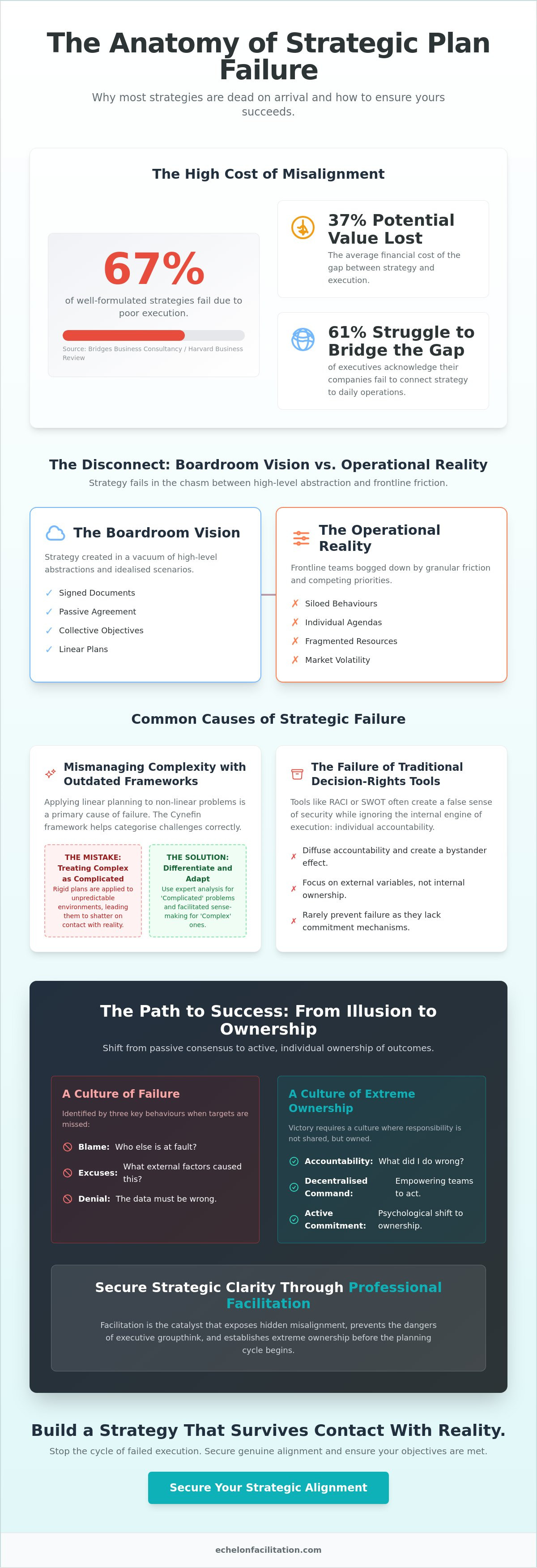
Research from the Bridges Business Consultancy reveals that 67% of well-formulated strategies fail due to poor execution, which is almost always rooted in a lack of executive alignment. This structural friction results in wasted capital and fragmented resources as departments pull in opposing directions. When leaders fail to present a unified front, the organisation loses credibility with the board and shareholders. According to a Harvard Business Review study, 61% of executives acknowledge that their companies struggle to bridge the gap between strategy formulation and day-to-day implementation.
You likely recognise that a strategy isn't effective if the leadership team doesn't share ownership of the results. This article provides a repeatable framework to secure genuine alignment and give your objectives a far better chance of being met. We will examine the structural reasons for execution failure and how to establish clear decision rights across your team.
Key Takeaways
- Identify the distinction between passive boardroom agreement and active operational commitment to prevent strategic plan failure.
- Categorise organisational challenges using the Cynefin framework to bridge the gap between executive intent and frontline execution.
- Shift focus from traditional planning tools to decentralised command and individual ownership to ensure your strategy survives contact with reality.
- Secure strategic clarity through professional facilitation that exposes hidden misalignment and prevents the dangers of executive groupthink.
The Illusion of Agreement: Why Most Strategic Plans Are Dead on Arrival
A chief executive presents a bold vision, the board nods in unison, yet twelve months later, the balance sheet remains stagnant. This disconnect is not a failure of vision; it is a collapse of executive alignment. Research by the Harvard Business Review indicates that 67% of well-formulated strategies fail due to poor execution. This strategic plan failure costs organisations an average of 37% of their potential financial value. When leadership teams prioritise consensus over clarity, they create a vacuum that consumes resources and morale. This is a systemic breakdown that erodes market position, often resulting in permanent competitive disadvantage for firms that cannot bridge the gap between intent and reality.
Securing execution requires more than a signature; it demands a psychological shift from passive consensus to active ownership. Understanding the mechanics of executive misalignment is the first step toward reclaiming control of the organisational mission.
The Disconnect Between High-Level Vision and Operational Reality
The visionary boardroom often creates strategy within a vacuum of high-level abstractions, whilst the operational frontline remains bogged down by granular friction. This structural gap ensures that 67% of well-formulated strategies fail because they ignore the messy reality of execution. When leaders treat strategy as a static document stored on a secure server, they miss the fundamental truth that strategy is a living behaviour. It exists in the daily choices and trade-offs made by employees, not in the appendices of a quarterly report.
Applying linear, step-by-step planning to non-linear problems is a primary cause of strategic plan failure. Many organisations struggle because they fail to categorise their challenges correctly using the Cynefin framework. They treat "Complex" environments, where cause and effect are only clear in hindsight, as if they were "Complicated" systems that merely require more data or expert analysis. This miscalculation leads to rigid plans that shatter the moment they encounter market volatility or internal resistance.
The Failure of Traditional Decision-Rights
Standard tools like the RACI matrix frequently collapse under the weight of high-stakes environments. Instead of providing clarity, they often diffuse accountability and create a bystander effect where no one feels empowered to act without consensus. This ambiguity is a significant driver of strategic plan failure in mid-to-large organisations. To rectify this, leadership teams must reset their decision-making protocols. A Strategy Sprint serves as a necessary intervention to realign these rights and establish extreme ownership before the next planning cycle begins.
Mismanaging Complexity with Outdated Frameworks
The Cynefin framework is a leader-standard for navigating uncertainty by categorising organisational challenges into specific domains of operation. Complicated problems are the territory of experts who can analyse known variables to find an optimal solution. In contrast, Complex problems involve unpredictable human dynamics and shifting market variables; these require professional facilitation to probe, sense, and respond to emerging patterns rather than following a fixed, linear script.
Dismantling the Myth of the Perfect Plan in Favour of Extreme Ownership
Traditional frameworks like SWOT or PESTLE offer a false sense of security, yet they rarely prevent strategic plan failure. These academic exercises focus on external variables whilst ignoring the internal engine of execution: individual accountability. Strategy does not survive contact with reality because of its logic; it survives because leaders take extreme ownership of the outcomes. When execution stalls, the cause is rarely a lack of data. It is a lack of decentralised command. Leaders must empower their teams to make high-stakes decisions at the edge of the organisation without waiting for permission from the centre. This human element remains the primary lever for victory. According to McKinsey research, 70% of complex large-scale change programmes fail to reach their goals, largely due to employee resistance and lack of management support. Victory requires a culture where responsibility is not shared, but owned.
Identify the three signs that a leadership team lacks ownership: blame, excuses, and denial. When a target is missed, a culture of ownership asks what the leader did wrong. A culture of failure asks who else is at fault. When leaders default to blame, they guarantee strategic plan failure by eroding the trust required for decentralised command. Discipline in communication and behaviour is the only path to reversing this decline.
Building a Culture of Strategic Accountability
Accountability is not a feeling; it is a structural requirement. Use a "Decision-Rights Reset" session to clarify who holds the final authority on specific outcomes. This session eliminates the ambiguity that leads to paralysis. Leaders must link individual performance metrics directly to the 2026 planning objectives. If an executive's bonus is not tied to the collective success of the strategy, their focus will inevitably drift toward departmental silos.
- The Owner: One individual with the final "Yes/No" authority.
- The Advisors: Subject matter experts who provide data but do not vote.
- The Executors: Those responsible for the labour of the task.
- The Informed: Those notified of the decision after it is made.
From Passive Compliance to Active Execution
"Buying in" is a weak substitute for owning an outcome. Compliance is passive; it suggests a team will follow orders until the first obstacle appears. Ownership is active; it ensures the team finds a way through the obstacle. After a strategy offsite, verify ownership using this 3-step checklist:
- Direct Linkage: Can every leader name the one specific strategic metric they own?
- Resource Autonomy: Does the owner have the budget and authority to reallocate resources without a committee meeting?
- Reporting Cadence: Is there a weekly, data-driven review where owners present progress and admit failures without fear?
If your team cannot answer these questions with clarity, your strategy is already at risk. To secure your execution path, book a strategy sprint to align your leadership team on clear decision rights.
Securing Strategic Clarity through Professional Facilitation
Strategic plan failure is rarely a consequence of poor data. It is almost always a consequence of poor dialogue. When executive teams attempt to self-facilitate high-stakes sessions, they inevitably fall prey to the existing power dynamics and unspoken hierarchies that created their misalignment in the first place. An external facilitator serves as an objective truth-teller. This neutral party does not seek political favour or career advancement within the organisation; their only mandate is the clarity of the mission. By stripping away comfortable narratives, a facilitator forces the team to confront the friction points that lead to strategic plan failure.The Value of an External Perspective
Internal leaders cannot facilitate their own sessions effectively because they are active participants in the system they are trying to fix. Research by McKinsey indicates that 70% of complex change programmes fail to reach their goals, largely due to management behaviour and employee resistance. A professional facilitator manages the ego-dynamics that often derail executive progress. They ensure that the loudest voice in the room does not dictate the direction of the company. This neutrality is essential for breaking the "groupthink" cycle, where teams agree on a path forward not because it is the most viable, but because it is the least confrontational.Implementing a Results-Driven Framework
Echelon Facilitation rejects the fluff of traditional corporate consulting. Our approach grounds every strategy in objective truth and disciplined execution. We use frameworks like the RACI matrix to define clear decision rights, ensuring that every executive understands their specific accountability. When a board identifies a critical execution gap, the next step is not another internal meeting; it is a structured intervention. Boards ready to address these barriers should contact Echelon for a diagnostic call. For teams requiring a rapid shift in trajectory, our Workshops provide the environment necessary for total strategic re-alignment. We move teams from theoretical agreement to operational commitment through a process that values results over excuses.Conclusion
Transforming Executive Alignment into Execution
Leadership teams often mistake a nodding head for genuine commitment. Research by Kaplan and Norton indicates that 90% of organisations fail to execute their strategies effectively, proving that a document alone cannot drive change. This chronic strategic plan failure usually stems from a refusal to confront the gap between high-level vision and the hard reality of decision-rights. True alignment isn't a byproduct of a well-formatted slide deck; it's the result of rigorous, facilitated debate where every executive takes extreme ownership of the collective path forward. Professional facilitation provides the objective lens necessary to dismantle comfortable narratives and establish a foundation of truth. Dr Andrew Greenland, a medical doctor who has spent years running large, high-stakes working sessions for senior expert groups, founded Echelon Facilitation to help UK-based executive teams move from theoretical agreement to precise execution. By focusing on objective truth and clear accountability, your leadership group can bridge the disconnect between the boardroom and the front line. Your strategy deserves more than a shelf; it requires a disciplined framework for action. Your organisation's future depends on the decisions you make today.
Secure your next strategy offsite with Echelon Facilitation to establish the clarity your organisation requires for sustained success.
Frequently Asked Questions
Why do 67% of strategic plans fail according to Harvard Business Review?
Harvard Business Review attributes this 67% failure rate to a fundamental disconnect between strategy formulation and operational implementation. Executives frequently design strategies in isolation, failing to account for the resource constraints and cultural resistance present within the organisation. This lack of integration ensures that even the most brilliant plans collapse under the weight of poor execution.
How does leadership team misalignment directly cause strategic plan failure?
Leadership misalignment triggers strategic plan failure by creating a vacuum of accountability. When the executive team lacks a unified front, individual departments pursue divergent agendas that drain the organisation’s energy and budget. This internal conflict forces employees to choose which leader to follow, ultimately stalling the collective progress required to achieve the primary objectives.
What is the difference between strategy and execution in a high-stakes environment?
Strategy represents the intellectual framework for achieving a specific objective, whilst execution is the systematic process of turning that framework into reality. In high-pressure scenarios, the distinction lies in the transition from planning to action. Strategy sets the direction, but execution requires the discipline to maintain that course despite the inevitable obstacles and friction encountered during the process.
Can professional facilitation prevent a strategic plan from failing?
Objective facilitation acts as a safeguard against strategic plan failure by identifying and resolving executive friction before it reaches the operational level. A skilled facilitator ensures that the leadership team reaches a state of true alignment rather than superficial agreement. This rigour establishes the ownership necessary to drive the plan forward and maintain momentum through complex organisational challenges.
What are the first signs that our current strategic plan is beginning to fail?
Early indicators of failure often manifest as a 20% decline in milestone completion rates or a resurgence of departmental silos. If senior leaders begin to distance themselves from the plan’s core objectives during quarterly reviews, the strategy is in jeopardy. These signals indicate a loss of clarity and commitment that, if left unaddressed, will lead to a total breakdown in execution.