
Most project reviews are sanitised exercises in blame avoidance that bury the root causes of failure under a layer of corporate politeness. Engaging a professional post-mortem meeting facilitator is the only way to strip away these comfortable narratives and secure the objective truth required for growth.
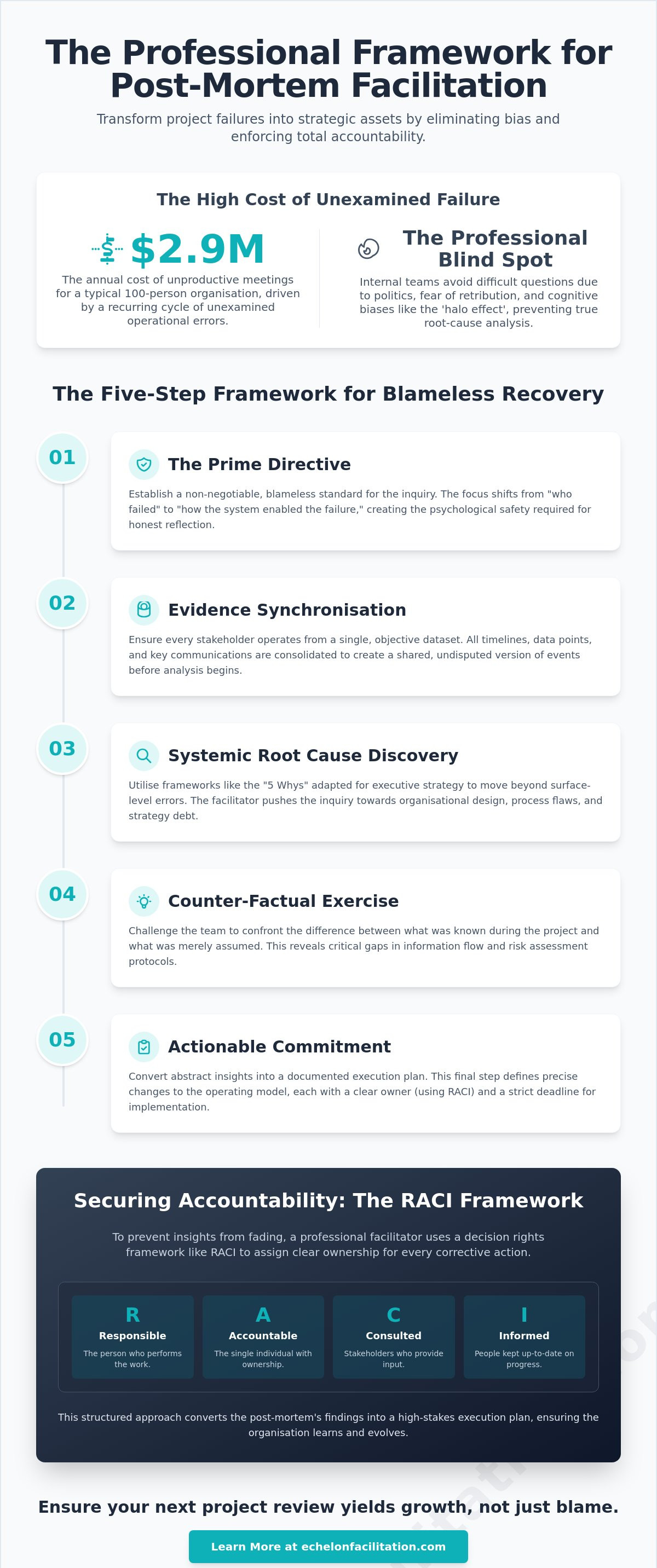
When project failures go unexamined, the financial haemorrhage is staggering. Research indicates that 71% of senior executives view their meetings as unproductive and inefficient, a systemic failure that costs a typical 100-person organisation approximately $2.9 million annually. These losses represent more than just wasted hours; they signify a recurring cycle of operational errors and eroded trust. Without a disciplined framework to extract lessons from these losses, your organisation remains trapped in a pattern of expensive, avoidable mistakes.
You understand that internal politics and the fear of retribution often silence the insights your team needs to progress. This article demonstrates how a professional facilitator transforms these high-stakes failures into strategic assets whilst ensuring total team accountability. We will examine the mechanics of root-cause analysis and the frameworks required to build an unshakeable execution plan for future growth.
Key Takeaways
- Eliminate the "halo effect" and cognitive biases that sanitise project reviews by establishing a neutral environment for objective enquiry.
- Utilise a professional post-mortem meeting facilitator to navigate the "Professional Blind Spot" and ask the difficult questions that internal teams often avoid.
- Standardise your recovery process with a five-step framework that prioritises evidence synchronisation and a non-negotiable tone of blameless investigation.
- Enforce total team accountability by using the RACI framework to convert abstract insights into documented, high-stakes execution plans.
Why a Post-Mortem Meeting Facilitator is Essential for Strategic Recovery
A post-mortem meeting facilitator functions as a neutral arbiter of objective truth within the organisation. Their presence ensures that the review process remains focused on systemic improvement rather than individual survival. In high-stakes environments, the "halo effect" often skews results; team members subconsciously defer to the opinions of high-status individuals or successful leaders, even when those leaders contributed to the failure. Professional facilitation neutralises these cognitive biases by equalising the weight of evidence and ensuring that data points take precedence over personal charisma.
When a project failure involves board-level decisions or senior leadership, internal facilitators often lack the authority or the distance to challenge the status quo. An external expert provides the necessary friction to interrogate these decisions without fear of political blowback. The facilitator acts as the guardian of a blameless culture whilst maintaining strict personal and professional accountability for future actions.
The Distinction Between Technical Debriefs and Strategic Post-Mortems
Simple project retrospectives often focus on technical glitches or immediate process errors. A strategic post-mortem examines why the organisation’s decision-making architecture failed to prevent the error. This requires three core pillars: systemic analysis of the environment, the psychological safety to speak without retribution, and a commitment to radical transparency regarding the data. Without these pillars, the review remains superficial.
The Cost of Poorly Facilitated Reviews
Unguided sessions frequently devolve into corporate theatre. Participants perform the motions of a review whilst carefully avoiding the uncomfortable truths that might disrupt their career paths. This lack of honesty prevents true growth. Building high performing executive teams requires a willingness to engage in honest friction, which only an objective facilitator can safely manage. When the real issues are never addressed, the investment in the project is truly wasted, as the organisation is destined to repeat the same errors.
A Five-Step Framework for the Post-Mortem Meeting Facilitator
A post-mortem meeting facilitator employs a structured framework to prevent the session from dissolving into anecdotal bickering. This process begins with the Prime Directive, a non-negotiable standard that establishes the inquiry as blameless. It shifts the focus from "who failed" to "how the system failed." Following this, Evidence Synchronisation ensures that every stakeholder operates from a single, objective dataset. Without a shared version of events, consensus is impossible.
The third step involves Systemic Root Cause Discovery, where the facilitator identifies strategy debt and process flaws. This is followed by a Counter-Factual Exercise. Participants must confront the difference between what was known during the project and what was merely assumed. Finally, the framework concludes with the Actionable Commitment. This step defines precise changes to the operating model, each with a clear owner and a deadline for execution. For organisations facing recurring operational friction, a professional Problem-Solving & Innovation Workshop can provide the external structure needed to break these cycles.
Using the Cynefin Framework to Categorise Failure
The facilitator uses the Cynefin framework to determine if a failure occurred within a simple, complicated, or complex domain. Simple failures require straightforward process adjustments. Complex failures involve unpredictable variables where cause and effect are only clear in hindsight. Treating a complex strategic failure as a simple technical error leads to "fixes" that fail to address the underlying volatility, ensuring the problem recurs.
The Role of the Facilitator in Step 3: Root Cause Discovery
During root cause discovery, the facilitator adapts the "5 Whys" technique for executive-level strategy. Rather than stopping at human error, the inquiry pushes deeper into organisational design. A critical template question used by a post-mortem meeting facilitator is: "What systemic constraint made this choice feel like the only option at the time?" This forces the team to look at the environment, not just the individual, to find the true source of the failure.
The Risks of Avoiding a Professional Post-Mortem Meeting Facilitator
Relying on internal staff to lead a project review is a strategic error. These individuals are often "captured" by the very organisational culture that led to the failure. They cannot ask the most difficult questions because their career progression depends on the goodwill of the people they are interrogating. Internal facilitation is often an exercise in confirmation bias rather than discovery. Without a professional post-mortem meeting facilitator, the session risks becoming a performance of alignment rather than a catalyst for change.
Teams also suffer from a "Professional Blind Spot." When you are too close to a project, systemic flaws appear as standard operating procedures. A post-mortem meeting facilitator provides the external perspective required to identify these invisible risks. They create a "safe container" where lower-level employees can speak truth to power without fearing retribution. This objectivity ensures that the organisation identifies the root cause instead of settling for a convenient scapegoat.
The Power Dynamic Trap
A junior manager cannot effectively facilitate a post-mortem involving their direct supervisor. The power imbalance is insurmountable. True accountability requires an external party who is immune to internal hierarchies and prioritises the health of the organisation over the comfort of the leadership team. Understanding how we work reveals the necessity of this external discipline to maintain the integrity of the review process.
Maintaining Neutrality in High-Stakes Environments
In high-stakes meetings, "loudest voice" bias often dominates the room. The facilitator’s role is to manage these dynamics and ensure every perspective is evaluated based on data. Because an external expert has no "skin in the game" regarding the project’s future, they remain focused on objective truth rather than protecting their own department’s interests. Secure the integrity of your next project review by engaging our professional Facilitation Services today.
Securing Accountability via the Post-Mortem Meeting Facilitator
The post-mortem meeting facilitator ensures that the session concludes with a transition from passive observation to active ownership. "Lessons learned" are often discarded because they lack a specific mechanism for execution. To prevent this, the facilitator implements the RACI framework. This system ensures every identified systemic fix is assigned to a single individual who holds the ultimate authority for its resolution. By moving the group from vague consensus to "actions owned," the facilitator protects the organisation’s investment in the review process.
Consider a professional services firm that implements a facilitated RACI reset following a major project collapse. By replacing group ownership with individual responsibility, it can transform its operating model into a more resilient structure and cut recurring operational errors. The facilitator ensures these action items are specific, measurable, and integrated into the strategy sprint process. This integration makes recovery a fundamental part of the organisation's forward momentum.
The RACI Reset: Beyond the Meeting
A critical task for the facilitator is assigning a single "A" (Accountable) for every systemic fix identified. Group ownership is the primary reason post-mortems fail to drive change. When everyone is responsible, nobody is. The facilitator forces the team to name one individual who will answer for the success of the corrective action; this ensures that the organisation's resources are deployed with precision and that progress is verifiable.
Integrating Findings into the Strategy Offsite
The data extracted during a post-mortem should inform the agenda for the next strategy offsite. A post-mortem is the beginning of a new strategy, not just the end of an old project. By using these insights to shape future objectives, the facilitator ensures that the organisation evolves beyond its previous limitations. This continuity creates a loop of constant refinement that distinguishes high-performing teams from those that merely survive.
Transforming Failure into Strategic Resilience
Organisational growth depends on the ability to interrogate failure without the interference of ego or internal politics. By removing the filters of cognitive bias and organisational hierarchy, a professional post-mortem meeting facilitator ensures that every project loss becomes a permanent strategic gain. This process requires more than a simple debrief; it demands a disciplined application of frameworks like RACI and the Cynefin model to transform systemic flaws into robust operating models. When you replace passive "lessons learned" with active accountability, you break the cycle of recurring operational errors.
Echelon, led by founder Dr Andrew Greenland, a medical doctor who has spent years running large, high-stakes working sessions for senior expert groups, specialises in high-stakes executive alignment and provides the external discipline required for strategic execution. Andrew and trusted associate facilitators help your leadership team move beyond the 'Professional Blind Spot' towards lasting alignment and measurable results. Secure your organisation’s future with a professional Post-Mortem Meeting Facilitator from Echelon.
The truth of a project's failure is your most valuable asset. Interrogate it properly, and it'll become the foundation of your next success.
Frequently Asked Questions
What is the role of a post-mortem meeting facilitator?
A post-mortem meeting facilitator acts as a neutral arbiter who ensures project reviews remain objective and evidence-based. They manage the session's rhythm, preventing senior leaders from dominating the conversation whilst ensuring that the team interrogates systemic flaws rather than individual errors. By providing a structured framework for inquiry, the facilitator converts emotional reactions into actionable data, protecting the organisation's investment in the review process.
How does a post-mortem differ from a project retrospective?
Post-mortems address significant strategic failures or unexpected project collapses, whereas retrospectives are typically routine technical reviews of standard deliveries. A post-mortem requires a deeper level of systemic analysis to understand why decision-making architectures failed. It moves beyond what happened to ask why the organisation allowed it to happen, making it a critical tool for high-level executive alignment and long-term risk mitigation.
When should an organisation hire an external post-mortem meeting facilitator?
An organisation should hire an external post-mortem meeting facilitator when a project failure involves senior leadership or high-stakes board decisions. Internal staff often suffer from professional blind spots or fear political retribution, which prevents them from asking the most difficult questions. External experts provide the necessary distance to challenge status quo assumptions and ensure the review doesn't devolve into an exercise in blame avoidance or corporate theatre.
How do you maintain a blameless culture whilst ensuring individual accountability?
Maintaining a blameless culture requires a focus on systemic constraints rather than human error during the investigation phase. The goal is to understand why a choice felt correct to the individual at the time. Once the team identifies the root cause, the facilitator uses the RACI framework to assign precise accountability for the solution. This distinction ensures that whilst the past is viewed through a blameless lens, the future is governed by strict, owner-led execution.
What are the key outcomes of a professionally facilitated post-mortem?
The primary outcomes include a definitive root-cause analysis, a clear RACI matrix for future interventions, and unshakeable team alignment. Participants leave with a documented execution plan that integrates findings into the next operating cycle. Beyond the paperwork, a successful session restores trust amongst leadership by demonstrating that the organisation can survive failure and convert it into a measurable strategic asset.