
Most executive teams leave a three-day retreat with a sense of accomplishment that evaporates before the first board meeting of the following month. You return to the office only to find that strategy offsite pitfalls have taken root, whilst the same unresolved friction and disconnected goals you intended to fix remain unchanged.
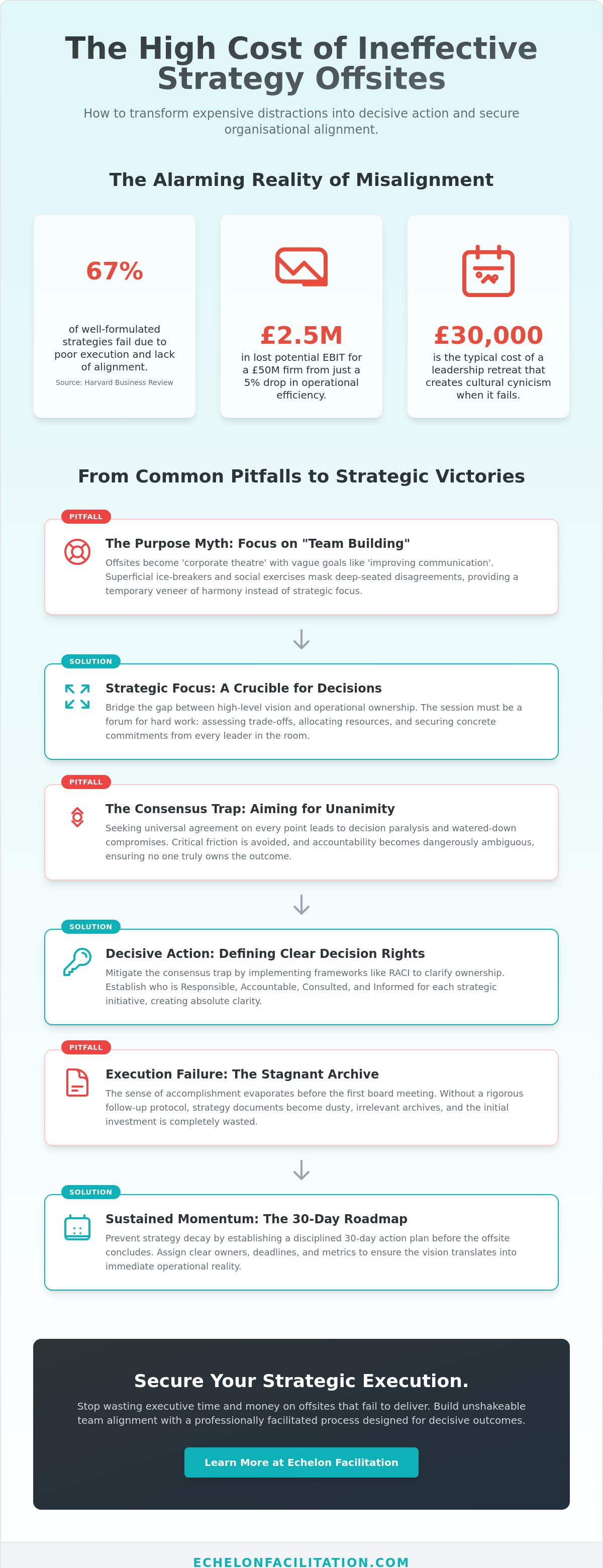
The cost of these failures is substantial. According to research published by Harvard Business Review, 67% of well-formulated strategies fail due to poor execution and lack of organisational alignment. When an executive team spends £30,000 on a retreat but fails to define decision rights or a 30-day roadmap, the investment is not just lost; it creates cultural cynicism. This friction slows down every subsequent initiative and drains the momentum required for significant growth. It's a waste of executive time that your organisation cannot afford.
You recognise that a retreat without a clear path forward is merely an expensive distraction. Neutralising the structural errors that undermine executive retreats requires a framework for rigorous strategic execution. This process establishes clear decision rights and secures unshakeable team alignment through a disciplined 30-day roadmap.
Key Takeaways
- Bridge the gap between high-level vision and operational reality by prioritising strategic focus over superficial ice-breakers.
- Avoid common strategy offsite pitfalls by implementing the RACI framework to define decision rights and eliminate the consensus trap.
- Secure strategic execution by establishing a rigorous 30-day follow-up protocol that prevents strategy documents from becoming stagnant archives.
- Engage an external facilitator to act as a neutral challenger, surfacing the critical frictions that internal leadership teams frequently suppress.
Strategy Offsite Pitfalls: How to Avoid Executive Alignment Failure
Senior leadership teams often emerge from three-day offsites with high spirits but zero clarity on who owns the next fiscal year's growth targets. This disconnect between intent and execution ensures that strategic initiatives stall within weeks of returning to the office.
Research by Harvard Business Review indicates that 67% of well-formulated strategies fail due to poor execution, often rooted in misaligned leadership teams. When an executive team fails to reconcile competing priorities during a strategy session, the financial impact is severe. For a mid-market firm with £50 million in annual revenue, a mere 5% drop in operational efficiency caused by executive friction results in a £2.5 million loss in potential earnings before interest and taxes (EBIT). This waste is an avoidable consequence of poor planning.
This article identifies the structural failures that turn expensive offsites into wasted opportunities. We examine why traditional team-building models fail and provide a framework for establishing absolute operational ownership.
Avoiding Strategy Offsite Pitfalls: The High Cost of Misaligned Objectives
A strategy offsite pitfall is not merely a poorly timed coffee break or a dull presentation; it's a systemic failure to bridge the gap between high-level vision and operational ownership. Many organisations treat these sessions as an opportunity to escape the office rather than a crucible for decision-making. When leaders fail to demand concrete commitments, the offsite becomes an expensive exercise in corporate theatre. Strategic alignment requires a cold assessment of trade-offs, not a collection of aspirational slides that ignore resource constraints.
The myth of the 'facilitator as entertainer' remains one of the most damaging strategy offsite pitfalls. Senior leaders don't require ice-breakers or personality quizzes to find common ground; they require a structured environment where they can resolve conflicting priorities. These social exercises often dilute strategic focus, providing a temporary veneer of harmony that masks deep-seated disagreements about the organisation's direction. If a team cannot discuss a £10 million budget reallocation without a 'warm-up' activity, the problem isn't their social bond; it's their lack of professional discipline.
Social cohesion is a byproduct of successful strategic work, not a prerequisite for it. Trust is built when executives see their peers making difficult choices and following through on commitments. You don't build a high-performing team by forcing them to enjoy each other's company; you build it by forcing them to solve complex problems together. To learn more about the mechanics of these sessions, read our guide on Strategic Alignment: How to Organise a Productive Strategy Offsite.
The Purpose Myth: Why Strategy is Not Team Building
A retreat focuses on relaxation and interpersonal relationships, whereas a high-stakes alignment session focuses on the hard work of resource allocation and accountability. Vague objectives, such as 'improving communication,' lead to 'talking shop' behaviour that erodes executive confidence. Without a clear mandate to produce a specific set of decisions, senior leaders default to safe, non-committal dialogue. This lack of rigour is one of the primary strategy offsite pitfalls that prevents meaningful progress.
Illustrative Scenario: The Cost of Unclear Intent
Consider a UK fintech board that spends 48 hours debating its internal culture whilst its primary market share is being eroded by a more agile competitor. Because the session lacks a defined output, the directors spend two days discussing employee engagement scores instead of addressing a decline in their customer retention rate. The outcome is 48 hours of senior leadership time lost and no decisions made on the growth plan. They leave the room feeling 'connected' but strategically no further forward, illustrating how easily a team can mistake activity for achievement.
The Consensus Trap: How Decision Rights Mitigate Strategy Offsite Pitfalls
One of the most damaging strategy offsite pitfalls is the consensus trap; the mistaken belief that every executive must agree on every detail for a strategy to be valid. This pursuit of total agreement often results in a "lowest common denominator" strategy that lacks the teeth required for market impact. When leadership teams prioritises harmony over clarity, they create a vacuum where accountability disappears. According to the Harvard Business Review, 67% of well-formulated strategies fail due to poor execution alignment. This failure often begins in the boardroom when the team mistakes polite agreement for genuine commitment.
To avoid these strategy offsite pitfalls, you must introduce a rigorous decision-rights framework like RACI (Responsible, Accountable, Consulted, Informed). The power of RACI lies in its ability to isolate the "Accountable" individual; the one person who owns the success or failure of a specific objective. Whilst multiple team members may be "Responsible" for doing the work, having more than one person "Accountable" ensures that nobody is truly held to account. Defining these roles early prevents the circular debates that paralyse many leadership teams. It shifts the focus from seeking permission to driving progress.
Implementing RACI in Strategic Planning
Assign ownership to specific strategic pillars before the session concludes. If an initiative lacks a single accountable owner, it should be removed from the plan. A frequent point of friction occurs when 'Consulted' stakeholders attempt to veto decisions made by the 'Accountable' leader. You must establish a firm rule: being consulted provides an opportunity to offer expertise, not a vote to block progress. This distinction protects the speed of your organisation and ensures that those with the most skin in the game retain the authority to act.
The Decision-Rights Reset
For boards suffering from chronic misalignment, a Leadership Team Decision Making reset is essential. This intervention forces the group to re-evaluate who holds the final say on capital allocation and resource prioritisation. Without this clarity, your strategy is merely a list of aspirations rather than a plan of action. If your current team dynamics are stalling execution, a structured strategy sprint can help codify these decision rights and restore operational momentum.
Execution Failure: Why a Strategy Offsite Agenda Requires a 30-Day Follow-up
An offsite isn't a finish line. It's a starting gun. Many executive teams treat the final session as the conclusion of their work, yet the true test of leadership begins the moment the team returns to the office. This 'one-and-done' mentality is why many organisations struggle to move past the conceptual phase. If the strategy document is archived in a digital folder and never revisited, the offsite has failed. Research from Harvard Business Review suggests that 67% of well-formulated strategies fail due to poor execution. To avoid common strategy offsite pitfalls, leaders must view the subsequent four weeks as an extension of the agenda itself.
The 30-Day Execution Framework
Execution requires a disciplined transition from high-level discussion to operational reality. Use this three-step template to maintain momentum:
- Step 1: Immediate Dissemination. Within 48 hours, distribute the decision log to the wider organisation. Clarity prevents the rumour mill from distorting the new direction.
- Step 2: Weekly Alignment Checks. The executive team must meet for 30 minutes every Monday for four weeks. These sessions aren't for status updates; they're to ensure every leader is still pulling in the agreed direction.
- Step 3: Resource Allocation Audit. Strategy is defined by where you spend money and time. If the budget isn't reallocated to match new priorities within 30 days, the strategy is merely a wish list.
For a detailed breakdown of this transition, consult our 30-Day Execution Plan: Converting Strategy into Operational Reality.
Avoiding the Strategy Offsite Agenda Overload
Most agendas are far too dense. They attempt to solve every departmental friction point in a single weekend, leaving no room for genuine debate or deep thinking. This congestion is one of the most frequent strategy offsite pitfalls. When leaders are rushed through twenty agenda items, they default to superficial agreement rather than rigorous interrogation.
Adopt the 'Rule of Three' to protect the quality of your decisions. Focus the agenda on three critical objectives that will move the needle over the next twelve months. By narrowing the focus, you allow the team to explore the complexities of each goal. This discipline ensures that when the team leaves the room, they aren't just exhausted; they're aligned on a manageable set of priorities that can actually be delivered.
Professional Neutrality: Choosing a Strategy Offsite Facilitator in the UK
Internal facilitation creates a structural conflict of interest. When a CEO or HR Director leads the session, they cannot simultaneously participate as a peer and manage the group dynamic objectively. This imbalance often results in artificial harmony, where dissent is suppressed to avoid offending the leader. Harvard Business Review research indicates that 67% of well-formulated strategies fail because of poor execution, often rooted in these initial alignment gaps. An external facilitator acts as a neutral challenger. They identify the elephant in the room that internal staff are too politically cautious to mention. This objectivity is the only way to avoid common strategy offsite pitfalls that derail long-term planning.
The Executive Alignment Sprint provides a structured environment for time-poor leadership teams. It replaces aimless discussion with high-velocity decision-making. This process ensures that every executive leaves the room with absolute clarity on their specific responsibilities. Use the following checklist to evaluate a facilitator's ability to handle high-stakes dynamics:
- Authority: Do they have the presence to manage dominant personalities without losing control of the agenda?
- Frameworks: Can they demonstrate a specific methodology, such as the Cynefin framework, for resolving complex deadlocks?
- Directness: are they willing to challenge the CEO directly when the group is falling into the Abilene Paradox?
- Objectivity: Do they prioritise evidence-based arguments over consensus-seeking behaviour?
The Value of External Perspective
Internal teams often suffer from organisational blindness. They repeat the same behavioural patterns because those patterns are baked into the company culture. An outsider brings disciplined authority to the room. They manage strong executive personalities by enforcing strict protocols on speaking time and evidence-based arguments. This ensures that the loudest voice doesn't dictate the strategy. By identifying these patterns, an external partner helps the team overcome the strategy offsite pitfalls that lead to recurring execution failures.
Next Steps for Your 2026 Planning
Effective planning requires a pre-mortem. Before your next session, ask your team to imagine the offsite has failed and identify why. This exercise surfaces hidden anxieties and potential obstacles before they manifest in the boardroom. Use these insights to set a rigorous agenda that demands extreme ownership from every participant. Stop settling for comfortable narratives and start demanding objective truth.
Book a Strategy Sprint with Echelon Facilitation to help your leadership team reach clear alignment on your objectives.
Convert Strategic Intent into Organisational Results
Executive alignment is not a byproduct of proximity; it is the result of rigorous process and clear decision rights. To avoid common strategy offsite pitfalls, leadership teams must move beyond the consensus trap. Implementing a RACI framework ensures that accountability is assigned before the room empties. Research from Harvard Business Review indicates that 67% of well-formulated strategies fail due to poor execution. This failure often begins in the first 30 days post-offsite. Teams that commit to a structured follow-up sequence transform abstract ideas into measurable results.
Echelon Facilitation brings disciplined authority to the boardroom. Every engagement is designed and led by Dr Andrew Greenland, a medical doctor who has spent years running large, high-stakes working sessions for senior expert groups, with a focus on RACI and decision-rights frameworks that reduce organisational friction. Based in Richmond, London, Echelon works with executive teams who require objective clarity over comfortable narratives. We provide the neutral perspective necessary to challenge assumptions and drive ownership across every level of your organisation. Stop leaving your execution to chance. Secure your executive alignment with an Echelon Strategy Sprint and help your leadership team stay focused on the objectives that matter most. Your next phase of growth starts with absolute clarity.
Frequently Asked Questions
What is the most common reason strategy offsites fail?
The primary reason for strategy offsite pitfalls is a lack of rigorous pre-work and post-session accountability. Research indicates that 67% of well-formulated strategies fail because leadership teams treat the event as a standalone workshop rather than a continuous process. Without clear decision rights and a defined execution roadmap, the energy generated during the session dissipates within 14 days. Success requires objective data and a commitment to ownership from every participant; it's the only way to ensure results.
How do I deal with a dominant personality during a strategy session?
Manage dominant personalities by implementing structured facilitation frameworks such as the Nominal Group Technique. This method ensures every executive has equal airtime by requiring individual silent reflection before group sharing. A lead facilitator maintains order by enforcing time limits and redirecting the conversation to quieter members. Neutralising power imbalances is essential for psychological safety, which Google’s Project Aristotle identified as the top predictor of team performance in 2012.
Should we include the whole company in our strategy offsite?
Strategy creation should remain restricted to the senior leadership team to maintain focus and depth. Including the entire organisation dilutes the quality of debate and slows decision-making. Optimal strategic groups consist of 8 to 12 individuals who hold accountability for the organisation's primary functions. Once the leadership team achieves alignment, they must communicate the strategy through a structured cascade to ensure the remaining employees understand their specific roles in the execution phase.
How much should a professional strategy offsite facilitator in the UK cost?
Professional strategy facilitators in the UK typically charge between £2,500 and £5,500 per day for senior leadership engagements. This fee often covers the session itself but excludes the essential 10 to 15 hours of diagnostic interviews and preparation required to avoid strategy offsite pitfalls. High-level advisors with specific industry expertise or those managing complex multi-day retreats often command higher rates based on the bespoke nature of the strategic challenge and the required output.
What is the ideal duration for a senior leadership strategy offsite?
The ideal duration for a senior leadership strategy session is two consecutive days. A single day is rarely sufficient to move beyond operational updates and address deep-seated structural or cultural barriers. A 48-hour window allows for an overnight period of reflection, which is vital for processing complex information and reaching a genuine consensus. This timeframe provides the necessary space to define strategic objectives, assign ownership, and establish clear metrics for the coming quarter.