
Most executive teams mistake a shared calendar for genuine alignment, yet they remain trapped in siloes that stifle cross-functional progress. Engaging an expert team charter workshop facilitator is the only way to move beyond the frustration of false consensus and establish a rigorous governance contract for leadership execution.
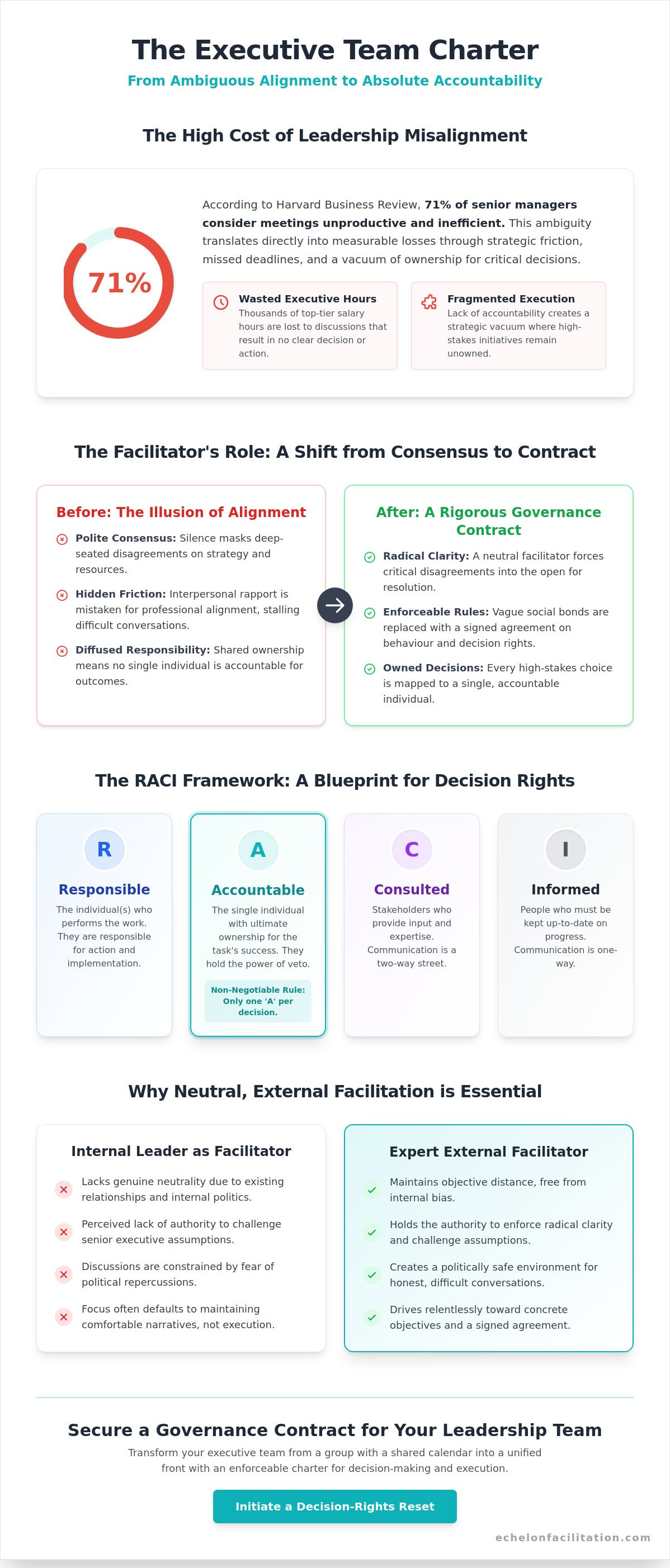
The cost of leadership ambiguity is measurable. Research from Harvard Business Review indicates that 71% of senior managers view meetings as unproductive, a statistic that translates into thousands of wasted hours at the highest levels of the organisation. Without a concrete framework for decision rights, leadership teams default to interpersonal friction and avoidance. This lack of accountability creates a strategic vacuum where high-stakes decisions remain unowned; this directly impacts the bottom line through missed deadlines and fragmented strategic execution plans.
This article explains how a professional team charter workshop facilitator transforms abstract values into a signed agreement on behaviours and individual responsibility. You will learn the mechanics of a Decision-Rights Reset, the application of RACI frameworks, and how to secure absolute clarity on who owns the most critical choices facing your business.
Key Takeaways
- Understand how a team charter workshop facilitator acts as a neutral arbiter to break through the veneer of polite consensus and enforce radical clarity amongst leadership teams.
- Implement the RACI framework to eliminate the diffusion of responsibility by ensuring every high-stakes decision is owned by a single accountable individual.
- Adopt a structured one-day agenda that begins with a diagnostic of existing organisational friction and unspoken rules to clear the path for strategic execution.
- Recognise why internal leaders are structurally incapable of neutral facilitation and how an external partner maintains the objective distance required for true executive alignment.
- Establish a concrete governance contract that dictates team behaviours and decision rights, ensuring the board operates as a unified front under pressure.
Defining the role of a team charter workshop facilitator
A team charter workshop facilitator serves as a neutral arbiter of organisational dynamics rather than a mere meeting coordinator. This role requires the authority to challenge executive assumptions and the skill to transition a group from polite consensus to radical clarity. Whilst many boards believe they are aligned, silence often masks deep-seated disagreements regarding resource allocation or strategic priority. A professional facilitator identifies these fractures and forces them into the open; they ensure that the final document is not a collection of platitudes but a rigorous governance contract.
Unlike internal HR-led sessions, which often suffer from a perceived lack of authority or the fear of political repercussions, an external facilitator maintains objective distance. They aren't concerned with the comfortable narratives of the leadership team. Instead, they focus on the practical fulfilment of objectives. A skilled team charter workshop facilitator uncovers the cost of silence by exposing the hidden friction points that stall execution and waste capital. By referencing a formal Project Charter, leaders can see how operational authority must be explicitly granted and documented to be effective.
The difference between team building and chartering
Chartering focuses on operational governance and decision rights; it's not a social exercise intended to foster social cohesion. Consider a FinTech board whose high levels of social trust prevent it from having difficult conversations about underperformance. Its members mistake personal rapport for professional alignment. A structured chartering process corrects this by replacing vague social bonds with clear, enforceable rules of engagement.
Why senior professionals require a disciplined approach
Leading high-performing executive teams requires a facilitator who understands the complexity of board-level dynamics. Senior professionals don't need motivation; they need a framework that eliminates ambiguity. The final charter must use the active voice and declarative commitments to ensure that every individual knows exactly what they are responsible for and how they will be held to account.
Establishing decision rights through the RACI framework
Accountability is the antidote to organisational drift. During a structured session, the team charter workshop facilitator introduces the RACI framework as the cornerstone of team governance. This model categorises roles into Responsible, Accountable, Consulted, and Informed. It is a rigorous tool that strips away the ambiguity of shared responsibility. Research from Harvard Business Review highlights the urgency of this work; 40% of leaders identify a lack of alignment on cross-functional decisions as their primary challenge. Without a clear matrix, leadership teams default to a state of permanent hesitation.
The facilitator enforces one non-negotiable rule: the Accountable role must belong to a single individual. Assigning accountability to a group ensures that no one is truly responsible when objectives fail. By forcing the team to map these roles onto their top three strategic priorities, the facilitator bridges the gap between high-level intent and operational reality. This process often reveals that critical tasks are either over-managed by too many Consulted parties or entirely unowned. Resolving these overlaps is a primary objective of a Decision-Rights Reset.
Mapping the 'Grey Zones' of leadership
Ownership overlaps often occur at the seams of the organisation, such as product-marketing handoffs or capital expenditure approvals. A facilitator identifies these grey zones and demands declarative clarity. For instance, a vague commitment like "we collaborate on hiring" must be transformed into a concrete directive: "The COO is Accountable for the final hire; the Department Head is Responsible for the shortlist." This shift replaces comfortable narratives with tactical certainty.
Codifying the breach protocol
A charter is only as strong as its enforcement. The facilitator helps the team develop a Recovery protocol to address what happens when a member violates a charter norm or ignores a decision right. These protocols must be realistic and enforceable, ensuring that the team has a pre-agreed mechanism to handle friction without defaulting to interpersonal conflict. This discipline ensures that the charter remains a living governance contract rather than a forgotten document.
A structured agenda for executive chartering sessions
A three-hour workshop focused on abstract values is insufficient for senior leadership. A professional team charter workshop facilitator employs a rigorous one-day agenda designed to extract objective truth and establish strategic clarity. This process moves through four distinct phases:
- The Diagnostic: Identifying current friction points and the 'unspoken rules' that govern behaviour.
- The Purpose Reset: Defining the team's unique value-add to the wider organisation.
- Norm Negotiation: Agreeing on specific communication protocols and conflict resolution mechanisms.
- Decision Rights: Mapping RACI for the upcoming fiscal year to ensure operational readiness.
This structure prevents the session from devolving into a social retreat. Instead, it forces the board to confront the practical realities of their leadership. By focusing on the upcoming fiscal year, the facilitator ensures that the charter remains grounded in current strategic objectives rather than historical aspirations. This level of discipline is essential for teams operating under high-stakes conditions.
The 'Fist of Five' ratification method
To break the cycle of false consensus, facilitators use the 'Fist of Five' technique. Participants vote on each clause of the charter using a scale from one (no support) to five (full commitment). If a member votes a two or three, the team charter workshop facilitator halts the process to address the underlying concern. The group must iterate until every member reaches a level four or five. This ensures total commitment; there is no room for 'disagree and commit' when the stakes involve strategic execution.
From document to daily habit
A charter only survives if it integrates with existing operational cadences. Maintenance rituals, such as 'charter check-ins' during monthly reviews, prevent the agreement from becoming a zombie document. Understanding how we work to sustain long-term alignment is critical for preventing organisational drift. To secure this level of disciplined accountability for your board, consider booking a Board & Leadership Session.
Why neutral facilitation is essential for high-stakes alignment
Internal leaders are structurally incapable of facilitating their own chartering sessions with the necessary level of objectivity. Power dynamics and established hierarchies inevitably skew the dialogue, as subordinates often default to self-censorship in the presence of their superiors. A team charter workshop facilitator provides the objective distance required to navigate these complexities. This neutral third party isn't invested in internal politics or comfortable narratives; they are solely focused on the practical fulfilment of the team's objectives. Neutrality is a prerequisite for uncovering the objective truth of why a team is failing to execute.
The financial argument for professional facilitation is grounded in the cost of inaction. Whilst an expert-led session requires an initial investment, the cost of executive misalignment is exponentially higher. Research from McKinsey indicates that organisations with aligned leadership teams are significantly more likely to achieve superior financial performance. Misalignment manifests as lost velocity, duplicated efforts, and strategic drift. These inefficiencies often cost enterprise-level organisations millions in unrealised value, making the ROI of a facilitated charter session a matter of tactical necessity.
Neutralising boardroom bias
Boardrooms are frequently susceptible to the HiPPO effect, where the Highest Paid Person's Opinion carries disproportionate weight and stifles dissenting views. A facilitator identifies this bias in real-time and ensures that every member contributes to the governance framework. This external perspective is vital for identifying blind spots within the strategic planning process. By challenging the CEO’s assumptions without triggering defensiveness, the facilitator creates a space where psychological safety and disciplined accountability exist simultaneously.
Securing a commitment to execution
The final role of the facilitator is to transition the group from discussion to formal ratification. This involves ensuring that every attendee signs the charter as a binding professional contract. This signature represents a public commitment to the agreed behaviours, decision rights, and recovery protocols. It transforms the document from a theoretical exercise into an enforceable governance tool. If your leadership team is currently hindered by ambiguity or internal friction, contact Echelon to discuss your organisation's specific constraints and alignment requirements.
Securing long-term leadership execution
Leadership teams that fail to codify their decision rights are destined for strategic drift. A professional team charter workshop facilitator provides the necessary friction to dismantle false consensus and replace it with a binding governance contract. By implementing the RACI framework, boards ensure that accountability is never diffused amongst the group but owned by specific individuals. This transition from social rapport to operational discipline is what distinguishes high-performing organisations from those trapped in executive siloes.
The work led by Dr Andrew Greenland prioritises the practical fulfilment of objectives through rigorous decision-rights frameworks. This objective approach ensures your charter remains a functional governance tool rather than an aspirational document. Book a Team Alignment Diagnostic with Echelon Facilitation today to secure the disciplined accountability your leadership team deserves. Establish the clarity required to lead your organisation with unwavering focus and collective stability.
Frequently Asked Questions
What exactly does a team charter workshop facilitator do during a session?
A team charter workshop facilitator manages the tension between high-stakes objectives and interpersonal dynamics. They lead the group through a structured diagnostic to uncover hidden friction points and then facilitate the negotiation of specific operational norms. By using the RACI framework, they ensure every strategic priority has a single accountable owner, preventing the diffusion of responsibility that often occurs in self-facilitated sessions.
How long does a professional team charter workshop typically take for an executive team?
A professional session typically requires a full day of focused engagement to achieve genuine strategic clarity. Whilst some providers suggest three-hour workshops, these sessions rarely provide enough time to resolve deep-seated disagreements or map complex decision rights. A one-day format allows for the diagnostic phase, norm negotiation, and the formal ratification of the governance contract, ensuring the team leaves with a finalised agreement.
Can we create a team charter ourselves without an external facilitator?
Internal leaders struggle to remain neutral observers whilst simultaneously participating in high-stakes alignment. Subordinates often self-censor when a CEO leads the session, which preserves the veneer of consensus but ignores underlying friction. An external team charter workshop facilitator mitigates the HiPPO effect and identifies blind spots that internal teams are structurally incapable of seeing, ensuring the final charter is grounded in objective truth.
What is the difference between a team charter and a company's core values?
Core values are broad cultural aspirations, whereas a team charter is a specific operational governance contract. Values describe how an organisation wants to feel; charters dictate how a leadership team will execute strategy and make decisions. A charter includes concrete elements like decision rights, communication protocols, and recovery protocols for when norms are breached, providing the tactical clarity that high-level values lack.
How do you ensure a team charter actually gets used after the workshop ends?
Integration into existing operational cadences is the only way to prevent a charter from becoming a forgotten document. Leadership teams must establish maintenance rituals, such as reviewing the charter during monthly board meetings or project post-mortems. By treating the document as a binding professional contract with clear recovery protocols, the team ensures that accountability remains a daily habit rather than a one-time workshop outcome.

Article by
Andrew Greenland
Dr Andrew Greenland is the founder of Echelon Facilitation, a UK practice that designs and runs high-stakes leadership sessions for executive teams who need decisions, not more discussion.
A medical doctor and medical educator, Andrew brings a clinician's discipline to the messy, political work of leadership alignment - surfacing the real disagreement, forcing the real choices, and ensuring every session produces a documented decision log with named owners and deadlines.
He designs Echelon’s sessions for CEOs, executive teams, transformation leads and boards. Based in Twickenham.