
Your leadership team nods in agreement during the boardroom session, yet the following week, departmental silos remain unmoved and critical decisions stall. This passive resistance prevents strategic momentum. Engaging a transformation alignment facilitator London ensures these surface-level agreements translate into concrete executive ownership and disciplined action.
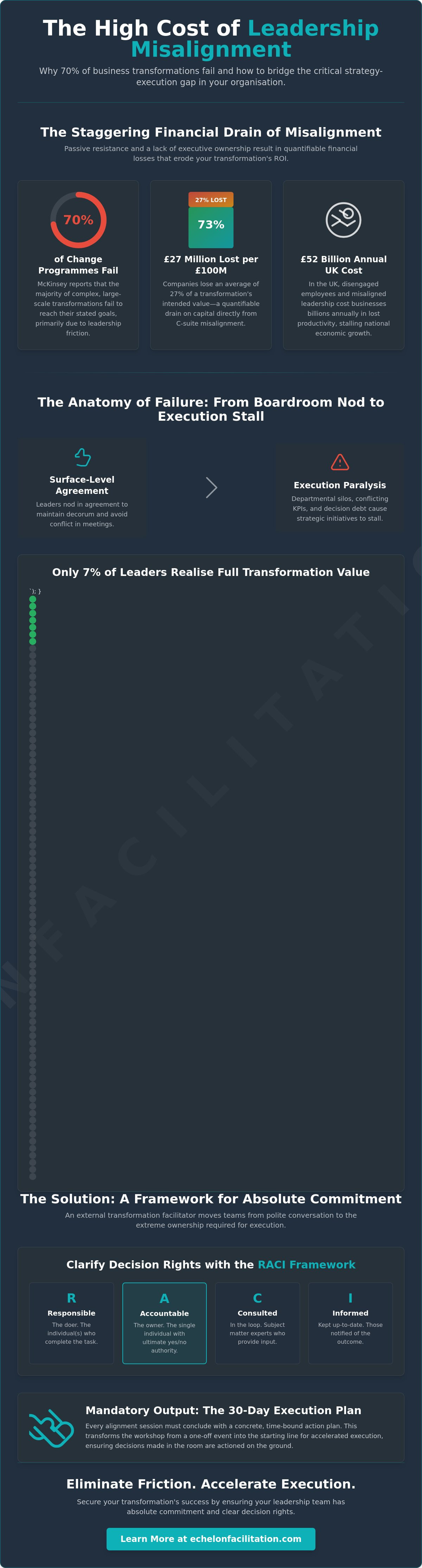
Research indicates that companies lose an average of 27% of the intended value of business transformations, representing a £27 million loss for every £100 million invested. In the UK, disengaged employees and misaligned leadership cost businesses £52 billion annually in lost productivity. These figures represent more than just financial waste; they reflect a fundamental breakdown in the strategy-execution gap where only 7% of C-suite leaders consistently realise the full value of their transformation initiatives.
You understand that a strategy's only as effective as the leaders who own its execution. This article outlines how to secure absolute executive alignment and eliminate the friction stalling your organisation's most critical initiatives. Effective transformation relies on clear decision rights and a leadership team that accepts extreme ownership of the strategic plan.
Key Takeaways
- Define alignment as the state where every leader owns the mission and its trade-offs. This clarity prevents the significant value loss seen in the 70% of transformations that fail due to leadership friction.
- Implement the RACI framework to clarify decision rights across the executive team. Assigning accountability to a single individual eliminates the diffusion of responsibility that frequently stalls progress.
- Engage a transformation alignment facilitator London to move the leadership team from polite conversation to absolute commitment. A structured diagnostic and intervention process resolves conflicting KPIs and departmental silos.
- Establish a 30-day execution plan as a mandatory output of every alignment session. This ensures that the workshop serves as a starting line for accelerated execution rather than a one-off event.
The Financial Burden of Leadership Misalignment in London Organisations
Transformation alignment is the state where every executive owns the mission and its associated trade-offs. It's not a superficial agreement or a polite consensus. In London's high-velocity market, the cost of hesitation is amplified. Indecision doesn't just stall progress; it erodes market share and investor confidence. Engaging a transformation alignment facilitator London ensures that the leadership team moves beyond mere compliance to genuine commitment. These facilitators identify the friction points that internal teams often overlook.
McKinsey reports that 70% of complex, large-scale change programmes fail to reach their stated goals. Leadership friction and a lack of executive ownership are primary drivers of this failure. When leadership teams aren't aligned, the organisation loses 27% of its intended value, which equates to £27 million for every £100 million invested. This isn't a theoretical risk. It's a quantifiable drain on capital that stems directly from passive resistance within the C-suite, where leaders agree in principle but fail to act in practice.
Quantifying the Cost of Executive Friction
A 10% delay in a major transformation project does more than push back a deadline. It compounds operational costs and delays revenue realisation. In a £50 million initiative, a three-month delay can cost upwards of £5 million in missed opportunities and extended overheads. Understanding the Hidden Cost of Indecision is vital for any board aiming to protect its ROI. Without a transformation alignment facilitator London, these delays often become permanent features of the corporate landscape.
Why Traditional Meeting Structures Fail to Resolve Conflict
Standard internal meetings often fall into the 'alignment trap'. Leaders agree to a plan in the boardroom to maintain decorum, yet they return to their departments and prioritise local KPIs over the collective mission. This behaviour is a failure of organizational change management at the highest level. External facilitation provides the necessary distance and authority to challenge these silos. It forces a move from polite conversation to absolute commitment, ensuring that decisions made in the room are executed on the ground.
A Framework for Decision Rights and Accountability
Accountability is not a collective endeavour. When everyone is responsible, nobody is. A transformation alignment facilitator London uses the RACI framework to dismantle this diffusion of responsibility. RACI (Responsible, Accountable, Consulted, Informed) provides a rigid structure for decision-making. The Accountable role must be assigned to exactly one individual. If two people are accountable, the system fails and execution stalls.
Leaders must also distinguish between types of problems to avoid applying the wrong solutions. Using A Leader's Framework for Decision Making, facilitators help teams categorise challenges through the Cynefin framework. Simple problems require standard operating procedures. Complex transformations require a probe-sense-respond approach. Misidentifying a complex problem as simple leads to rigid plans that shatter under pressure. A facilitator ensures the leadership team recognises the environment they're operating in before committing resources.
A primary blocker in London organisations is Decision Debt. This represents the backlog of unmade choices that paralyse middle management and drain resources. A transformation alignment facilitator London identifies these bottlenecks and forces an outcome. Clearing this debt is a prerequisite for momentum. If you find your progress stalled by unresolved debates, a Decision-Rights Reset can restore operational clarity and move the mission forward.
Implementing RACI at the Executive Level
Mapping workstreams to owners requires brutal honesty. A common pitfall occurs when senior leaders insist on being Consulted on every minor detail. This creates a bottleneck that slows the entire organisation. A facilitator ensures that Consulted status is reserved for those whose input is technically required, whilst Informed is used for those who simply need to know the result. This distinction protects the executive's time and empowers the individual who's Accountable.
The Difference Between Consensus and Commitment
Consensus is the enemy of speed. Waiting for every executive to agree on every detail is a recipe for mediocrity and delay. High-performing teams adopt the Disagree and Commit principle. This means that once a decision is reached, every leader supports it publicly and privately, regardless of their initial stance. Alignment is about commitment to the collective mission, not unanimous agreement. This shift in behaviour allows organisations to move faster than their competitors.
The London Facilitation Process: From Conversation to Commitment
Every successful strategic intervention follows a rigorous architecture. A transformation alignment facilitator London does not rely on open-ended brainstorming; they execute a three-phase process: Diagnostic, Intervention, and Ownership Reset. This approach moves beyond the standard discovery-design-delivery model used by generic consultancies. It focuses instead on the immediate extraction of truth and the assignment of responsibility.
Consider a London fintech that recently underwent a merger integration. Despite a public show of unity, two legacy leadership teams operated with conflicting KPIs, causing a 15% reduction in cross-functional output within the first quarter of 2025. By utilising a Strategy Sprint, the facilitator forced an immediate reconciliation of priorities. This 48-hour window broke a four-month deadlock that internal meetings had failed to address.
The physical environment plays a critical role in this process. Selecting a professional London centre away from the primary office removes the home-ground advantage and disrupts established power dynamics. This neutral territory is essential for psychological safety, allowing leaders to speak candidly without the shadow of office politics. To resolve your current bottlenecks, book a Transformation Alignment session today.
The 48-Hour Alignment Sprint
Success requires a compressed timeframe to maintain intensity. The first step involves a diagnostic to identify the 'Elephant in the Room', which represents the unspoken conflicts that everyone knows but no one names. The second step involves structured prioritisation exercises that force leaders to make binary choices. You cannot have five top priorities. You can read more about our specific methodology on our How We Work page.
Managing Group Dynamics in High-Stakes Environments
High-stakes sessions often feature dominant personalities who attempt to steer the narrative. A facilitator maintains the centre of gravity, ensuring that the mission remains the focus rather than individual egos. They provide the disciplined authority needed to redirect unproductive debates and hold every participant to a standard of extreme ownership. This professional composure ensures the team reaches a definitive commitment by the close of the second day.
Sustaining Transformation Momentum Beyond the Workshop
Alignment is not a destination; it's a continuous state of operational readiness. Whilst a session with a transformation alignment facilitator London provides the initial breakthrough, the transformation succeeds or fails in the weeks that follow. Every session must produce a 30-Day Execution Plan that translates high-level strategy into immediate, measurable actions. Without this, the organisation risks reverting to legacy behaviours within days of the intervention.
True success relies on decentralised command. Once the executive team achieves absolute clarity on the strategic objectives and associated trade-offs, they must empower their subordinates to lead within that framework. This prevents the executive team from becoming a bottleneck. It ensures that the Strategic Planning Process remains a live, evolving operation. Research from Harvard Business Review suggests that 67% of well-formulated strategies fail due to poor execution, often because the top-level alignment never reached the operational front lines.
The 30-Day Ownership Audit
Organisations often fail because they treat the workshop as a finish line rather than the start of a new operational tempo. To prevent this, implement a weekly 'Alignment Check-in' for the first month. This audit tracks whether the specific decisions made during the intervention are being executed on the ground. A professional transformation alignment facilitator London ensures these check-ins focus on objective progress rather than subjective updates. Use these three questions to maintain focus:
- Which decisions from the RACI matrix were challenged or ignored this week?
- Are the Accountable individuals meeting their 7-day milestones without intervention?
- What new friction points have emerged that require a Decision-Rights Reset?
Building a Culture of Extreme Ownership
Leadership alignment is a discipline that requires constant maintenance. It's the difference between a team that merely cooperates and one that takes extreme ownership of the collective result. This shift in behaviour is the primary solution to organisational friction. The facilitator provides the framework, but the executive team must provide the daily commitment to uphold these standards. If your current transformation is stalling due to a lack of follow-through, Book a Complimentary Diagnostic Call to reset your execution framework. Success is a product of disciplined action, not just a well-facilitated conversation.
Achieving Strategic Velocity Through Executive Ownership
Transformation success depends on the disciplined assignment of ownership rather than the pursuit of consensus. By establishing rigid decision rights and clearing the Decision Debt that clogs London boardroom agendas, organisations can reclaim the 27% of value typically lost during execution. A transformation alignment facilitator London acts as a strategic lever, forcing the trade-offs necessary to move from departmental silos to a unified mission.
The expertise of Dr Andrew Greenland ensures that these interventions deliver more than just temporary agreement. One recent client scenario resulted in a 300% increase in execution speed after a 48-hour alignment sprint resolved their integration bottlenecks. This process transforms the leadership team into a high-functioning unit capable of sustaining momentum through a culture of extreme ownership and weekly accountability audits.
Your strategic plan requires more than a signature; it requires absolute executive commitment. Secure your leadership alignment with a diagnostic call to eliminate friction and accelerate your organisation's most critical initiatives. Victory belongs to the team that executes with the greatest clarity.
Frequently Asked Questions
What exactly does a transformation alignment facilitator do?
A transformation alignment facilitator London identifies and resolves the friction points preventing executive ownership. They use structured frameworks to clarify decision rights and ensure every leader is committed to the strategic objectives. This role is about extracting objective truth and forcing the difficult trade-offs that internal teams often avoid. They turn polite boardroom agreement into disciplined operational action.
How long does it take to align a misaligned leadership team?
A high-stakes intervention typically requires a 48-hour Strategic Sprint to reach a state of commitment. This condensed timeframe maintains the intensity needed to break through months of organisational deadlock. Pre-workshop diagnostics ensure the session addresses the specific conflicts immediately. Whilst the initial alignment occurs in days, sustaining it requires a 30-day execution plan with weekly audits to track progress.
Why should we hire an external facilitator in London instead of using our HR lead?
External facilitators provide the necessary distance to challenge senior executives without the constraints of internal office politics. An HR lead is often part of the same power dynamic they are trying to fix, which limits their ability to confront dominant personalities. A specialist brings an objective perspective and a battle-tested framework for resolving complex conflict. This independence is essential for creating a neutral environment where leaders can speak candidly.
What is the difference between transformation alignment and standard team building?
Team building focuses on interpersonal relationships whilst transformation alignment focuses on strategic execution and decision rights. Standard activities aim for social cohesion; alignment aims for operational clarity and executive ownership. One is about how people feel; the other is about how the organisation functions. Alignment ensures that every leader understands their specific accountability and accepts the trade-offs required for success.
How do you measure the ROI of a facilitation workshop?
ROI is measured through the reduction in Decision Debt and the acceleration of execution milestones. If a major project is stalled, resolving that deadlock in 48 hours provides a quantifiable return in saved overheads and faster revenue realisation. Tracking the completion rate of the 30-day execution plan provides a direct metric for the success of the intervention. Success is found in the speed of action, not the quality of the conversation.

Article by
Andrew Greenland
Dr Andrew Greenland is the founder of Echelon Facilitation, a UK practice that designs and runs high-stakes leadership sessions for executive teams who need decisions, not more discussion. A medical doctor and medical educator, Andrew brings a clinician's discipline to the messy, political work of leadership alignment - surfacing the real disagreement, forcing the real choices, and ensuring every session produces a documented decision log with named owners and deadlines. He works with CEOs, executive teams, transformation leads, and boards across the UK and internationally. Based in Twickenham.