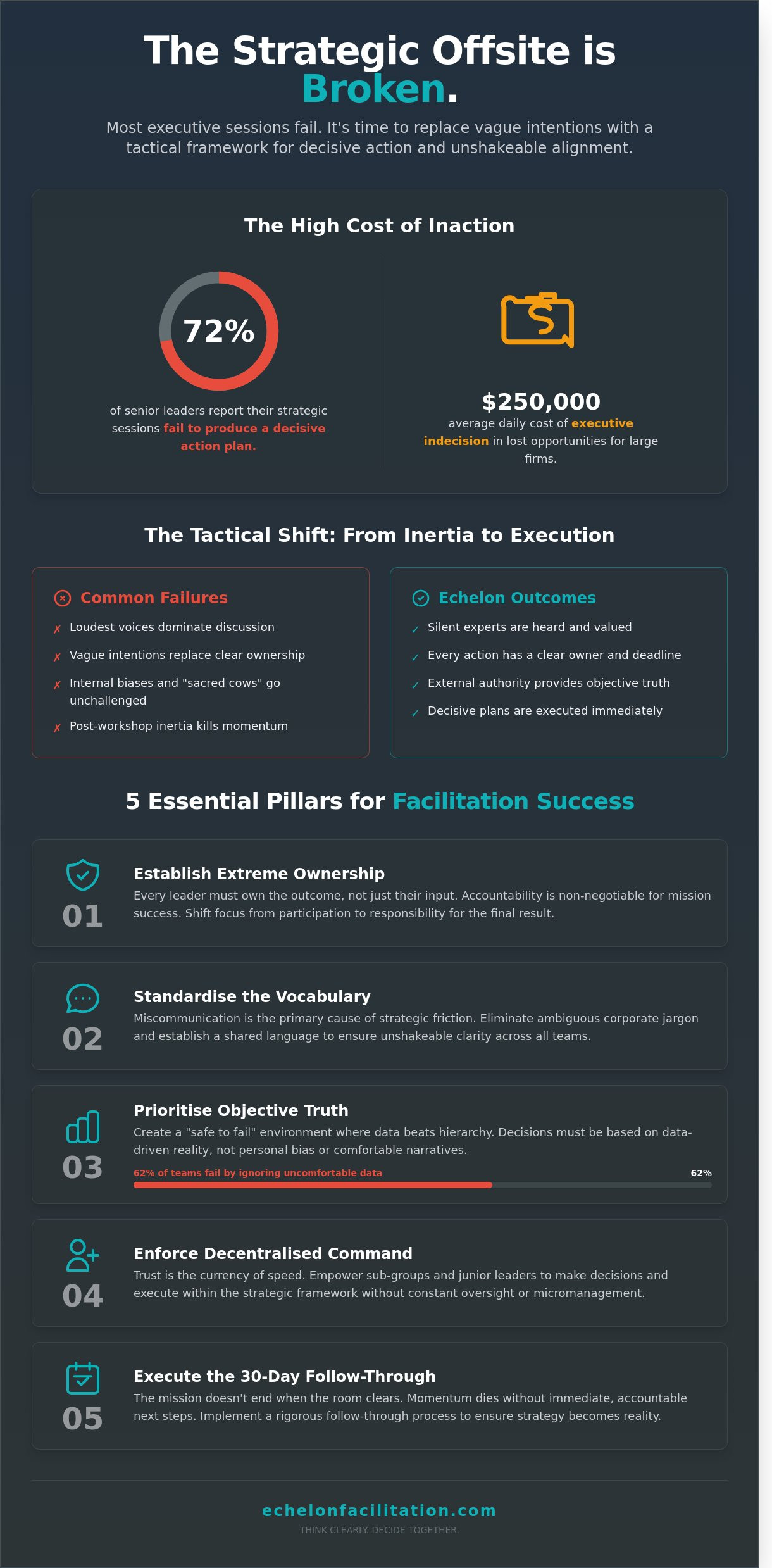
Most executive offsites are a high-cost failure; 72% of senior leaders report that their strategic sessions fail to produce a decisive action plan. When meetings are dominated by the loudest voices, the mission suffers and team alignment dissolves before the final slide is shown. You've experienced the frustration of post-workshop inertia where clear ownership is replaced by vague intentions. Mastering the essential Tips for Echelon Facilitation success is the only way to stop treating facilitation as a soft skill and start treating it as a tactical necessity for mission success.
This guide delivers the critical frameworks required to navigate the high-stakes complexities of 2026. You'll learn to apply disciplined leadership principles that turn chaotic workshops into decisive organizational victories. We provide the tactical systems to help every session produce clear alignment and outcomes you can measure. We're moving beyond conversation into the realm of extreme ownership and execution. Here's how you lead your team to strategic clarity through ten proven principles.
Key Takeaways
- Implement the principle of Extreme Ownership to ensure every team member is accountable for decisive organizational outcomes rather than mere participation.
- Apply tactical Tips for Echelon Facilitation success to transform stagnant boardroom discussions into clear, actionable operational realities.
- Leverage external authority to neutralize internal biases and challenge the "sacred cows" that often hinder strategic progress.
- Master the human element of leadership by balancing dominant personalities with silent experts to achieve unshakeable team alignment.
- Bridge the gap between high-level strategy and ground-level execution using a disciplined framework that prioritizes mission success over fleeting motivation.
Defining Strategic Success: Why Facilitation is a Mission-Critical Tool
Facilitation success isn't measured by a clean whiteboard or a polite round of applause. It's the deliberate transformation of group friction into strategic momentum. Most organizations settle for "efficient meetings" where participants leave with a vague sense of agreement but no clear path forward. This approach fails because it ignores the tactical reality of leadership. True business facilitation focuses on decisive organizational outcomes rather than simple moderation. It requires a shift from passive listening to active, disciplined engagement.
A facilitator shouldn't just be a neutral observer. You need a tactical advisor who navigates the room with the same precision as a commander on a battlefield. They identify bottlenecks, challenge comfortable narratives, and force the team to confront objective truths. Implementing these Tips for Echelon Facilitation success ensures your leadership team moves from passive observation to extreme ownership of the result. When the stakes are high, the facilitator is the engine that drives alignment.
The High-Stakes Environment
Traditional workshop models are crumbling under the weight of 2026 market volatility. A 2024 analysis of Fortune 500 decision-making found that executive indecision costs large firms an average of $250,000 per day in lost opportunities. You can't afford to let your team circle the same problems for months. This is why we prioritize high-stakes leadership workshops over standard corporate retreats. These sessions are designed to eliminate the hidden cost of indecision by forcing immediate, actionable alignment. If your current model doesn't produce a clear tactical advantage, it's a liability.
Mission-First Facilitation
Every session must begin with a clearly defined "Commander’s Intent." This concept ensures every participant understands the end state, even if the tactical situation changes during the meeting. Leaders must enter the room prepared to strip away ego and focus on the mission at hand. Use these three pillars to maintain focus:
- Establish objective truth: Remove personal bias and focus on data-driven reality.
- Eliminate ambiguity: Every directive must have a clear owner and a hard deadline.
- Promote decentralized command: Empower your leaders to execute the strategy without constant oversight.
Facilitation success is the bridge between strategy and execution. Success in the current year demands a faster, more disciplined approach to leadership alignment. By following these Tips for Echelon Facilitation success, you ensure that your team doesn't just talk about the mission; they possess the clarity to accomplish it.
5 Essential Tips for Echelon Facilitation Success and Leadership Alignment
Achieving organizational victory requires more than a productive meeting. It demands a shift in the fundamental culture of leadership. To secure Tips for Echelon Facilitation success, teams must move beyond passive participation and embrace a tactical mindset. High-stakes environments don't allow for ambiguity; they require absolute alignment on the mission at hand.
Success is built on five core pillars that transform a standard session into a strategic engine:
- Establish Extreme Ownership: Every participant must own the outcome, not just the input. If a leader doesn't own the failure of a plan, they can't own the solution.
- Standardise the Vocabulary: Miscommunication is the primary cause of friction. Eliminate corporate jargon to ensure unshakeable clarity across the team.
- Prioritise Objective Truth: Create a "safe to fail" environment where data beats hierarchy. In a 2023 analysis of executive performance, 62% of teams failed because they ignored uncomfortable data points.
- Enforce Decentralised Command: Empower sub-groups to make decisions within the framework. Trust is the currency of speed.
- Execute the 30-Day Follow-Through: Momentum dies without immediate, accountable next steps. The mission doesn't end when the room clears.
Cultivating Extreme Ownership
Passive observers are a liability in any high-pressure environment. Facilitators must force a transition from "passive observer" to "active mission owner" by challenging every participant to define their stake in the result. It's the facilitator’s role to hold leaders accountable for their specific domains in real-time. We document every commitment and assign ownership immediately. This prevents the "diffusion of responsibility" that often occurs in larger groups. When everyone is responsible, no one is responsible. Clear, documented ownership ensures that Tips for Echelon Facilitation success are grounded in individual accountability.
Navigating the 30-Day Execution Window
The first 72 hours post-facilitation are the most critical for long-term victory. This is when the "drift" back to old habits is strongest. To counter this, teams must establish a "battle rhythm" of check-ins to monitor progress against the objectives. Using a 30-day execution plan bridges the gap between strategic theory and operational reality. This plan acts as a tactical roadmap, ensuring that the energy generated during the session is converted into measurable results. Teams seeking this level of alignment often find that structured workshops provide the necessary pressure to forge lasting change and maintain momentum well beyond the initial meeting.
Tactical Execution: Moving from Boardroom Discussion to Operational Reality
Strategy is a hallucination until it meets the reality of execution. Facilitation must bridge the gap between high-level theory and the tactical requirements of the team. One of the primary Tips for Echelon Facilitation success is treating every session as a mission-critical operation. This requires a bias for action and a refusal to accept vague commitments. You aren't there to host a discussion; you are there to forge a path to victory.
Structuring the Agenda for Victory
Status updates are the enemy of progress. They consume 60% of traditional corporate meetings but offer zero strategic ROI. Successful facilitation eliminates this waste. Focus 80% of your time on "unsolved friction" problems that actively hinder the mission. Structure the remaining time as "white space." This allows for emergent strategic breakthroughs that a rigid schedule would otherwise suppress. Discipline in the agenda creates freedom in the execution. If your team struggles to move past the status report, consider professional workshops to master the art of tactical agenda design.
Managing Group Dynamics Under Pressure
The human element is the most volatile variable in any room. Dominant personalities often suppress the silent experts who hold the keys to technical success. Data shows that 74% of employees feel their input is ignored during high-stakes planning. The facilitator must act as the guardian of the mission, not a passive moderator. Use these tactics to maintain control:
- Enforce balanced participation: Directly engage silent stakeholders to ensure their expertise isn't lost to the loudest voice.
- Neutralize rank-pulling: Remind the group that the mission dictates the path, not the hierarchy. Ownership must be decentralized to be effective.
- Challenge assumptions: Use structured frameworks to stress-test business models safely before they reach the market.
Complexity breeds hesitation. Every Tips for Echelon Facilitation success strategy relies on turning complex trade-offs into simple binary choices. Does this move the team closer to the objective? If the answer isn't a clear yes, it's a no. This clarity is essential for maintaining momentum. Every decision must result in a clear owner and a hard deadline. Without extreme ownership, the session is merely a conversation. You must demand accountability to ensure that boardroom talk becomes operational reality.
Why Neutrality and External Authority are Non-Negotiable for Victory
Internal leaders often fall into the "Internal Bias" trap. When an HR Director or Head of Strategy attempts to facilitate their peers, the existing power structure remains intact. True progress requires a level of friction that internal leaders are often hesitant to trigger. They have to work with these individuals the following morning; they won't risk the social capital required to challenge a flawed strategy. Neutrality isn't just a preference; it's a tactical requirement for objective truth.
External facilitators bring a stoic confidence to the room. They remain composed when the leadership team is under extreme pressure. This objectivity allows them to ask the "stupid question." These questions are rarely stupid. They're tactical probes designed to dismantle "sacred cows" that have hindered growth for over 10 years. By applying these Tips for Echelon Facilitation success, organizations ensure that the truth isn't buried under layers of corporate politeness. A facilitator from the outside doesn't fear the CEO's reaction. They only care about the mission.
The Limitations of Internal Facilitation
Power dynamics stifle honest debate. In internally-led sessions, 64% of participants report feeling unable to disagree with senior leadership without repercussions. This leads to "comfortable narratives" where the team agrees on a safe, mediocre path rather than the necessary, difficult one. Internal authority is often too entangled in legacy decisions to provide the objective perspective needed for high-stakes conflict resolution. It's impossible to be the judge and the defendant simultaneously.
The Value of the External Commander
A battle-tested facilitator brings immediate credibility. They use external benchmarks from across multiple industries to diagnose leadership constraints that internal teams are too close to see. This perspective shifts the focus from individual egos to collective mission success. External facilitators act as a strategic lever for organisational victory. Implementing these Tips for Echelon Facilitation success requires recognizing that an outside perspective isn't a sign of weakness; it's a commitment to extreme ownership and tactical clarity.
Secure the objective perspective your leadership team needs to break through stagnation and achieve total alignment.
Explore our high-stakes facilitation workshopsThe Echelon Advantage: Implementing High-Stakes Facilitation for Your Team
Strategy often dies in the boardroom because it lacks a direct conduit to ground-level execution. Echelon Facilitation serves as that vital bridge. We ensure that high-level objectives translate into tactical wins across every layer of your organization. Our approach centers on the "Commander’s Perspective," where we prioritize discipline over fleeting motivation. Motivation is a temporary emotional state that fluctuates with external circumstances. Discipline is a repeatable, reliable process. When you implement our Tips for Echelon Facilitation success, you're choosing to build a culture where execution is non-negotiable. We help you identify and strip away the administrative waste that often clogs corporate decision-making.
Our frameworks are built on the principles of decentralized command. This ensures that even when the situation changes rapidly, your team stays aligned with the primary mission. We don't just provide advice; we provide a roadmap for organizational victory. We focus on the human element of leadership, recognizing that trust and clarity are the primary drivers of speed. By removing the ambiguity that leads to hesitation, we empower your team to move with purpose and precision.
Tailored Facilitation Services
We offer specialized professional facilitation workshops for executive teams facing complex hurdles. The process starts with the Echelon diagnostic, a rigorous assessment that uncovers the specific misalignment points within your hierarchy. Dr Andrew Greenland leads these sessions with disciplined authority, working with trusted associate facilitators for larger groups. He doesn't just observe; he actively steers the conversation toward objective truths. We expect every leader to take extreme ownership of their role, ensuring the Tips for Echelon Facilitation success become part of your team's DNA.
Booking Your Strategic Diagnostic
Your mission begins with a 60 minute strategic diagnostic call. Expect a direct, unfiltered assessment of your team's current state. We'll identify the friction points that are stalling your progress and outline a path to eliminate them. Preparing your team for this session requires a commitment to radical transparency. It's about shifting from a "me" mindset to a "mission" mindset. This is the final step in moving from interest to mission execution. Don't let another quarter pass with the same unresolved issues. Contact Echelon Facilitation to secure your mission success.
Command Your Strategic Execution
Success in 2026 demands more than a simple plan; it requires absolute alignment and extreme ownership at the executive level. You've explored how neutral authority and tactical execution transform boardroom discussions into operational victories. These Tips for Echelon Facilitation success provide the framework for decentralized command and clear mission focus. Echelon Facilitation is led from Richmond, London by Dr Andrew Greenland, a medical doctor who has spent years running large, high-stakes working sessions for senior expert groups. We specialize in high-stakes executive alignment where there's no room for error. Strategy fails when it lacks a bridge to reality. We provide that bridge through disciplined process and objective truth. Don't leave your organization's future to chance or comfortable narratives. It's time to demand accountability and drive results that land with impact. We remain composed under pressure, keeping your leadership focused on the mission at hand. Every session we facilitate is a step toward organizational victory. You have the tools to lead. Now, you must execute with precision. Your team is ready for the next level of operational excellence.
Secure your mission success with Echelon Facilitation today.
Frequently Asked Questions
How do I know if my leadership team needs professional facilitation?
Your team needs professional facilitation when decision-making cycles exceed 30 days or internal friction prevents the execution of core objectives. If 2 or more strategic goals have missed their deadlines by over 15 percent, your leadership lacks the necessary alignment. Facilitation removes internal bias and forces a return to mission clarity. It identifies the root causes of stagnation that internal leaders often overlook due to proximity.
What is the difference between a facilitator and a consultant?
A consultant provides a pre-packaged solution, while a facilitator extracts the solution from your team to ensure extreme ownership. Consultants often deliver 50 page reports that fail to gain traction within the organization's culture. Facilitators focus on the human element and tactical execution. We guide your leaders through a process where they build the strategy themselves. This builds genuine commitment to the mission.
Can Echelon Facilitation help with remote or hybrid executive teams?
Echelon Facilitation manages remote and hybrid teams by using high-fidelity digital platforms to maintain strategic focus. Remote environments often suffer from a 25 percent drop in engagement during traditional meetings. Our structured approach mitigates this by enforcing disciplined communication protocols and clear accountability. We ensure every team member, regardless of their physical location, remains fully integrated into the decision-making process.
How long does a typical strategic alignment workshop take?
A standard strategic alignment workshop requires 2 full days of intensive engagement to achieve mission success. This 16 hour timeframe allows for the identification of friction points and the development of a concrete execution plan. These are high-intensity sessions. We eliminate distractions to focus entirely on your primary objectives. Shorter sessions often fail to reach the depth required for true organizational change.
What happens if our leadership team cannot reach a consensus during a session?
The facilitator utilizes a predefined decision-making framework to break deadlocks and maintain momentum. We don't seek a comfortable narrative; we seek the objective truth. If consensus isn't reached within 45 minutes of debate, the senior leader makes the final call based on the gathered data. This follows the principle of decentralized command where speed of execution is prioritized over perfect agreement.
How do we measure the ROI of a facilitated workshop?
You measure ROI by tracking the completion rate of 90 day tactical goals established during the session. We track specific metrics like reduced meeting times and increased departmental alignment. Success is measured in execution, not in the feeling of the workshop.
Does Echelon Facilitation provide follow-up support after the initial workshop?
Every Echelon engagement includes a 30-day follow-up call, with optional 90-day review sessions and a quarterly review retainer for teams that want ongoing support. These check-ins focus on accountability and the practical application of the Tips for Echelon Facilitation success discussed during the workshop. Statistics show that 70 percent of strategic initiatives fail due to lack of follow-through. Structured follow-up is designed to prevent this decay by reinforcing ownership.