
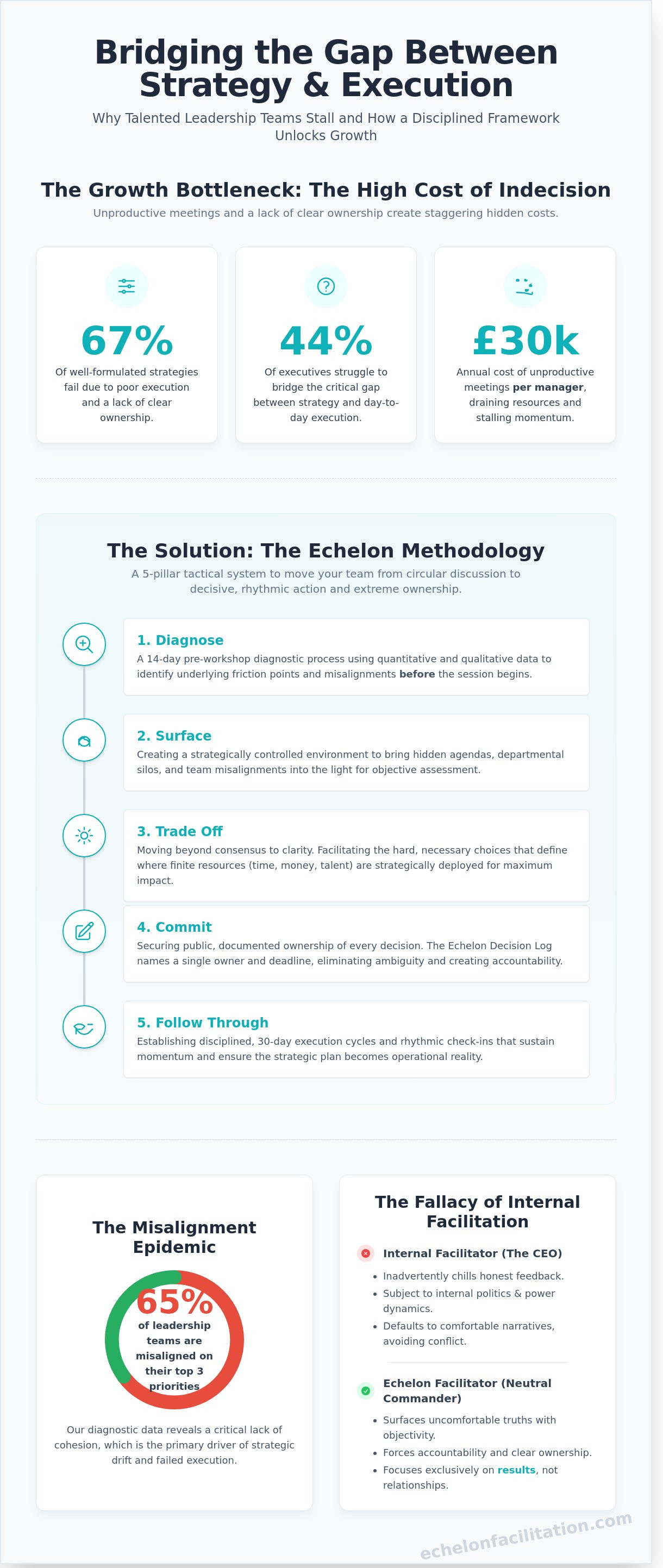
Most leadership teams don't fail because they lack talent; they fail because they lack the discipline to make a decision and stick to it. Research indicates that 67% of well-formulated strategies fail due to poor execution and a lack of clear ownership. When you implement Echelon Facilitation strategies for growth, you replace this uncertainty with a tactical framework that demands results. You've likely sat through meetings that ended in nothing but a scheduled follow-up, watching your momentum stall as resource allocation becomes a source of friction rather than a tool for victory.
It's a common reality where strategic drift replaces mission success. We understand that your time is a finite resource that shouldn't be wasted on circular debates, especially when 44% of executives struggle to bridge the gap between strategy and execution. We promise to show you how to transform boardroom tension into a clear decision log with named owners and a 30-day execution plan that actually moves the needle. This article breaks down the mechanics of aligning your team on the top three growth priorities and ensuring every action serves the mission.
Key Takeaways
- Identify the "Growth Bottlenecks" that stall strategic intent and learn how to eliminate the staggering costs of unproductive executive meetings.
- Leverage Echelon Facilitation strategies for growth to shift your leadership team from circular discussion to disciplined, rhythmic action.
- Establish true executive alignment by bridging the gap between high-level vision and the practical, operational ownership required to win.
- Move beyond the "corporate retreat" mindset by implementing 30-day execution plans and the Echelon Decision Log to ensure total accountability.
- Discover how a battle-tested approach to facilitation provides the tactical clarity needed to secure your organization’s future in a volatile market.
The Growth Bottleneck: Why Conventional Leadership Meetings Stifle Scale
Growth isn't a linear progression; it's a series of tactical hurdles. Many leadership teams find that the systems that served them at 20 employees fail at 100. This gap between high-level strategic intent and ground-level execution is the growth bottleneck. It's where momentum dies and frustration begins. In the UK, research indicates that unproductive meetings cost businesses approximately £30,000 per manager annually. When you multiply that across an entire executive board, the financial drain is staggering. Echelon Facilitation strategies for growth address this by stripping away the noise and focusing exclusively on the mission.
Most "smart teams" struggle because they rely on consensus rather than clarity. As headcounts increase, the complexity of communication grows exponentially. Without a rigorous strategic planning process, teams drift into silos and lose sight of the objective. Facilitation isn't a luxury for these organisations. It's a strategic necessity to ensure every resource is aligned with the primary goal. You can't scale a business on vague intentions; you scale it through disciplined execution.
The High Cost of Indecision
Indecision is a silent killer of market share. A study by Bain & Company found that a company’s decision-making effectiveness is 95% correlated with its financial performance. When leaders avoid difficult trade-offs, they create hidden friction that slows every department. This lack of resolve erodes team morale as high performers become frustrated by the lack of direction. Teams that can't decide can't win. The Cost of Indecision is the primary tax on organisational growth.
The Fallacy of Internal Facilitation
Internal leaders cannot objectively facilitate high-stakes sessions. Power dynamics and personal histories always enter the room, regardless of the intent. A CEO who facilitates their own strategy session inadvertently chills honest feedback, as subordinates often mirror the leader’s bias to avoid conflict. You need a neutral commander in the boardroom to surface uncomfortable truths and force accountability. Without this external pressure, teams default to comfortable narratives rather than objective reality. Implementing Echelon Facilitation strategies for growth ensures that the neutral commander focuses on results rather than internal politics. Review our facilitation frameworks to understand the tactical advantages of an outside perspective.
The Echelon Methodology: 5 Pillars of Strategic Growth Facilitation
Effective leadership requires a disciplined, rhythmic process for decision making. The Echelon framework operates as a tactical system designed to move teams from circular discussion to decisive action. Most executive sessions fail because they prioritize consensus over clarity. Echelon Facilitation strategies for growth replace this ambiguity with a rigorous methodology centered on five distinct pillars: Diagnose, Surface, Trade Off, Commit, and Follow Through. This process removes emotional hyperbole from the boardroom; it forces leaders to confront objective reality and prioritize the mission over individual comfort.
- Diagnose: Identifying the underlying friction points before the session begins.
- Surface: Bringing hidden agendas and misalignments into the light.
- Trade Off: Making the hard choices that define where resources are actually deployed.
- Commit: Securing public, documented ownership of the plan.
- Follow Through: Establishing the 30-day execution cycles that sustain momentum.
Diagnose and Surface: Identifying the Real Constraints
Strategic failure rarely stems from a lack of intelligence. It stems from unaddressed friction. Our methodology begins with a 14-day pre-workshop diagnostic process. This phase uses quantitative data and qualitative interviews to pinpoint specific team weaknesses. Diagnostics like this commonly reveal that leadership teams are misaligned on their top three priorities. We identify these gaps early so the workshop can focus on solutions rather than discovery.
The "Surfacing" phase is where the human element of leadership becomes the foundation. We create an environment where leaders must voice hidden agendas. If a department head is protecting a failing project, that reality is brought to the table. We don't settle for comfortable narratives. By surfacing these constraints, we ensure the team is solving the right problems. This level of transparency is essential for anyone seeking to master strategic workshops that yield actual results.
Trade Off and Commit: The Mechanics of Choice
Strategy is the art of sacrifice. Growth requires brutal prioritization because resources are always finite. During the Trade Off phase, we facilitate the difficult conversations where leaders must decide what they will stop doing. If every initiative is a priority, nothing is. We ensure that capital and talent follow the strategy, not the loudest voice in the room. This stage is the bridge to successful strategic execution, as it aligns the team's capacity with its stated objectives.
Commitment is the final hurdle. In the Echelon framework, commitment isn't a head nod; it's a public, documented agreement. Every leader leaves the room with clear ownership of specific outcomes. This precludes future backtracking and ensures that Echelon Facilitation strategies for growth land with impact. We replace "we'll look into it" with "I will deliver X by date Y." This shift in language reflects a shift in culture toward extreme ownership and tactical clarity. When a team commits under this methodology, they aren't just agreeing to a plan. They're accepting a mission.
Achieving Executive Alignment: The Foundation of Any Growth Strategy
Alignment represents a state where every leader understands and owns the primary mission. It's not a passive agreement or a simple nod of the head during a presentation. It's a deep, psychological commitment to a single outcome. Research confirms that executive team alignment is the primary driver of organizational velocity. Without this unity, the board functions as a collection of siloed interests rather than a single, cohesive force. Echelon Facilitation strategies for growth prioritize this psychological buy-in to ensure that every resource is pointed toward the same objective.
Misaligned boards create organizational whiplash for the levels below them. A 15% discrepancy in strategic priorities at the executive level often results in a 60% drop in execution speed for front-line teams. This friction destroys capital and erodes trust. The Echelon Alignment Workshop serves as the bridge between high-level vision and tactical action. We force leaders to confront objective truths and eliminate the "polite fictions" that often mask deep-seated disagreements. This process ensures that when the meeting ends, the leadership speaks with one voice.
True alignment enables Decentralised Command. When every leader understands the mission intent, they can act independently to achieve the collective goal. This removes the bottleneck of centralized decision-making and allows the organization to move faster than the competition. It transforms the leadership team from a group of supervisors into a group of owners.
Building the Team Charter
High-performing executive teams require a formal set of operating principles. We call this the Team Charter. It's a tactical document that defines how the team handles conflict, makes decisions, and allocates resources. A Team Charter prevents future friction during high-stakes execution by setting the rules of engagement before the pressure mounts. For example, a growth-focused charter element might state: "We prioritize long-term market share over quarterly margin preservation when the opportunity for 20% year-over-year growth exists." This clarity eliminates hesitation during critical moments.
Navigating Complex Trade-Offs in 2026
Leaders in 2026 face intense pressures from rapid digital transformation and a 30% increase in talent mobility across the executive sector. These variables demand rapid pivots that can't happen in a fragmented environment. We use the Echelon framework to help boards navigate these specific strategic crossroads. It's about making the hard choices that others avoid. Market data suggests that 40% of digital transformation projects fail specifically because of leadership fragmentation. Echelon Facilitation strategies for growth mitigate this risk by forcing a consensus on trade-offs before the first dollar is spent. Alignment is the ultimate force multiplier for ambitious organisations.
From Strategy to Execution: Establishing Extreme Ownership and 30-Day Plans
A workshop without a rigorous 30-day execution plan is a corporate retreat. It's a waste of leadership capital. Most strategies fail not because they're poorly conceived, but because they lack a bridge to daily operations. Echelon Facilitation strategies for growth solve this by shifting the focus from ideation to immediate tactical movement. We don't accept vague "next steps." We demand a concrete roadmap that begins the moment the team exits the room.
The Decision Log: Accountability in Writing
Standard meeting minutes serve as a passive history. They're often ignored or filed away. The Echelon Decision Log is a living document that functions as a tactical directive for the leadership team. It records every commitment made during the session with absolute clarity. Echelon acts as the objective voice of reality, making sure that every entry is both aggressive and achievable. This document becomes the single source of truth for the mission's progress.
Each entry in the log must meet three non-negotiable criteria:
- Single Ownership: Every task is assigned to one individual. Committees don't execute; people do. A 2023 analysis of executive performance found that teams with a single-owner accountability model are 45% more likely to hit quarterly targets.
- Defined Deadlines: Every action has a hard date. "Ongoing" is not a valid timeline in a high-stakes environment.
- Binary Success Metrics: The objective is either achieved or it isn't. There's no room for subjective interpretation or comfortable narratives.
The 30-Day Execution Sprint
The first 30 days are the most volatile period for any new strategy. Research from the 2022 Bridges Strategy Implementation Survey indicates that 67% of leaders fail to implement their strategies due to a lack of immediate follow-through. We counter this by establishing a 30-day execution sprint. This structure breaks the mission into manageable, high-impact intervals. It protects the new strategy from the daily operational whirlwind that usually suffocates growth.
Maintaining this pace requires relentless discipline. The team must meet weekly to review the Decision Log and update their progress. This cadence cements the gains made during the offsite and ensures that the mission remains the priority. For those looking to implement this structure immediately, utilize our 30-Day Execution Plan guide to access proven templates.
Securing Your Organisation’s Future: Engaging Echelon for Strategic Victory
Leaders don't seek consensus; they seek clarity. Echelon Facilitation is built for executives who've outgrown traditional consulting models and want a disciplined approach to leadership alignment. We provide the disciplined authority necessary to strip away distractions and focus entirely on the mission. By implementing Echelon Facilitation strategies for growth, your leadership team moves from passive observation to extreme ownership. This process isn't about comfort. It's about securing a strategic victory through objective truth and tactical execution. Our aim is that potential isn't just discussed but is actively converted into operational success.
The Echelon Diagnostic Call
Every engagement begins with a complimentary 30-minute diagnostic call. This isn't a sales pitch. It's a high-level strategic assessment designed to identify the specific constraints holding your team back. Expect a no-fluff conversation centered on your operational reality. Prepare to discuss your team’s bottlenecks with total transparency. We'll determine if our methodology aligns with your current mission requirements and whether your team is ready for the discipline our process demands.
Customising Your Strategy Offsite
Echelon doesn't offer off-the-shelf solutions. We tailor every workshop to the specific mission and tactical environment of the client. Whether you're a London-based firm or an international corporation, every session is designed and led by Andrew from our Richmond base, working with trusted associate facilitators for larger groups. This lead time ensures we can properly analyse your market position and internal dynamics before the first session begins. Echelon acts as the strategic lever that turns your organisation's latent potential into a measurable victory. Use Echelon Facilitation strategies for growth to ensure your next move is your strongest. Book your diagnostic call with Echelon Facilitation today.
Transform Strategic Intent Into Operational Victory
Growth isn't a byproduct of hope; it's the result of disciplined, tactical execution. By applying the five pillars of our methodology—Diagnose, Surface, Trade Off, Commit, and Follow Through—your leadership team eliminates the bottlenecks that stifle scale. These Echelon Facilitation strategies for growth move your board from passive discussion to extreme ownership. Founder Dr Andrew Greenland, a medical doctor who has spent years running large, high-stakes working sessions for senior expert groups, makes sure that every session results in a concrete 30-day plan rather than empty corporate jargon. Operating from Richmond, London, we help executive teams find the tactical clarity needed to win in high-stakes environments. We don't settle for comfortable narratives; we demand objective truth and unwavering alignment.
This commitment transforms fragmented departments into a unified force capable of sustained victory. Your mission's success requires a commander's focus on the human element of leadership and a refusal to accept mediocrity. Take the first step toward organizational clarity today.
Secure your mission success—book a diagnostic call with Echelon Facilitation
Your team is ready for the next level of performance. We look forward to leading you there.
Frequently Asked Questions
What is the difference between Echelon Facilitation and traditional business consulting?
Echelon Facilitation prioritizes immediate tactical execution and leadership ownership over the delivery of static reports. While 70% of traditional consulting projects fail due to a lack of implementation, our methodology focuses on decentralized command. We don't just provide a 50 page slide deck; we facilitate the difficult conversations that result in a unified mission and clear, actionable objectives for your executive team.
How much does a high-stakes leadership alignment workshop cost in the UK?
High-stakes leadership alignment workshops in the UK typically range from £8,000 to £25,000 for a comprehensive 2 day engagement. This investment covers the pre-offsite diagnostic phase, professional facilitation, and the delivery of a finalized tactical execution plan. Costs vary based on the number of stakeholders involved and the complexity of the organizational friction we must address to achieve alignment.
Can Echelon Facilitation help with board-level disputes and misalignment?
We help resolve board-level disputes by stripping away ego and refocusing the group on the collective mission. Research indicates that 65% of high-growth failures stem from board or co-founder conflict. Echelon Facilitation strategies for growth utilize objective frameworks to identify the root cause of friction. We guide the board through a disciplined process that demands accountability and results in a decisive path forward for the organization.
What is a Decision Sprint, and how does it drive business growth?
A Decision Sprint is a 48 hour intensive framework designed to eliminate analysis paralysis and move teams into a state of action. By compressing the decision making cycle, we help organizations bypass months of circular debate. This process drives growth by reclaiming time previously lost to indecision, allowing your team to execute on high value opportunities with speed and precision.
How long does it take to see results after an Echelon strategy offsite?
Execution begins the moment the offsite concludes, with initial clarity achieved within the first 24 hours. We track specific metrics established during the session to ensure the team maintains its trajectory. Success is measured by the speed of decentralized decision making and the achievement of defined mission milestones.
Does Echelon Facilitation provide follow-up support after the initial workshop?
Every Echelon engagement includes a 30-day follow-up call, with optional 90-day review sessions and a quarterly review retainer for teams that want ongoing support. These sessions serve as accountability checkpoints where progress is reviewed and priorities are adjusted as needed.
Is Echelon Facilitation suitable for small businesses or just large corporations?
Our frameworks scale across any organization with a leadership team of 5 or more members facing strategic complexity. Whether you're a mid market firm with 150 employees or a global enterprise, the principles of alignment and execution remain constant. We adapt our Echelon Facilitation strategies for growth to fit the specific scale of your mission, ensuring every leader understands their role in the broader objective.
How do we prepare our leadership team for an Echelon engagement?
Preparation requires every participant to complete a 20 minute diagnostic assessment and commit to a philosophy of radical transparency. We expect leaders to arrive with their data ready and their egos checked at the door. You'll receive a briefing pack 14 days before the engagement. This ensures we spend 100% of our time on high value strategy rather than catching up on basic context during the session.