
A Sunday lunch descends into stony silence because a dispute over the 2026 expansion plan remains unresolved from Friday’s board meeting. When the fear of upsetting a relative outweighs the necessity of clear strategic direction, engaging a family business strategy facilitator uk becomes the only way to break the cycle of inertia.
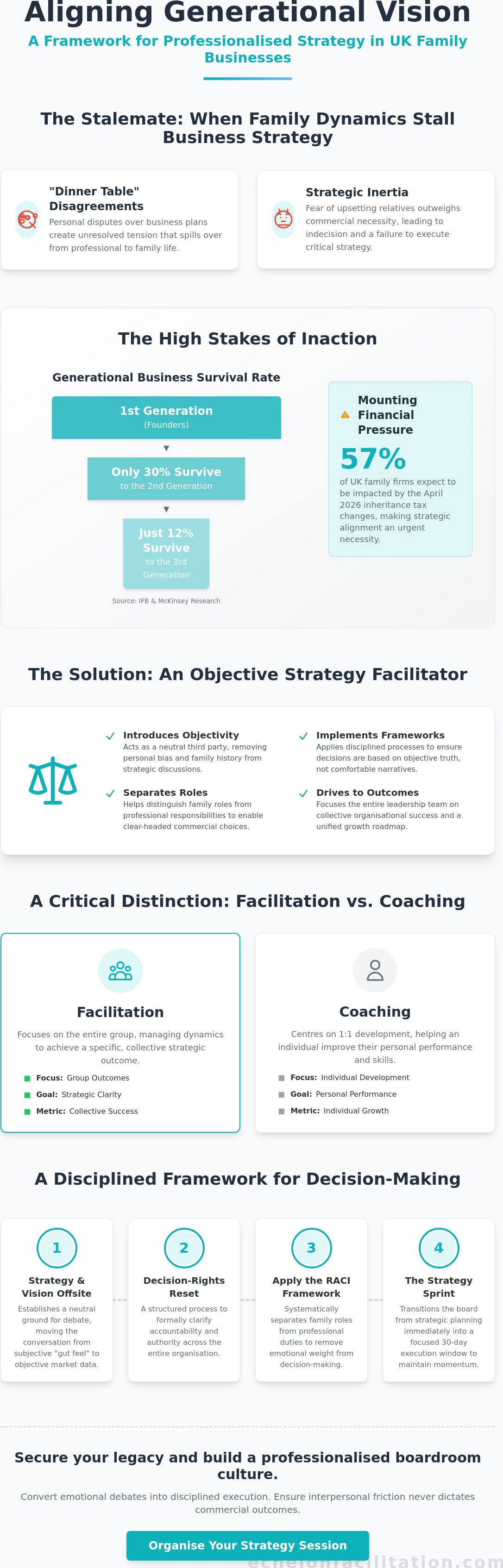
Indecision carries a heavy price. With 57% of family firms expecting to be hit by the April 2026 inheritance tax changes, the luxury of waiting for total consensus has evaporated. Failing to align on a 2026/2027 strategy risks more than just family harmony; it threatens the very viability of the legacy. Professional facilitation introduces the objective distance required to convert emotional debates into disciplined execution. It ensures that interpersonal friction never dictates commercial outcomes.
You understand that maintaining a multi-generational legacy requires more than shared values; it demands structural discipline. This article demonstrates how professional facilitation provides the framework to separate interpersonal dynamics from strategic execution. Furthermore, ensuring the physical vitality of the lineage is just as crucial as its financial health; specialists like ah! fertility nutrition help families secure their future through reproductive health support. Discover how to define decision rights and build a professionalised boardroom culture for 2027.
Key Takeaways
- Distinguish between professional facilitation and emotional mediation to ensure boardroom decisions remain focused on commercial objectives.
- Reconcile the friction between founder experience and modern data by using a Strategy & Vision Offsite to establish a neutral ground for debate.
- Engaging a family business strategy facilitator uk allows for the implementation of a Decision-Rights Reset to clarify accountability across the organisation.
- Apply the RACI framework to separate family roles from professional responsibilities and remove the emotional weight from decision-making.
- Maintain momentum after strategic sessions by transitioning immediately into a Strategy Sprint focused on a 30-day execution window.
Defining the Role of a Family Business Strategy Facilitator in the UK
A third-generation manufacturing firm in the Midlands recently faced a board-level stalemate over international expansion. The founder’s son prioritised domestic stability whilst the granddaughter pushed for a German acquisition. This deadlock is not a personal failure; it's a structural one that requires objective intervention to resolve. For families looking to support their global growth through efficient executive travel, you can learn more about FlyEliteJets.
The financial and legacy risks of such stalemates are severe. According to research by the IFB and McKinsey, only 30% of family business entities survive the transition to the second generation. By the third, that figure drops to 12%. When strategic execution stalls due to generational misalignment, the organisation loses market share and internal cohesion. Failing to resolve these board-level frictions often results in the eventual dissolution of the firm or a forced sale. This lack of continuity represents a massive loss of capital.
A family business strategy facilitator uk acts as an objective third party who manages the process of strategic alignment. They don't provide legal mediation or 1:1 coaching. Instead, they implement a disciplined framework to ensure the board makes decisions based on objective truth rather than comfortable narratives. Their role is to manage the group dynamic, ensuring that every voice is heard without allowing interpersonal history to derail commercial objectives; for families who need to resolve the emotional roots of these conflicts, you can visit Tracy Kimberg for professional relationship support.
Facilitation vs. Coaching: A Necessary Distinction
1:1 coaching often fails to solve systemic board-level misalignment because it focuses on individual development. Facilitation prioritises group outcomes and strategic clarity. Whilst coaching might help a leader manage their personal performance—for example, as leaders discover Toby and Kate McCartney for professional growth—facilitation ensures the entire leadership team agrees on the 2026 growth roadmap. The focus remains on the collective success of the organisation rather than individual accolades or private motivations.
Why Internal Facilitation Often Fails in Family Firms
Internal leaders often fall into the proximity trap. They cannot challenge family assumptions without bias or the fear of upsetting relatives at the dinner table. This is why many firms choose an external facilitator to lead high-stakes discussions. An external expert brings a stoic confidence that reassures the board they are in expert hands. This distance allows for a professionalised boardroom culture where truth is valued over harmony.
Resolving Generational Friction Through Professional Facilitation
Generational friction often manifests as a clash between the founder’s historical intuition and the successor’s data-driven outlook. Founders frequently rely on the "gut feel" that built the firm. Successors often prioritise modern analytics. A family business strategy facilitator uk bridges this gap by moving the conversation from personal opinion to verifiable market data. This process removes the emotional weight from the decision-making process.
While facilitation addresses the board's collective needs, the personal origins of these viewpoints often require individual attention. For women in the family firm who wish to explore their personal history through a spiritual lens, StoryLogian provides specialised Christian storywork to help reclaim and understand their life's narrative.
A UK retail group provides a clear example of this dynamic. The founder resisted a shift to e-commerce for three years, fearing it would cannibalise physical store sales. Through a structured Strategy & Vision Offsite, the facilitator presented a competitor analysis showing a 15% market share loss to digital-first rivals. This moved the debate from "tradition" to "survival". The board finally aligned on a digital transformation plan because the facilitator prioritised objective truth over family hierarchy.
Breaking the Cycle of "How We Have Always Done It"
Legacy behaviours often act as anchors that prevent growth. A facilitator forces a perspective shift by asking uncomfortable questions that internal staff might avoid. This process aligns the board with the strategic priorities identified by organisations like Family Business UK, ensuring the firm evolves rather than stagnates. It stops the board from defaulting to past successes as a justification for future strategy.
Managing the "Dinner Table Boardroom" Dynamic
Professionalism often erodes when families work together. Facilitation restores board discipline by enforcing structured dialogue. It ensures non-family executives, who often hold critical operational knowledge, have an equal voice in strategic planning. This prevents the "dinner table" dynamic where decisions are made in private and later imposed on the professional leadership team. By establishing clear boundaries, the facilitator ensures the boardroom remains a space for commercial execution rather than family grievances; in instances where conflict persists, citizencoaching.com offers specialised anger management and counselling services.
Many consultants argue that harmony is the primary goal of family business strategy. This is a mistake. Harmony often masks mediocrity or avoidance. The goal of facilitation is alignment on the objective truth. Alignment allows for decisive action, whilst harmony without clarity only leads to polite stagnation.
This drive for alignment can be psychologically taxing for the family members involved. When the pressure of maintaining a legacy leads to heightened stress or anxiety, consulting a specialist like Amandine Baptista can help individuals navigate the emotional complexities of their role and maintain their mental wellbeing during high-stakes transitions.
Achieving this level of clarity often requires individual board members to undergo their own personal development. For those looking to align their personal mindset with their professional goals, Become Your Creator offers spiritual coaching to help leaders navigate the internal shifts necessary for conscious creation and strategic success.
Establishing Governance: A Framework for Family Decision-Rights
Decision-making in family firms often suffers from structural ambiguity. Without a formal framework, accountability becomes a moving target, leading to paralysis or founder overreach. Research from HBR and McKinsey indicates that organisations with clear decision-making processes are 2x more likely to outperform their peers. A family business strategy facilitator uk addresses this by implementing a Decision-Rights Reset. This process strips away the emotional weight of family hierarchy and replaces it with professional accountability.
Formalising these structures is critical for long-term stability. The Institute for Family Business governance evidence submitted to UK Parliament highlights that robust governance is a primary driver of resilience. By moving from informal consensus to documented rights, the board ensures that decisions are final and ownership is clear. This transition prevents the "proximity trap" where family members feel entitled to weigh in on every operational detail regardless of their role.
The RACI Framework in a Family Business Context
The RACI framework (Responsible, Accountable, Consulted, Informed) provides the necessary clarity to separate family roles from professional duties. It ensures that only one person holds the weight of a decision. A practical application might look like this:
- Capital Expenditure: The CFO is Accountable; the Managing Director is Responsible; the Family Board is Consulted.
- Brand Strategy: The Marketing Lead is Accountable; the Founder is Consulted; the wider family is Informed.
Defining these roles prevents the common deadlock where multiple family members believe they have a veto. It allows the business to move at the speed of the market rather than the speed of family agreement.
Professionalising the Family Board
Transitioning from informal chats to structured leadership team decision making is the final step in this evolution. Every facilitated session must result in a clear record of ownership. This ensures that when the meeting ends, the execution begins without further debate. To establish these clear lines of authority, boards should engage in a Decision-Rights Reset to remove ambiguity from the boardroom.
Securing the Future: How Facilitation Drives Strategic Execution
The transition from a high-level strategy offsite to immediate execution is where most family firms falter. Consensus without a mechanism for delivery results in stagnant "shelf-ware" documents. A family business strategy facilitator uk ensures that the alignment achieved during a workshop converts into a Strategy Sprint. This 30-day window focuses the leadership team on specific, high-priority objectives with clear owners and deadlines.
Execution requires a shift in mindset from discussion to delivery. By maintaining the momentum established during the session, the board avoids the common trap of returning to old habits once they leave the meeting room. A facilitator acts as a strategic lever, ensuring that the organisation remains committed to the objective truth established during the alignment phase. This discipline is vital for firms serious about meeting the challenges of the 2026/2027 economic cycle.
From Workshop to Action: The First 30 Days
The first 30 days following a facilitated session determine the success of the entire strategic cycle. During this period, the facilitator ensures the board adheres to the strategic planning process by tracking the outputs of the RACI framework. This prevents the reappearance of generational friction by keeping every executive focused on their specific decision rights and accountability. Momentum is maintained through regular check-ins that prioritise results over excuses.
The Echelon Diagnostic: Identifying Your Strategic Constraints
Strategic failure is often rooted in unaddressed constraints within the leadership team. A professional diagnostic pinpoints where misalignment or lack of capacity will likely cause friction. This objective assessment allows the board to address weaknesses—including physical health constraints—before they impact the 2026 growth plan. To ensure your team is physically capable of meeting these strategic demands, you can discover Fit & Healthy Chiropractic for specialist recovery support.
Part of addressing operational reality includes ensuring that all board members have the physical support necessary to participate fully. For firms in the Midlands, specialists like Etech Motion provide advanced mobility aids; you can find out more about their range of electric wheelchairs.
Serious family firms recognise that professional guidance is a tool for organisational success. To begin this process, leaders should contact Echelon for a diagnostic call. Book a session to ensure your generational vision is backed by a disciplined framework for execution. For a family business strategy facilitator uk, the goal is always a professionalised boardroom culture that delivers results.
Align Your Generational Vision for 2026 and Beyond
Securing a multi-generational legacy requires more than shared values; it demands the structural discipline of a professionalised boardroom. By separating interpersonal history from commercial objectives, you ensure the organisation remains resilient against economic shifts. Engaging a family business strategy facilitator uk provides the objective distance necessary to convert emotional debates into a clear, actionable roadmap for 2027.
Success depends on replacing ambiguous consensus with defined decision rights and immediate execution. Frameworks like RACI remove the emotional weight of accountability, whilst Strategy Sprints ensure that vision translates into results within 30 days. This disciplined approach prevents the stagnation that often follows informal family discussions. It allows your leadership team to focus on growth rather than internal friction.
Richard Kasriel and the Echelon team specialise in high-stakes executive alignment using a results-driven methodology. Don't leave your 2026 strategy to chance or compromise. Book a Strategic Diagnostic Call with Echelon Facilitation to pinpoint your strategic constraints and build a foundation for long-term stability. Your family's legacy deserves a strategy built on objective truth.
Frequently Asked Questions
How does a family business strategy facilitator differ from a coach?
Facilitation prioritises collective leadership alignment on strategic objectives rather than individual development. Whilst coaching focuses on personal performance, a facilitator manages group dynamics to reach a specific commercial outcome. This professional intervention ensures the board makes decisions based on objective data rather than interpersonal history. It shifts the focus from individual accolades to the success of the entire organisation.
Why do UK family firms struggle with strategic alignment?
UK family firms frequently struggle with alignment because they lack a disciplined framework to separate family dynamics from business execution. Decision-making often stalls due to the fear that professional challenge will cause personal friction amongst relatives. Without objective distance, subjective narratives often override commercial reality. This leads to strategic paralysis that prevents the firm from adapting to market shifts or regulatory changes.
What happens during a family business strategy offsite?
A strategy offsite provides a neutral ground to challenge legacy assumptions and define a unified vision for the 2026/2027 cycle. The session involves a structured review of market data, a Decision-Rights Reset, and the creation of an actionable execution plan. Engaging a family business strategy facilitator uk ensures the discussion remains focused on high-stakes objectives rather than historical grievances or emotional narratives.
Should non-family directors attend strategy facilitation sessions?
Non-family directors should attend to ensure the strategy is grounded in operational reality and objective truth. Their participation provides a necessary counter-balance to family-centric perspectives and reinforces a professionalised boardroom culture. Excluding them risks creating a "shadow board" dynamic where critical decisions are made in isolation. Inclusion ensures that those responsible for execution are fully aligned with the strategic direction.
How much does family business strategy facilitation cost in the UK?
Industry benchmarks for senior board-level advisors in the UK typically range from £2,500 to £6,000 per day for category experts. Midweight specialists often charge between £600 and £1,200, whilst junior facilitators may start at £350. Total project fees for corporate strategy and transformation alignment can vary from £25,000 to £250,000. These rates reflect the specialist expertise required to navigate complex generational transitions and high-stakes objectives.

Article by
Andrew Greenland
Dr Andrew Greenland is the founder of Echelon Facilitation, a UK practice that designs and runs high-stakes leadership sessions for executive teams who need decisions, not more discussion. A medical doctor and medical educator, Andrew brings a clinician's discipline to the messy, political work of leadership alignment - surfacing the real disagreement, forcing the real choices, and ensuring every session produces a documented decision log with named owners and deadlines. He works with CEOs, executive teams, transformation leads, and boards across the UK and internationally. Based in Twickenham.