
When a senior board member demands a mid-cycle pivot based on a fleeting whim, the resulting scope creep often signals the start of delivery failure. Most leaders recognise that project friction rarely stems from technical incompetence, but rather from the misalignment of executive priorities. Learning how to manage stakeholder expectations is the only way to transition from administrative tracking to a state of disciplined alignment that ensures executive accountability.
The consequences of organisational misalignment are quantifiable and severe. According to Gartner, more than 40% of projects involving complex emerging technologies like agentic AI will be cancelled by the end of 2027 due to a failure to establish clear value or risk controls. This failure usually stems from executive whims and unapproved pivots that drain resources without achieving strategic intent. When senior board members operate with conflicting priorities, the resulting friction creates a vacuum of accountability that compromises delivery plans.
This article provides a framework to establish clear accountability and ensure unshakeable alignment on project outcomes. You will learn to move beyond passive reporting toward a facilitated approach that reduces friction in decision-making.
Key Takeaways
- Distinguish between stakeholder satisfaction and alignment to ensure project success remains a leading indicator of performance rather than a lagging measure of sentiment.
- Learn how to manage stakeholder expectations by applying the RACI framework to define clear boundaries between delivery teams and those accountable for the final outcome.
- Surface conflicting assumptions by facilitating an expectation reset workshop that documents the objective truth of your project's current status.
- Adopt a change control mindset where any shift in stakeholder expectation is treated as a formal change in scope requiring rigorous governance.
- Transition from passive administrative tracking to a facilitated model of disciplined strategic alignment that eliminates friction amongst senior leadership.
The Strategic Cost of Vague Stakeholder Alignment
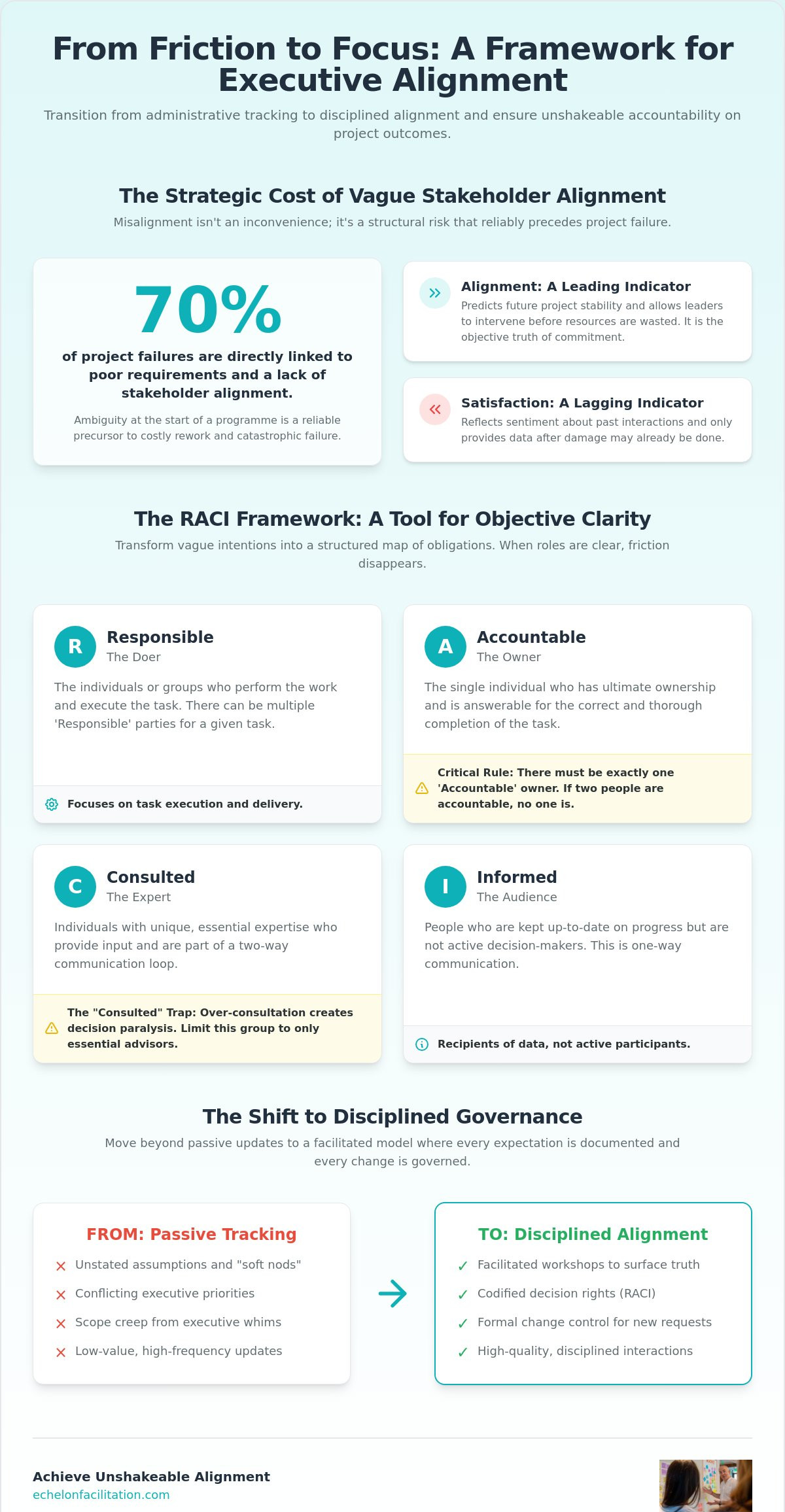
Most organisations mistake stakeholder satisfaction for project health. Satisfaction is a lagging indicator; it reflects sentiment regarding past interactions. True alignment is a leading indicator that predicts future stability. Vague agreements or "soft" nods in boardrooms create hidden friction that eventually manifests as scope creep. Learning how to manage stakeholder expectations requires moving past these unstated assumptions toward objective truth. A leading indicator like alignment allows a leader to intervene before resources are wasted, whereas satisfaction only provides data when the damage is already done.
The Price of Misalignment in Executive Teams
Misalignment is not merely an inconvenience; it is a structural risk. Industry data suggests that roughly 70% of project failures are directly linked to poor requirements and a lack of stakeholder alignment. Consider a global logistics firm that recently halted a major digital transformation. The project lost six months of progress and significant capital because a single board member held an unvoiced expectation regarding legacy system integration. The board member assumed the new platform would mirror the old interface exactly, a detail never explicitly discussed during initial workshops. Because this expectation wasn't surfaced early, the entire architecture required a costly redesign. In executive environments, a clear "No" is always superior to a vague "Maybe". Ambiguity at the start of a programme is a reliable precursor to catastrophic failure.
Moving Beyond the Communication Plan
Traditional Stakeholder management often relies on high-frequency, low-value updates. Sending a weekly status report doesn't ensure alignment; it often masks its absence. High-quality, disciplined interactions are essential. Success depends on facilitation that forces executives to confront trade-offs. If a stakeholder's request conflicts with the core objective, it must be addressed immediately through a Strategy Sprint or a similar alignment mechanism. Passive observation is the enemy of delivery.
Implementing the RACI Framework for Objective Clarity
Alignment collapses when individual roles are left to interpretation. The RACI framework; Responsible, Accountable, Consulted, and Informed; serves as a primary tool for expectation discipline. This tool transforms vague intentions into a structured map of obligations. Understanding how to manage stakeholder expectations requires a granular approach to these categories. Without this structure, executive teams often drift into a state of collective indecision where everyone is involved but no one is truly answerable.
Defining Decision Rights and Ownership
Ambiguity is the enemy of execution. In high-stakes environments, the critical difference between being Accountable and being Responsible must be enforced. Responsibility refers to those who execute the task; accountability belongs to the one person who must ensure its completion. Every project task or decision must have exactly one Accountable owner to avoid the diffusion of responsibility. When two people are accountable, no one is. Leaders should utilise a Decision-Rights Reset to codify these boundaries during a strategy offsite. A standard matrix for these sessions lists strategic pillars on the vertical axis and executive roles on the horizontal axis, ensuring no pillar has multiple "A" designations.
Avoiding the "Consulted" Trap
Over-consultation is a common failure mode that dilutes expectations and leads to decision paralysis. Including too many stakeholders in the Consulted category creates a culture of consensus-seeking that slows momentum. Limit this group to individuals with essential, unique expertise. Socialising the final RACI matrix amongst the executive team prevents future overlap and ensures that Informed parties understand they are recipients of data, not active decision-makers. If your leadership team struggles with ownership, a structured Transformation Alignment session can restore clarity and speed. Maintaining this discipline prevents senior board members from overstepping their defined roles during the delivery phase.
Facilitating the Expectation Reset Workshop
Expectations diverge over time. Red flags include recurring debates over previously settled decisions, inconsistent feedback from board members, or a sudden surge in urgent, out-of-scope requests. When these signals appear, a passive approach fails. You must pause to reset the baseline. Understanding how to manage stakeholder expectations effectively involves a three-step workshop process designed to extract objective truth.
First, surface the current reality by documenting all conflicting expectations without judgement. List every assumption regarding timelines, deliverables, and resource allocation on a shared visible surface. Second, facilitate a trade-off session. Executives cannot have everything; they must choose between competing priorities such as speed versus quality or cost versus breadth. Finally, formalise the new baseline. Obtain an explicit, public commitment from every party to ensure no one can later claim they were unaware of the agreed direction.
Surfacing Hidden Agendas through Neutral Facilitation
Power imbalances often suppress honest dissent. An external facilitator neutralises these dynamics, creating a space where objective truth outweighs seniority. Use the Pre-Mortem exercise to ask stakeholders exactly how the project will fail six months from now. This technique forces the disclosure of hidden risks and unvoiced concerns that standard status meetings miss. It shifts the focus from defending personal positions to protecting the collective objective.
Formalising the Agreement
A verbal agreement is insufficient for high-stakes delivery. Create a written Expectation Charter that outlines the agreed trade-offs and decision rights. This document serves as the foundation for establishing high performing executive teams that operate with total clarity. Once signed, this charter becomes the primary reference point for all future governance. It provides the project leader with the authority to reject requests that deviate from the agreed baseline without a formal change control process.
To secure this level of alignment for your next programme, consider a Problem-Solving & Innovation Workshop to reset your strategic trajectory.
Sustaining Alignment through Disciplined Governance
Sustaining alignment requires a deliberate shift from managing individual personalities to managing the governance process itself. This is the final stage in mastering how to manage stakeholder expectations effectively. When alignment is treated as a repeatable procedure rather than a series of negotiations, it becomes resilient to executive turnover or shifting market conditions. Leaders who prioritise process over personality ensure that project objectives remain stable regardless of internal politics.
Establish a change control mindset for all expectations. Any shift in an executive's requirement must be processed as a formal change in scope. If a board member suddenly prioritises a new metric, the project leader must present the impact on existing deliverables immediately. This discipline prevents the slow erosion of project boundaries that leads to failure. It forces stakeholders to confront the reality that every new demand has a corresponding cost in time or quality.
Integrate these expectation reviews into regular leadership team decision making sessions. Alignment is not a peripheral activity; it is the core of strategic execution. Personal accountability is the only solution to organisational friction. Leaders must own their part in maintaining the agreed boundaries, resisting the urge to bypass established governance for short-term gains.
The 30-Day Execution Review
A reset is only effective if it survives the first month of implementation. Use a structured review at the 30-day mark to verify that the expectations established in the workshop are being met in practice. This review mirrors the rigour required for a 30-day execution plan, ensuring that early deviations are corrected before they become entrenched habits. If alignment is slipping, the governance process must trigger an immediate intervention.
Building a Culture of Radical Clarity
Managing expectations is a cultural discipline, not a one-off event. Success depends on an environment where objective truth is valued over comfortable narratives. In high-stakes leadership dynamics, the ability to speak clearly about trade-offs is a strategic lever. When a team operates with radical clarity, friction decreases and velocity increases. This culture of discipline ensures that the collective effort remains focused on the practical fulfilment of objectives rather than the management of individual egos.
Securing Long-Term Strategic Cohesion
Alignment is not a destination but a continuous state of operational readiness. It requires moving beyond the comfort of vague agreements to the rigour of objective truth. By implementing a structured RACI framework and facilitating regular expectation resets, leaders can eliminate the friction that typically derails complex programmes. This transition from administrative tracking to disciplined strategic alignment ensures that executive accountability remains the foundation of project success.
Understanding how to manage stakeholder expectations effectively means treating every shift in requirement as a formal change in scope. This level of governance protects your resources and maintains the integrity of your original objectives. When you prioritise the process of alignment over the management of individual personalities, you create a resilient environment where delivery becomes predictable. High-performing teams don't rely on luck; they rely on a culture of radical clarity and personal responsibility.
Echelon has facilitated over 500 executive sessions as specialists in high-stakes decision-making. Based in the UK with a global reach, we provide the neutral facilitation required to surface hidden agendas and secure total commitment. Book a Leadership Team Alignment Session with Echelon to reset your strategic trajectory and ensure your leadership team operates with unwavering clarity. Your objectives are achievable when the entire board is moving in the same direction.
Frequently Asked Questions
How do you handle a stakeholder whose expectations are fundamentally unrealistic?
Surface the impossibility through data-driven trade-offs immediately. If a stakeholder demands a timeline that contradicts resource capacity, present the objective conflict without apology. Force a choice between scope, quality, and time. This disciplined approach removes emotion from the conversation and focuses the executive team on the practical limitations of the current delivery plan.
Can you manage expectations without a formal RACI framework in place?
You can attempt to manage expectations through informal agreements, but you risk the diffusion of responsibility. A formal framework like RACI provides the necessary discipline to prevent overlap and ensure individual accountability. Without it, you rely on individual memory and goodwill; both are unreliable variables in high-stakes environments where priorities shift rapidly.
What is the most effective way to communicate a negative change in project expectations?
Deliver the news directly and immediately with a focus on the impact on the final objective. Avoid emotional hyperbole or lengthy excuses. State the change, the cause, and the adjusted plan with stoic clarity. This approach maintains professional stability and ensures the leadership team remains focused on the solution rather than the setback.
How frequently should a leadership team review its stakeholder alignment?
Review alignment at least monthly during standard leadership sessions to ensure no unvoiced expectations have surfaced. High-stakes programmes often require fortnightly checks to maintain velocity. These reviews are a core part of how to manage stakeholder expectations over the long term, as they allow for the early correction of minor deviations before they become entrenched failures.
What happens if a primary stakeholder refuses to commit to the agreed-upon expectations?
Pause the project or escalate the conflict to the highest decision-making body within the organisation. Proceeding with a primary stakeholder who refuses to commit is a guaranteed precursor to failure. Use a neutral facilitator to resolve the underlying friction and surface the objective truth. You cannot deliver success whilst a key leader remains fundamentally misaligned with the project's core objectives.

Article by
Andrew Greenland
Dr Andrew Greenland is the founder of Echelon Facilitation, a UK practice that designs and runs high-stakes leadership sessions for executive teams who need decisions, not more discussion.
A medical doctor and medical educator, Andrew brings a clinician's discipline to the messy, political work of leadership alignment - surfacing the real disagreement, forcing the real choices, and ensuring every session produces a documented decision log with named owners and deadlines.
He works with CEOs, executive teams, transformation leads, and boards across the UK and internationally. Based in Twickenham.