
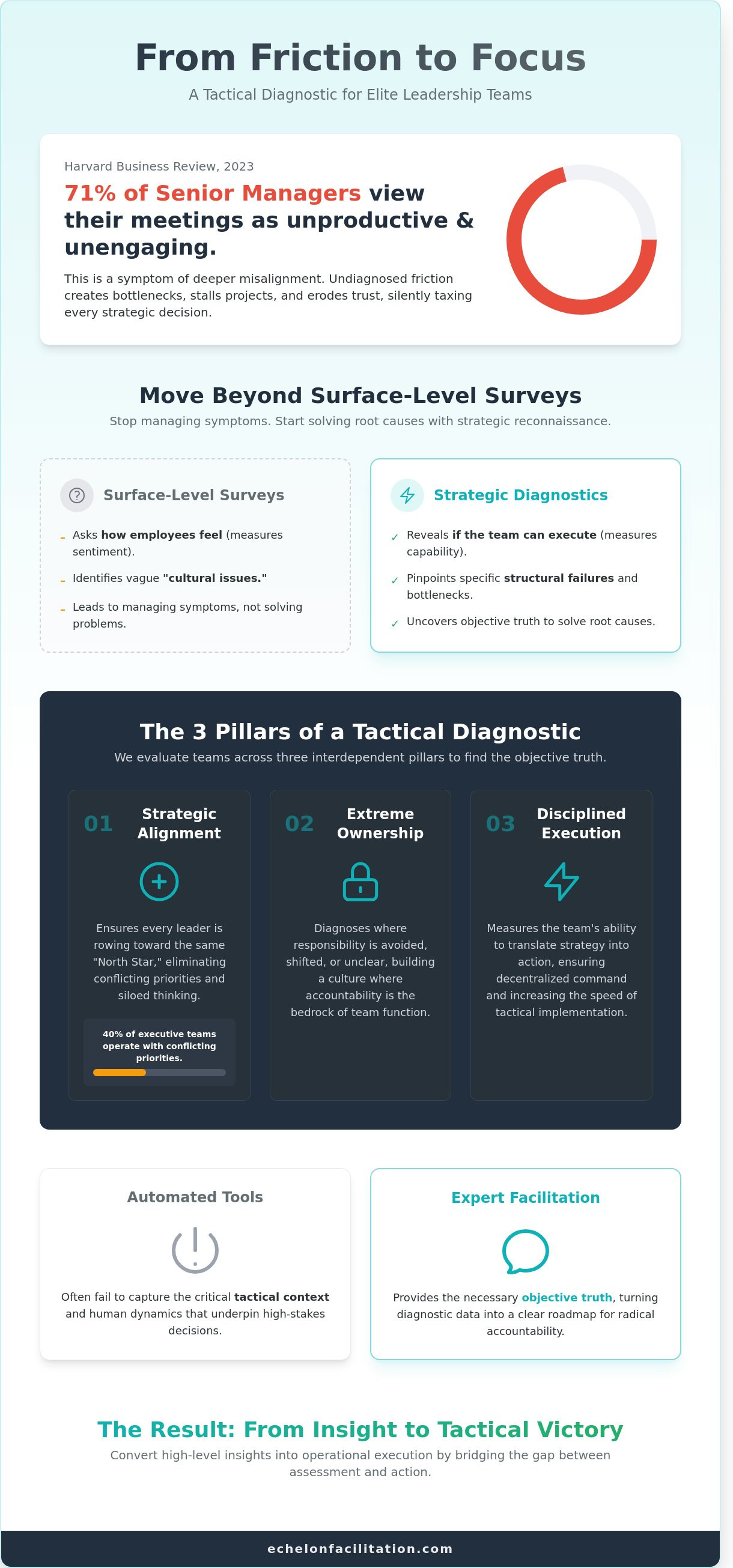
A 2023 Harvard Business Review analysis revealed that 71% of senior managers view their team's meetings as unproductive, a clear symptom of deep-seated strategic drift. You've likely felt this friction when decision-making bottlenecks stall your momentum or when vague cultural issues resist standard HR solutions. It's a reality where a lack of cohesion at the top creates a ripple effect of hesitation throughout the entire chain of command. To fix this, you must move beyond surface-level observations and employ rigorous leadership team diagnostics to find the objective truth of your operations.
This guide details how to transition from generic surveys to high-stakes diagnostics that identify specific constraints and drive extreme ownership. You'll gain a clear map to transform executive hesitation into a tactical advantage that serves the mission. We will examine the frameworks required to achieve radical alignment on your core objectives and implement decentralized command to increase your speed of execution. It's time to stop managing symptoms and start solving the leadership gaps that hold your organization back.
Key Takeaways
- Shift from surface-level surveys to strategic reconnaissance that pinpoints the root causes of friction within the executive ranks.
- Utilize leadership team diagnostics to assess the three pillars of mission success: alignment, ownership, and execution.
- Discover why expert facilitation provides the tactical context and objective truth that automated tools often fail to capture.
- Define "Mission Intent" to transform diagnostic data into a roadmap for radical accountability and disciplined leadership.
- Convert high-level insights into tactical victories by bridging the gap between organizational assessment and operational execution.
Beyond Surveys: Why Leadership Team Diagnostics are Strategic Reconnaissance
Strategic success isn't a result of luck; it's the byproduct of precise alignment at the executive level. Leadership team diagnostics represent a rigorous assessment of executive health, moving past the surface-level metrics found in standard HR tools. While a generic engagement survey might tell you how employees feel, a diagnostic reveals whether your top tier is capable of executing the mission. It functions as strategic reconnaissance, identifying the hidden obstacles that prevent a team from operating as a single, cohesive unit.
Vague friction is the primary enemy of execution. It manifests as slow decision cycles, duplicated efforts, and a lack of accountability. Without a clear diagnostic, leaders often mistake these symptoms for personality clashes or poor culture. In reality, they're usually structural failures in how the team processes information and assigns ownership. Before launching a high-stakes turnaround or a new market entry, a diagnostic is a prerequisite. You wouldn't send a unit into the field without intelligence; you shouldn't lead a company without a clear map of your team's internal dynamics.
The Cost of Undiagnosed Misalignment
Executive indecision creates a ripple effect that slows the entire organization. A 2023 report from the Harvard Business Review indicated that 61% of executives believe their leadership teams aren't aligned on strategy. This gap isn't just frustrating; it's expensive. When the top tier hesitates, projects stall and market opportunities vanish. Misalignment at the summit cascades into organizational paralysis, where mid-level managers stop taking initiative because they lack clear direction. Misalignment is a silent tax on every strategic decision your team makes. It drains resources and erodes the trust necessary for decentralized command.
Moving from "Culture" to "Tactical Clarity"
Effective leadership requires moving from soft cultural metrics to hard performance indicators. We treat the human element as a strategic lever rather than an HR problem to be managed. By utilizing established team effectiveness models, we can quantify how well a group functions under pressure. These diagnostics identify specific bottlenecks in leadership team decision making, such as information silos or a lack of radical candor. When you apply leadership team diagnostics, you stop guessing why things aren't working. You gain the tactical clarity needed to optimize your roster and ensure every member is fully committed to the collective objective.
The 3 Pillars of a Tactical Diagnostic: Alignment, Ownership, and Execution
The Echelon framework for leadership team diagnostics operates on a single premise: effectiveness is a byproduct of discipline. We evaluate teams through three interdependent pillars that provide the objective truth required for mission success. These pillars don't exist in isolation. If one fails, the entire structure collapses. Our diagnostic process identifies decentralized command failures where the commander's intent is lost between the boardroom and the front line. These results serve as the necessary baseline for high-stakes workshop facilitation, ensuring that every session addresses the root causes of friction rather than just symptoms.
Pillar 1: Strategic Alignment
Strategic alignment requires every leader to row toward the same North Star. It's common to find that 40% of executive teams operate with conflicting priorities despite sitting in the same weekly meetings. Our diagnostic detects hidden agendas and siloed thinking that hamper the collective goal. We look for the attributes of high performing teams, ensuring every department head understands how their specific operational mission supports the broader corporate objective. Without this clarity, effort is wasted on tasks that don't move the needle.
Pillar 2: Extreme Ownership
Accountability is the bedrock of a functional team. We diagnose where responsibility is being avoided or shifted to other departments. AHRQ's call to action for leadership highlights that creating collective accountability is a strategic imperative for high-stakes environments. We identify ownership gaps in cross-departmental initiatives where projects often stall. If a project fails, the team must take responsibility together. We look for leaders who own the outcome, not just their specific portion of the checklist. This mindset eliminates the "not my job" culture that kills momentum.
Pillar 3: Velocity of Execution
Speed is a competitive advantage. We measure the specific time from "decision made" to "action taken." Bureaucratic friction often slows this momentum, turning a three-day task into a three-month project. We analyze how confidence in leadership directly impacts this speed. When teams trust their leaders and the strategic plan, they move with conviction. High-velocity execution is impossible without the first two pillars. If the diagnostic reveals a lag in execution, it usually points back to a lack of alignment or a failure in ownership.
Identifying these gaps is the first step toward reclaiming operational control. If your team is struggling with fragmented goals or slow response times, consider how strategic alignment workshops can bridge the distance between your current state and mission success.
Automated Tools vs. Expert Facilitation: Choosing Your Diagnostic Method
Selecting the right methodology for leadership team diagnostics determines whether you receive a superficial report or a roadmap for victory. You must choose between the speed of automated tools and the depth of expert-led intervention. Executive teams often mistake data for insight. Raw numbers lack the tactical nuance required to solve complex interpersonal friction. In high-stakes environments, objective truth is the only currency that matters. You cannot build a resilient mission on a foundation of misinterpreted statistics.
The choice between a digital survey and a human expert isn't just about cost. It's about the level of truth you're prepared to handle. Automated tools offer a safe, distanced view of the organization. Facilitation forces a direct confrontation with the operational realities that hold your team back. For a leadership team to achieve true alignment, they must move past the comfort of a dashboard and into the discipline of a structured diagnostic process.
When a Survey Is Enough
Surveys serve a specific, limited purpose. They work well for low-stakes pulse checks or gathering broad feedback from a workforce of 500 or more. However, they possess a critical flaw in executive settings. Anonymized data allows leaders to hide. It fails to capture the unspoken truths that dictate boardroom behavior. A survey might show that 65% of your team feels the mission is unclear, but it cannot explain the specific power struggle or lack of ownership causing that gap. Automated tools provide a snapshot of the surface. They don't have the capacity to dig into the root causes of systemic failure or the subtle nuances of decentralized command.
The Facilitator-Led Advantage
Expert facilitation provides the objective truth that automated tools miss. A facilitator uncovers the "why" behind the "what" by observing team dynamics in real-time. During facilitated workshops, a trained professional identifies the subtle cues, the defensive postures, and the avoided topics that stall progress. This method demands accountability from every individual in the room. It forces leaders to confront the reality of their performance rather than hiding behind a percentage. A survey records the symptoms; a facilitator diagnoses the disease.
This human-led approach is the gold standard for teams facing high-stakes transitions or deep-rooted friction. It moves beyond passive observation into active strategic alignment. When you prioritize expert facilitation, you aren't just collecting data. You're initiating a tactical process that transforms friction into execution. A facilitator bridges the gap between high-level strategy and the operational reality of leading a team under pressure. They ensure that every member of the leadership team takes extreme ownership of the resulting solution, ensuring that the diagnostic leads to action rather than a forgotten file on a hard drive.
Executing the Diagnostic: From Observation to Radical Accountability
Execution transforms raw data into a tactical advantage. The process begins with Phase 1: Preparation and Mission Intent. You must define exactly what a successful diagnostic looks like for your specific operational context. This isn't about general improvement; it's about identifying the specific friction points preventing mission success. Phase 2 moves into rigorous data gathering. We utilize deep-dive interviews, direct observation of high-stakes meetings, and structured assessments to map the team's current state. This phase uncovers the delta between perceived performance and actual output.
Phase 3 is the "Truth Session." This is where we present the mirror to the team. It's an objective delivery of findings that strips away comfortable narratives. Finally, Phase 4 codifies the solution by establishing a Team Charter. This document serves as the tactical manual for how the team will operate, communicate, and hold one another accountable. It's the foundation of radical alignment.
Managing Defensiveness During the Reveal
Truth often triggers a defensive reflex. Leaders must approach leadership team diagnostics with an Extreme Ownership mindset. If the team is misaligned, the leader must take responsibility for the conditions that allowed it. The facilitator acts as a neutral arbiter of reality; they don't take sides, they only report the terrain. In a 2023 study of executive teams, those who adopted radical transparency during feedback sessions saw a 25% faster resolution of internal friction compared to those who avoided hard truths.
Identifying the "Constraints" to Growth
Effective leadership team diagnostics identify the single "bottleneck" to growth. Is it a structural flaw in reporting lines or an interpersonal breakdown in trust? You must prioritize the single biggest hurdle first. Fixing three minor issues while ignoring one catastrophic constraint is a failure of leadership. This process forces a perspective shift for the entire board, moving them from siloed thinking to a unified mission focus. We don't just find problems; we identify the leverage points that will move the needle.
Prioritizing fixes requires a cold assessment of ROI. Structural issues, such as overlapping authorities, often require immediate policy shifts. Interpersonal issues require disciplined, ongoing coaching. Successful teams address the structural "plumbing" first to ensure the environment supports the necessary behavioral changes. This methodical approach ensures the diagnostic leads to execution rather than just another report on a shelf.
To begin the process of aligning your senior leaders through a disciplined diagnostic framework, explore our strategic alignment workshops.
Strategic Re-alignment: Turning Diagnostic Insights into Mission Success
Data without direction is a tactical failure. A leadership team diagnostics report provides the coordinates; it does not drive the vehicle. Many organizations treat the diagnostic phase as the finish line. This is a mistake that leads to stagnation. For the insights to matter, they must be converted into a rigorous execution plan that demands total accountability from every member of the executive suite. Identification is not correction. Analysis without execution is a liability.
Echelon bridges the gap between raw data and operational victory by integrating these findings into long-term facilitation services. We don't just identify friction; we provide the framework to eliminate it. Strategic alignment requires a consistent cadence of re-checks. Under pressure, teams often revert to old habits. Establishing a quarterly review cycle ensures that the mission remains the primary focus even when market conditions shift. Victory depends on the discipline to revisit the data when the stakes are highest.
Building the Action Plan
The first 30 days post-diagnostic are critical for building momentum. Teams must identify and win the easy battles first. This might include clarifying a single ambiguous reporting line or standardizing a communication protocol. Every finding requires a designated owner. If three people are responsible for a metric, nobody is. By the 90-day mark, success looks like a 20% reduction in meeting friction or a measurable increase in decentralized decision-making speed across the department.
- Immediate Ownership: Assign one lead to every diagnostic action item to ensure nothing falls through the cracks.
- The 30-Day Sprint: Execute three high-impact, low-complexity changes to prove the process works and build internal trust.
- The 90-Day Review: Measure progress against the baseline established during the initial leadership team diagnostics phase to validate the ROI of the intervention.
The Echelon Approach to Team Victory
Echelon Facilitation operates with the discipline of a tactical unit. We don't offer fluff or comfortable narratives. Our background is in running high-stakes working sessions where clarity is the only currency that matters. We invite you to schedule a complimentary diagnostic call to assess your current operational state and identify the gaps in your alignment. This call provides an objective look at your team's health without the filter of internal politics. Ownership starts with the courage to look at the data. It ends with the discipline to act on it.
Secure Your Strategic Advantage Through Radical Accountability
Leadership isn't a matter of chance; it's a discipline of objective truth. Effective leadership team diagnostics move beyond surface-level surveys to provide the strategic reconnaissance necessary for mission success. You now understand that alignment, ownership, and execution form the bedrock of a high-performing board. By choosing expert facilitation over automated tools, you prioritize the human element of leadership. This approach ensures that every team member accepts extreme ownership of the collective objective.
UK-based facilitator Dr Andrew Greenland is a medical doctor who has spent years running large, high-stakes working sessions for senior expert groups, and he designs and leads every engagement. He applies structured workshop methods to reduce organisational friction and drive tactical clarity. Don't let strategic drift compromise your operational reality. It's time to transform diagnostic insights into a decisive victory for your organization. Expert guidance ensures your strategy survives the first contact with reality.
Book a Complimentary Diagnostic Call with Echelon Facilitation
Your team possesses the capability to lead with unwavering clarity; now is the moment to provide them with the alignment they deserve.
Frequently Asked Questions
What is the difference between a team assessment and a leadership team diagnostic?
A team assessment focuses on individual personalities and interpersonal dynamics, while leadership team diagnostics evaluate the team's ability to execute the mission and achieve strategic alignment. Assessments often rely on psychometric data from tools like the 1962 Myers-Briggs Type Indicator. Diagnostics examine operational friction and decision-making speed. You use a diagnostic when the objective is 100% mission success rather than just improved social cohesion.
How long does a full leadership team diagnostic process typically take?
A comprehensive diagnostic process typically spans 4 to 8 weeks from initial data collection to the final debrief. This timeline includes 10 days for anonymous surveys and 3 days for intensive stakeholder interviews. Rapid execution is critical to maintain momentum. If the process exceeds 60 days, the data becomes stale and the team loses focus on the necessary tactical adjustments.
Will our diagnostic results be shared with the entire organisation?
Diagnostic results remain confidential within the leadership team to ensure 100% honesty during the evaluation. Sharing raw data with the broader organisation often creates unnecessary friction and undermines the 360-degree feedback loop. Instead, leaders should communicate the high-level action plan within 14 days of the diagnostic completion. Transparency regarding the mission is essential, but the internal mechanics of leadership development require a secure environment.
Can a diagnostic help if there is significant interpersonal conflict on the board?
A diagnostic resolves conflict by shifting the focus from personal grievances to objective mission requirements. By identifying the 5 core areas of strategic misalignment, the process forces board members to take extreme ownership of their roles. Data from the 2023 Harvard Business Review suggests that 70% of board conflict stems from unclear decision-making rights. The diagnostic provides the tactical clarity needed to neutralize these disputes through structured accountability.
How often should a high-performing team undergo a diagnostic check?
High-performing teams should conduct leadership team diagnostics every 12 to 18 months to prevent complacency. Even the most elite units experience drift in strategic focus over a 365-day period. Regular diagnostics serve as a tactical reset, ensuring that decentralized command structures remain effective. Scheduling these sessions alongside annual strategy reviews maintains a consistent rhythm of execution and keeps the team calibrated for long-term victory.
Is an external facilitator necessary, or can HR perform the diagnostic?
External facilitators are necessary because they provide the objective truth that internal HR departments often struggle to deliver. An outside expert isn't tethered to internal politics or reporting lines, allowing for 100% candor. While HR can manage the logistics, an external lead ensures that the diagnostic doesn't become a "check-the-box" exercise. This separation of power is vital for maintaining the integrity of the feedback loop and ensuring total ownership.
What happens if a leader refuses to accept the findings of the diagnostic?
If a leader rejects the findings, it becomes a matter of accountability and alignment with the mission. The diagnostic data provides an objective mirror that individual opinions cannot easily dismiss. In 90% of cases, refusal to accept data indicates a lack of extreme ownership. The CEO must then decide if that individual's resistance poses a 10/10 risk to the team's strategic objectives and overall execution.