
Most strategic planning sessions are little more than expensive theatre where executives trade polite nods before returning to their functional silos. You understand the frustration of concluding a three-day offsite with a glossy document that fails to drive a single tangible change in operational behaviour. The role of a facilitator in strategic planning is to dismantle this passivity and replace it with a disciplined engine for organisational execution.
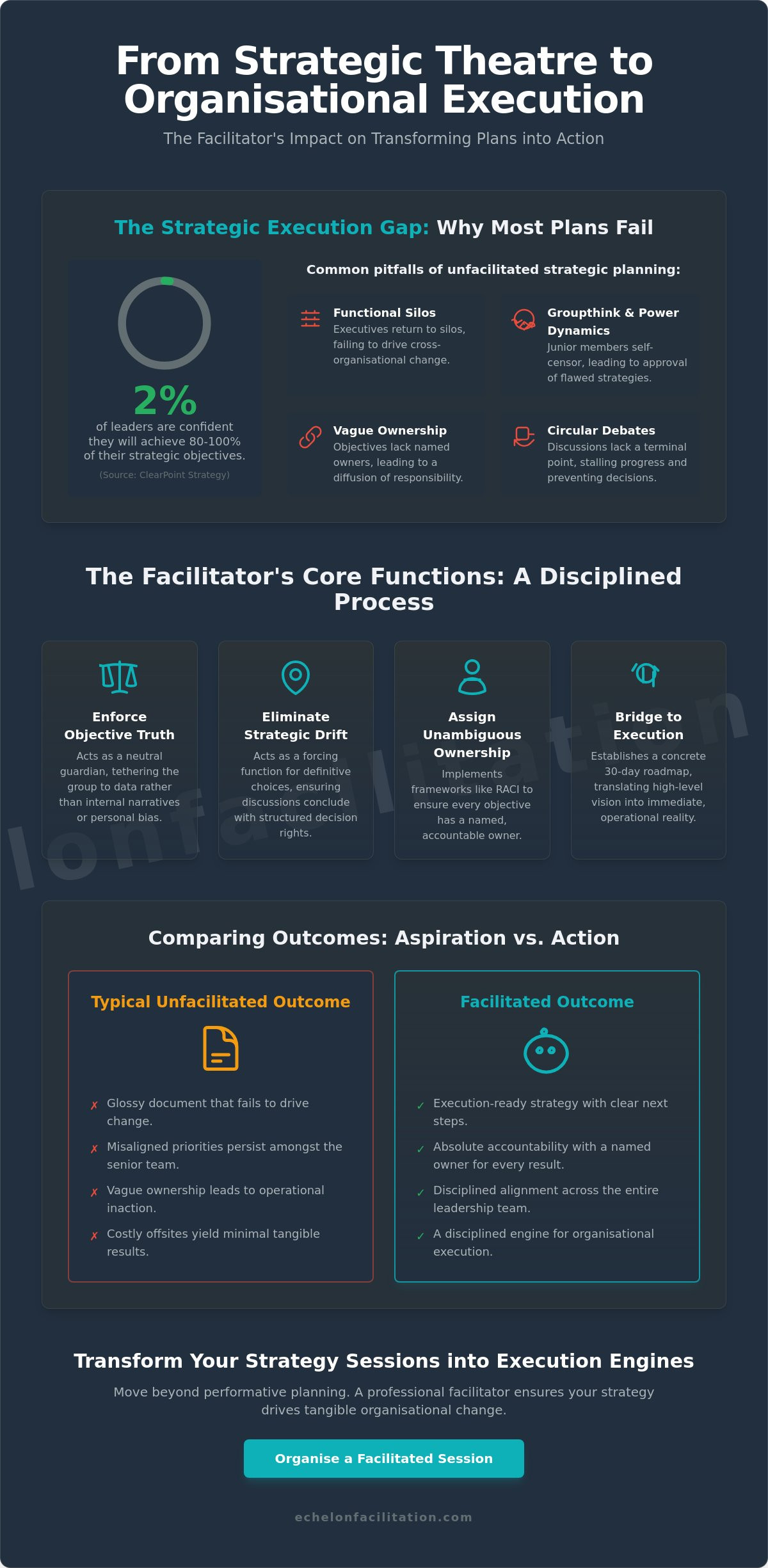
Failure to execute represents a systemic drain on resources. Research from ClearPoint Strategy indicates that only 2% of leaders are confident they will achieve 80 to 100% of their strategic objectives. This lack of confidence stems from vague ownership and misaligned priorities amongst the senior team. When leadership spends less than one day a month reviewing strategy, the cost is measured in lost market share and wasted capital. A professional facilitator forces the uncomfortable conversations necessary to bridge this gap and ensures every objective has a named owner.
This article examines how a neutral third party challenges flawed assumptions and enforces unambiguous ownership of results. You will learn the mechanics of transforming a passive discussion into an execution-ready strategy that drives accountability across the entire organisation.
Key Takeaways
- Discover how an external expert neutralises internal power dynamics to surface objective truths and challenge comfortable organisational narratives.
- Identify the specific decision rights required to eliminate strategic drift and move beyond circular debates that stall progress.
- Understand how the role of a facilitator in strategic planning utilises the RACI framework to ensure absolute accountability for every key result.
- Establish a concrete execution roadmap for the first 30 days to bridge the gap between high-level vision and operational reality.
The Core Role of a Facilitator in Strategic Planning: Enforcing Objective Truth
The role of a facilitator in strategic planning extends far beyond managing a meeting agenda. A professional facilitator acts as the guardian of the strategic process, ensuring that the group remains tethered to objective reality rather than internal narratives. Whilst internal leaders often struggle to separate their personal biases from the organisational goals, an external expert maintains a disciplined focus on the intended outcome. This objective stance allows for a rigorous examination of the facts, preventing the session from devolving into a performative exercise.
Internal facilitation frequently fails because of established power dynamics and the pervasive threat of groupthink. When a senior executive leads the session, junior members often self-censor to avoid conflict or perceived insubordination. This creates a dangerous feedback loop where flawed strategies are approved simply because no one felt empowered to challenge them. Our how we work methodology addresses this by establishing a neutral environment where the hierarchy is temporarily suspended in favour of strategic clarity.
Consider a hypothetical scenario involving a major UK retail board. The leadership team has been deadlocked for months over a digital transformation initiative. Each department head holds conflicting assumptions about customer behaviour and technical requirements, yet these disagreements remain unspoken. A neutral third party can surface these hidden tensions and get the board to confront the data directly, which is often what breaks the deadlock and allows for a unified execution plan.
Neutrality as a Strategic Asset
An external facilitator provides a "safe container" for high-stakes debate. They ensure that challenging the status quo is done with professional decorum rather than personal animosity. Because the facilitator has no stake in internal politics or future promotions, they can remain composed under pressure. This neutrality is a strategic lever that encourages honest participation from every member of the leadership team. It ensures the focus remains on the collective success of the organisation.
Challenging Executive Assumptions
The facilitator's primary duty is to ask the uncomfortable questions that internal staff avoid. This requires a perspective shift to break through the cognitive biases that often cloud executive judgment. By questioning the "way we've always done it," the facilitator forces the team to justify their positions with evidence rather than intuition. This process ensures that the final strategy is built on a foundation of verified truth, not just historical habit.
Eliminating Strategic Drift through Structured Decision Rights
Strategic drift occurs when executive discussions lack a terminal point. Without a structured conclusion, meetings become "talking shops" where ideas circulate but never land. The role of a facilitator in strategic planning is to act as a forcing function for definitive choices. If a session concludes without explicit decision rights, the resulting document is merely a list of aspirations. A professional facilitator identifies where these rights are blurred or contested, ensuring that every strategic move has a designated authority. This rigorous approach to leadership team decision making prevents the ambiguity that often stalls organisational progress.
The Mechanism of Group Consensus
Moving from divergent thinking to convergent action requires more than a simple show of hands. Facilitators use specific techniques to narrow down options and force a selection. In high-stakes environments, seeking a "unanimous" vote is often counterproductive; it encourages compromise and dilutes the strategy. Instead, the focus is on being "aligned." This means that whilst every leader may not have had their first choice selected, they commit to the final decision with total organisational discipline.
Preventing Post-Session Inertia
Executive teams often suffer from "selective memory" once they leave the offsite. To counter this, the facilitator captures every critical decision in real-time. This documentation includes the specific "why" behind each choice. Recording the underlying logic ensures that the team remains committed to the path even when market pressures tempt a return to old habits. Ultimately, the role of a facilitator in strategic planning is to ensure that the strategy is a tool for action, not just a document for the shelf. If your leadership team struggles with circular debates, a Strategy Sprint can provide the necessary reset to your decision-rights framework.
Implementing the RACI Framework for Unambiguous Ownership
Accountability is the bedrock of strategic execution. The role of a facilitator in strategic planning is to strip away the ambiguity of "shared goals" and replace it with individual responsibility. Many organisations fall into the trap of collective ownership; they assume that if the entire team is responsible, the work will naturally progress. In reality, shared responsibility usually equates to zero accountability. A professional facilitator dismantles this myth by enforcing a structure where every objective has a single, named owner.
To achieve this, the facilitator introduces the RACI framework. This matrix categorises involvement into four distinct levels: Responsible, Accountable, Consulted, and Informed. The most critical rule enforced during the session is that only one individual can hold the "Accountable" status for any given task. This prevents the diffusion of responsibility that often leads to strategic failure. According to research cited by Harvard Business Review, 40% of strategic initiatives fail specifically because of unclear individual accountability. By identifying the "A" in RACI, the facilitator ensures there is a single point of contact for every high-stakes objective.
Mapping the Strategic Plan to Individual Responsibility
During a Strategy Sprint, the facilitator maps each key result to a specific executive. This process often surfaces latent friction amongst the leadership team. Two department heads might both believe they should lead a project; conversely, both might attempt to avoid it if the risks are high. The facilitator mediates these disputes by focusing on the objective requirements of the goal rather than internal politics. They ensure that the person with the most direct influence over the outcome accepts the accountability.
A practical RACI application during a session might look like this:
- Strategic Objective: Launching a new service line.
- Accountable (A): Chief Operating Officer (Sole decision-maker).
- Responsible (R): Product Development Lead (Executes the work).
- Consulted (C): Marketing Director, CFO.
- Informed (I): CEO, Board of Directors.
This structure ensures that when a deadline is missed or a target is bypassed, there is no confusion regarding where the responsibility lies. If your leadership team struggles with vague ownership, our Decision-Rights Reset can provide the structural clarity required to drive results.
Transitioning from Planning to Execution: The Facilitator’s Closing Impact
The role of a facilitator in strategic planning concludes only when the team establishes a clear path for the first 30 days of implementation. Most offsites fail because the momentum generated in the room is lost upon return to the daily operational grind. A professional facilitator prevents this by "Closing the Loop" before the session ends. This process converts raw workshop notes into a disciplined execution roadmap that specifies exactly who does what and by when. It ensures that the collective vision translates into immediate, measurable action.
The facilitator also sets the rhythm for ongoing accountability. They establish the frequency of progress reviews and the specific metrics that will signal success or failure. This structure provides a psychological bridge between the high-level strategy discussed during the retreat and the operational reality of leading a team. By defining these follow-up mechanisms, the facilitator ensures that the strategy remains a living priority rather than a forgotten document. This disciplined approach ensures that the investment in facilitation yields a tangible return in organisational performance.
Defining the First 90 Days
Success in the first quarter depends on the team's ability to prioritise the "vital few" actions over the "trivial many." A facilitator forces the executive team to make hard choices about which initiatives take precedence. This focus is a core component of a robust strategic planning process. By narrowing the scope to high-impact objectives, the facilitator ensures the organisation avoids the dilution of effort that leads to mediocrity. This final act of facilitation transforms a list of aspirations into a focused, execution-ready plan.
Ultimately, the role of a facilitator in strategic planning is to act as the architect of the transition. They ensure that the leadership team leaves the room not just with a plan, but with the specific commitments required to execute it. This transition is where strategic intent meets operational reality. Without this final, disciplined step, even the most brilliant strategy will fail to survive the first week of business as usual.
Securing Strategic Execution Through Disciplined Facilitation
Strategic planning fails when it remains a conceptual exercise. To drive real change, leadership teams must move beyond polite consensus and embrace the friction of definitive choices. The role of a facilitator in strategic planning is to act as the catalyst for this shift; ensuring that objective reality dictates the path forward and that every executive accepts unambiguous ownership of their results. By applying frameworks like RACI and defining a rigorous 30-day execution roadmap, you bridge the gap between high-level vision and operational success.
Organisational cohesion is not a product of chance; it is the result of a disciplined process that prioritises the vital few objectives over the trivial many. A professional facilitator ensures that your senior team remains focused on these priorities whilst navigating the interpersonal dynamics that often stall progress. Echelon Facilitation, founder-led by Dr Andrew Greenland, a medical doctor who has spent years running large, high-stakes working sessions for senior expert groups, specialises in high-stakes executive alignment. We provide the neutral authority required to challenge assumptions and enforce the accountability necessary for your organisation to thrive.
Ready to transform your planning sessions into a disciplined engine for results? Book a Strategic Diagnostic Call with Echelon Facilitation and ensure your next strategy is execution-ready. Build a leadership team that delivers on its promises.
Frequently Asked Questions
How does a facilitator handle conflict between strong-willed executives?
A facilitator manages executive conflict by depersonalising the debate and refocusing the team on objective data. They establish ground rules that prioritise organisational health over individual ego. If a discussion becomes circular or aggressive, the facilitator intervenes to identify the underlying assumption causing the friction. This ensures that the conflict becomes a productive tool for clarifying strategy rather than a destructive force that stalls progress.
Can we use an internal facilitator for our strategic planning?
Whilst using an internal staff member is possible, it often compromises the strategic process. Internal facilitators usually lack the perceived neutrality required to challenge senior leadership or manage peer-to-peer conflict effectively. The role of a facilitator in strategic planning requires an external perspective to bypass existing power dynamics and groupthink. An external professional can ask uncomfortable questions without fear of internal repercussions or career impact.
What is the difference between a strategy consultant and a facilitator?
A strategy consultant typically provides the answers and industry benchmarks, whereas a facilitator guides the leadership team to discover and own their own solutions. Consultants focus on the content of the plan; facilitators focus on the process of alignment and the mechanics of accountability. Effective facilitation ensures that the leadership team remains the architect of the strategy, which significantly increases the likelihood of successful implementation.
How much time should a facilitated strategic planning session take?
A comprehensive strategic planning session typically requires between one and three days. A one-day session is suitable for a high-intensity Strategy Sprint or a specific Decision-Rights Reset. More complex organisational transformations or enterprise-level planning often require a two or three-day offsite to allow for deep diagnostic work, scenario testing, and the detailed mapping of accountability frameworks like RACI.
What happens if the team cannot reach an agreement during the session?
If a team cannot reach an agreement, the facilitator identifies the specific point of deadlock and forces a decision-rights reset. They clarify who holds the ultimate authority to make the choice and ensure that the rest of the team commits to the outcome. The primary role of a facilitator in strategic planning is to prevent circular debates by ensuring that every session ends with a definitive, documented choice that the entire leadership team supports.

Article by
Andrew Greenland
Dr Andrew Greenland is the founder of Echelon Facilitation, a UK practice that designs and runs high-stakes leadership sessions for executive teams who need decisions, not more discussion.
A medical doctor and medical educator, Andrew brings a clinician's discipline to the messy, political work of leadership alignment - surfacing the real disagreement, forcing the real choices, and ensuring every session produces a documented decision log with named owners and deadlines.
He designs Echelon’s sessions for CEOs, executive teams, transformation leads and boards. Based in Twickenham.