
Your leadership team spends ninety minutes debating a critical pivot, yet the meeting concludes with three different interpretations of the next steps. This misalignment is not a personality clash; it is a breakdown in the mechanics of executive discourse that necessitates the intervention of a team communication workshop facilitator.
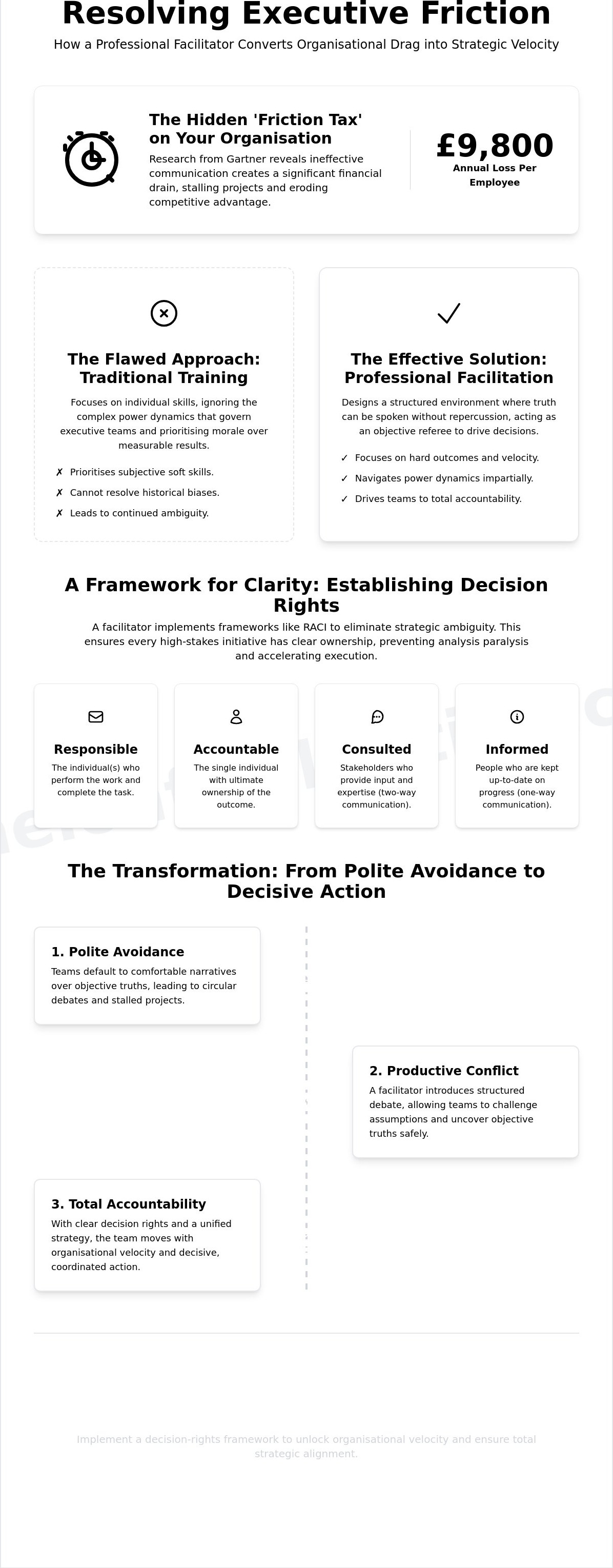
Gartner research estimates that ineffective communication costs businesses up to $12,506 per employee, per year. For an executive team, these losses manifest as stalled projects and fractured strategy. When leaders operate in silos, the resulting friction creates a drag on the entire organisation. Without a neutral expert to enforce clarity, leadership teams often default to comfortable narratives over objective truths. This structural failure prevents the rapid execution required to maintain a competitive advantage for the collective business team.
You likely recognise that fragmented communication at the top level is the primary bottleneck to your strategic execution. This article explains how professional facilitation converts leadership friction into a strategic lever for organisational velocity. We will examine the mechanics of decision rights, the reduction of cognitive friction, and the implementation of a framework for high-stakes discussions.
Key Takeaways
- Identify how cognitive friction amongst leadership creates organisational drag that diminishes operational speed across all departments.
- Recognise why an effective team communication workshop facilitator must act as an objective truth-teller to navigate complex power dynamics.
- Learn to apply the RACI framework during high-stakes sessions to establish clear decision rights and eliminate strategic ambiguity.
- Discover the mechanics of transitioning a board from polite avoidance to productive conflict to ensure absolute accountability.
The Financial Weight of Executive Communication Friction
Executive communication friction is the measurable gap between strategic intent and operational execution. It occurs when a leadership team lacks a unified understanding of priorities, causing departments to pull in diverging directions. This cognitive friction amongst senior leaders creates a pervasive organisational drag that slows every internal process, from product development to customer service. Engaging a team communication workshop facilitator allows a leadership team to diagnose these misalignments before they metastasise into systemic failure.
The fiscal impact of these failures is profound. Research highlights that poor communication costs large organisations between £7,000 and £23,000 per employee annually, with Gartner estimating the cost at up to $12,506 per employee. For a mid-sized enterprise, these figures represent an annual loss of millions in unrealised potential and wasted overhead. Communication friction is the primary inhibitor of executive alignment. Every hour spent in a circular boardroom debate without a clear resolution compounds this financial burden, eroding the organisation's bottom line whilst more cohesive competitors seize market share.
By formalising the business facilitation process, organisations can convert this lost capital into operational velocity. A team communication workshop facilitator identifies where executive intent becomes blurred, ensuring that high-level strategy translates into specific, accountable actions. This intervention moves the team from a state of passive observation to one of decisive, coordinated action.
Quantifying the Cost of Misalignment
Indecision at the executive level trickles down, manifesting as wasted resources and redundant effort at the front line. When a leadership team remains in a state of polite avoidance, the cost of their hesitation far exceeds the investment required for professional intervention. Contrast the fixed fee of a Problem-Solving & Innovation Workshop with the hidden, compounding cost of a failed strategic execution that delays market entry by six months. The latter often represents a ten-fold loss in potential revenue and a significant blow to organisational morale.
Why a Team Communication Workshop Facilitator Must Focus on Results
Traditional communication training often fails at the executive level. It operates on the flawed assumption that better individual skills automatically lead to collective success. In reality, leadership teams are governed by complex power dynamics and historical biases that individual upskilling cannot resolve. A professional team communication workshop facilitator does not merely teach people how to talk; they design the environment where truth can be spoken without repercussion.
Instead of focusing on subjective soft skills, our methodology prioritises the hard outcomes that drive organisational velocity. This is the central objective of a strategy sprint. Engaging a team communication workshop facilitator ensures that the group moves beyond the engagement-first model favoured by many competitors, which often prioritises team morale over strategic clarity. Leaders must understand The True Cost Of Poor Communication, which often involves the total stagnation of critical initiatives and the erosion of competitive advantage.
Our approach is rooted in disciplined authority. We do not facilitate for the sake of participation; we facilitate for the sake of decision. Every session is structured to move the team from ambiguity to a state of total accountability. If your leadership team is struggling with alignment, consider a Decision-Rights Reset to clarify who owns the final call on strategic priorities.
Facilitation vs. Training: A Necessary Distinction
Executive teams do not need another teacher. They require a referee. While training focuses on personal competence, facilitation focuses on group alignment and high-stakes decision-making. A team communication workshop facilitator ensures that the loudest voice does not dictate the strategy; the most logical one does. This requires a partner who values objective truth over comfortable narratives. By maintaining this separation, the facilitator remains an objective truth-teller who can challenge the status quo without being entangled in internal politics.
Choosing a Team Communication Workshop Facilitator for High-Stakes Sessions
Selecting a team communication workshop facilitator for the C-suite requires a shift in perspective. You are not hiring a generalist to improve "team spirit"; you are engaging a specialist to resolve strategic friction. A qualified facilitator must possess the intellectual weight to challenge senior leaders whilst maintaining the composure required to guide high-stakes discussions. They should demonstrate mastery of the Cynefin framework, which allows the team to categorise challenges as simple, complicated, complex, or chaotic. This distinction prevents the leadership team from applying reductive solutions to systemic organisational problems.
The right partner employs rigorous Facilitation Techniques to ensure every executive's perspective is tested against objective reality. This includes the use of intentional silence to allow for reflection and tracking to maintain focus on the primary objective. Our disciplined process ensures that workshops do not devolve into circular debates but instead move toward concrete commitments. If your leadership team is currently operating in silos, it is time to secure a Decision-Rights Reset to re-establish clear lines of authority.
The RACI Framework: Eliminating Ambiguity
A team communication workshop facilitator uses the RACI framework to assign clear ownership immediately following a decision. This model defines four distinct roles for every task or project:
- Responsible: The individual who performs the work.
- Accountable: The single person who owns the result and has the final "yes" or "no" authority.
- Consulted: Those whose opinions are sought before a decision is finalised.
- Informed: Those kept up to date on progress after the decision is made.
Shared accountability is often a mask for no accountability. In many executive teams, a lack of clarity regarding the "A" in RACI leads to stalled initiatives and finger-pointing when objectives are missed. A facilitator forces the team to name one individual as the accountable party for every strategic lever. This discipline removes the cognitive friction that occurs when leaders are unsure of their specific decision rights, allowing the organisation to move with greater speed and precision.
How a Team Communication Workshop Facilitator Resolves Strategic Friction
Consider a mid-sized financial services board struggling with a stalled digital transformation. For six months, the directors have engaged in polite avoidance, refusing to confront the reality that their legacy systems are incompatible with the proposed strategy. This stalemate creates significant organisational drag. By engaging a team communication workshop facilitator, the board can move from vague agreement to specific, actionable conflict. During a single eight-hour session, the facilitator strips away the layers of corporate diplomacy, asking each member to defend their position against objective data rather than departmental bias.
The facilitator’s primary function in this environment is to act as a steward of objective truth. They ensure that no critical observation remains unsaid for the sake of comfort. When a team communication workshop facilitator identifies a contradiction between a leader’s stated intent and their proposed actions, they must challenge it immediately. This process requires a neutral third party who is not influenced by internal hierarchies or the desire for future promotion. The result is a team that leaves the room with a singular, unambiguous direction.
From Productive Conflict to Executive Alignment
Productive conflict is the rigorous, unsentimental testing of ideas. It differs from personal animosity because it focuses entirely on the merit of the strategy rather than the character of the individual. A professional facilitator manages the heat in the room, ensuring that the tension remains high enough to spark a breakthrough whilst preventing it from devolving into unproductive hostility. This controlled friction is the only way to burn away the assumptions that prevent executive alignment.
Achieving this level of clarity requires a structured approach to communication. If your leadership team is currently trapped in a cycle of circular debates, it is time to intervene. You can begin this process by booking a professional Problem-Solving & Innovation Workshop to reset your communication standards and restore operational velocity.
Restoring Organisational Velocity through Executive Alignment
Executive communication friction is a structural failure that creates a measurable drag on your organisation's bottom line. Resolving this requires more than simple dialogue; it demands a rigorous framework that enforces decision rights and personal accountability. By engaging a professional team communication workshop facilitator, leadership teams can move beyond the stagnation of polite avoidance and adopt a culture of productive conflict. This transition ensures that strategic intent is consistently translated into operational reality without the interference of departmental silos or individual biases. When leaders commit to this level of clarity, the entire organisation gains the stability required to execute at pace.
Echelon Facilitation, founded by Dr Andrew Greenland, a medical doctor who has spent years running large, high-stakes working sessions for senior expert groups, specialises in executive alignment for boards and leadership teams. Based in Richmond, London, we provide the disciplined guidance necessary to transform fragmented communication into a strategic lever for success. Our approach prioritises objective truth over comfortable narratives, with every session designed to produce concrete decisions rather than fleeting motivation. Book a Leadership Team Diagnostic Call with Echelon Facilitation to begin resolving your team's strategic friction and restoring organisational velocity today. Clear communication is the foundation of effective leadership.
Frequently Asked Questions
What is the primary role of a team communication workshop facilitator?
The primary role of a team communication workshop facilitator is to act as a neutral steward of objective truth who ensures strategic intent translates into operational execution. Unlike a traditional trainer, the facilitator identifies communication bottlenecks and enforces individual accountability within the leadership team. They design a structured environment where executives can move beyond polite avoidance to address the underlying causes of organisational drag.
How does a communication workshop differ from standard team building?
Communication workshops differ from standard team building by prioritising strategic clarity over social engagement. Whilst team building often focuses on interpersonal rapport through experiential activities, a professional facilitator focuses on the mechanics of decision-making and the resolution of cognitive friction. These sessions are designed to produce concrete frameworks and clear decision rights rather than fleeting improvements in team morale.
Can a facilitator help resolve long-standing conflicts within a leadership team?
A facilitator resolves long-standing conflicts by introducing a framework for productive conflict that focuses on the merit of ideas rather than personal character. By acting as an objective referee, they ensure that no critical observation remains unsaid for the sake of comfort. This process strips away the layers of corporate diplomacy that typically allow disagreements to fester, forcing the team to align on a single, unambiguous direction.
How long does a typical executive communication workshop last to see results?
A typical executive communication workshop, such as an Executive Alignment Sprint, usually lasts between one and two days. This timeframe allows the team to move from initial diagnostic phases to the finalisation of a concrete framework for future discussions. Immediate results manifest as reduced cognitive friction and the establishment of clear decision rights, allowing the organisation to restore operational velocity without delay.
What frameworks do professional facilitators use to improve team communication?
Professional facilitators use rigorous frameworks such as RACI (Responsible, Accountable, Consulted, Informed) and the Cynefin framework to improve team communication. These tools allow the leadership team to categorise challenges as simple, complicated, complex, or chaotic whilst assigning clear ownership for every strategic lever. Using a team communication workshop facilitator ensures these models are applied with the discipline required to eliminate ambiguity and drive collective accountability.