
Your executive strategy is likely dying in the gap between the boardroom table and the operational floor. Engaging an operational strategy workshop facilitator uk prevents this disconnect by ensuring that leadership vision translates directly into daily action rather than stalling at the middle-management layer.
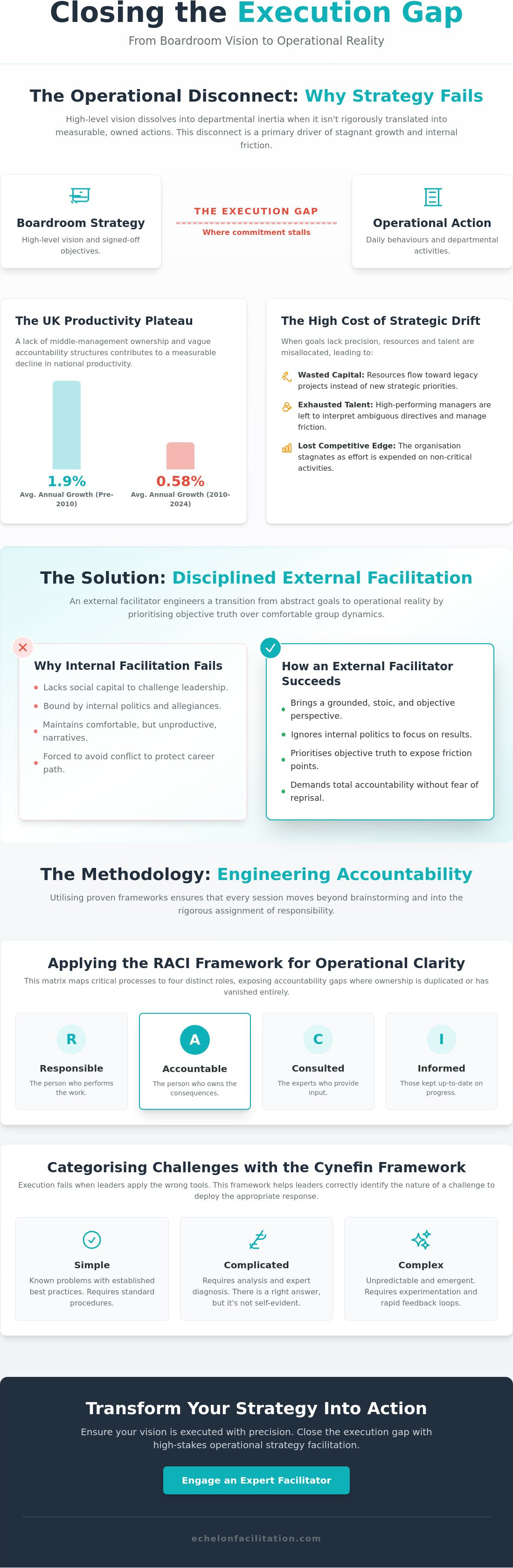
The financial cost of this disconnect is measurable and severe. Between 2010 and 2024, the UK's output per job grew by a mere 0.58% per year, a stark decline from the 1.9% average seen in the decade prior. This productivity plateau stems from a lack of middle-management ownership and vague accountability structures. Organisations that fail to bridge this divide face stagnant growth and internal friction that consistently erodes the achievement of critical board objectives.
You likely recognise that even the most sophisticated vision is worthless without a concrete plan for execution. This article explains how high-stakes workshop facilitation transforms high-level intent into unambiguous individual ownership. We will examine the mechanics of closing the execution gap and the frameworks required to drive sustained growth.
Key Takeaways
- Understand the mechanics of the execution gap and why high-level vision often fails to translate into operational reality without disciplined intervention.
- Learn to use an operational strategy workshop facilitator uk to enforce accountability and transform vague board objectives into clear roadmaps.
- Adopt the Strategy Sprint methodology to rapidly align leadership teams and establish the decision rights necessary for sustained organisational progress.
- Prioritise facilitators who value objective truth and professional composure over maintaining comfortable but unproductive group dynamics.
- Recognise the distinction between strategic planning and operational readiness to ensure your organisation functions as a high-performance engine.
The Operational Disconnect: Why Strategy Fails at the Execution Layer
Most UK organisations possess a strategy; few possess the discipline to execute it. This execution gap occurs where high-level vision dissolves into departmental inertia. Board members often mistake consensus for commitment, assuming that a signed-off document automatically dictates daily behaviour. In reality, strategy implementation requires a rigorous translation process that many leadership teams overlook. An operational strategy workshop facilitator uk acts as the bridge, ensuring that broad intent becomes specific, measurable action.
A facilitator does not merely lead a discussion. They engineer a transition from abstract goals to operational reality. Without this intervention, departments often retreat into silos, protecting legacy processes rather than adopting new strategic priorities. This lack of cohesion is a primary driver of the UK productivity gap, as effort is expended on activities that do not advance the organisation toward its stated objectives.
The High Cost of Strategic Drift
Vague objectives create strategic drift. When goals lack precision, resources flow toward legacy projects rather than new priorities. This misallocation wastes capital and exhausts your most capable people. High-performing middle managers often suffer most; they are left to interpret ambiguous directives whilst managing the friction of competing departmental interests. Without clear operational roadmaps, productivity plateaus and the organisation loses its competitive edge.
Why Internal Facilitation Often Falls Short
Internal staff rarely possess the social capital to challenge senior leadership or dismantle established silos. They are part of the system they are trying to fix, which often forces them to maintain comfortable narratives to avoid conflict. An external operational strategy workshop facilitator uk brings a grounded, stoic perspective that ignores internal politics. They prioritise objective truth over maintaining a comfortable group dynamic. This rigor is essential for exposing the friction points that internal sessions typically ignore. Unlike an internal lead, an external expert can demand total accountability without fear of career repercussions.
Engineering Accountability: The Role of an Operational Strategy Workshop Facilitator
Ideation without accountability is a corporate distraction. An operational strategy workshop facilitator uk ensures that every session moves beyond brainstorming and into the rigorous assignment of responsibility. This role acts as a strategic lever for organisational stability; it forces a transition from abstract possibilities to concrete ownership. Whilst many workshops end with colourful post-it notes and vague optimism, a disciplined intervention concludes with binding commitments and clear deadlines. This process often necessitates a Decision-Rights Reset to resolve the structural ambiguity that widens the UK productivity gap.
A facilitator provides the objective distance required to challenge the status quo. They don't just ask questions; they demand clarity on who owns the final decision for every strategic initiative. This rigour prevents the "consensus trap," where teams agree on a direction but fail to assign the specific individual responsibility required to reach the destination. By establishing these boundaries, the facilitator creates a foundation for measurable progress.
Applying the RACI Framework for Operational Clarity
Accountability gaps are the silent killers of strategic progress. We utilise the RACI matrix to map critical processes to four distinct roles: Responsible, Accountable, Consulted, and Informed. This framework exposes instances where multiple managers believe they lead a project or where ownership has vanished entirely. By highlighting these voids, the facilitator forces the leadership team to make definitive, often difficult, choices about individual responsibility. It is not enough to agree on a goal; the team must agree on who owns the consequences of failure.
The Cynefin Framework: Categorising Operational Challenges
Execution fails when leaders apply the wrong tools to a problem. We introduce the Cynefin framework to help leaders categorise challenges as simple, complicated, or complex. A simple problem requires a standard procedure; a complex one demands experimentation and rapid feedback. Misidentifying the nature of a hurdle leads to wasted effort and systemic failure. A skilled operational strategy workshop facilitator uk uses this framework to prevent the team from applying rigid, outdated solutions to fluid environments, ensuring that resources are deployed with operational precision and clear intent.
Strategic Frameworks: Moving from Vision to Tactical Ownership
Strategic planning is merely the creation of a map; operational readiness is the assembly of the engine. Many UK firms confuse the two, resulting in a beautifully designed route that the organisation lacks the power to travel. This systemic failure contributes significantly to the UK's productivity problem. To solve this, an operational strategy workshop facilitator uk utilises a Strategy Sprint to bridge the divide. This methodology focuses on rapid alignment, forcing leaders to move beyond high-level vision and into the granular reality of tactical ownership.
Traditional industry advice often suggests that executive offsites should prioritise team building or "soft" bonding activities. We reject this approach. A high-stakes session must prioritise rigorous problem solving and the removal of operational blockages. Trust is built through the collective achievement of difficult objectives, not through artificial social exercises. For organisations undergoing significant structural shifts, a Transformation Alignment session is essential to ensure that every department understands its specific role in the new model.
The Anatomy of a Results-Driven Agenda
Effective facilitation starts long before the session begins. Pre-workshop diagnostics identify the specific constraints and "unspoken truths" that hinder progress. The agenda must be structured to demand total accountability, moving logically from identifying friction to assigning ownership. If you are ready to move from vision to execution, consider booking a Strategy Sprint to reset your operational focus.
From Offsite to Action: The First 30 Days
The success of a workshop is measured by what happens after the participants return to the office. Momentum often dies within 72 hours if a structured follow-up is absent. A facilitator ensures that the Strategic Planning Process includes a 30-day "hard-start" phase. This phase requires immediate, visible action on the commitments made during the session, reinforcing the new culture of accountability and ensuring the engine of execution remains engaged.
Selecting an Operational Strategy Workshop Facilitator in the UK
Selecting an operational strategy workshop facilitator uk requires a focus on professional composure rather than logistical support. Venue sourcing and catering are secondary; the primary value lies in the facilitator's ability to maintain stability under high-stakes pressure. You need an expert who values objective truth over a comfortable group dynamic. If a facilitator relies on corporate jargon or superficial ice-breaker activities, they likely lack the authority to manage a senior leadership team. Prioritise those with a proven track record in Executive Alignment within complex organisations.
A disciplined facilitator identifies the unspoken barriers that prevent progress. They don't seek to be liked; they seek to be effective. This requires a grounded, stoic approach that remains unswayed by internal politics or departmental egos. By maintaining this focus, the facilitator creates an environment where leaders can confront operational reality and assign the accountability necessary for growth.
While the facilitator manages the strategic environment, the physical and technological foundations of the workplace must also be fit for purpose.
The UK Context: Productivity and Governance
UK corporate governance codes demand clear lines of accountability and transparent decision-making. A UK-based facilitator understands these regulatory expectations and the specific cultural nuances of British leadership. They recognise that polite consensus often masks deep-seated organisational friction. By engaging an operational strategy workshop facilitator uk, you ensure that the organisation remains compliant with governance standards whilst actively closing the productivity gap. This nuanced understanding is essential for driving long-term organisational stability.
The Echelon Approach to Operational Excellence
Our How We Work philosophy focuses on unwavering strategic clarity. We don't offer generic advice or team building distractions. Instead, we provide a disciplined framework for execution that demands results and enforces individual ownership. If your organisation is struggling with strategic drift or departmental inertia, we invite you to book a diagnostic call. This session allows us to identify your team's specific constraints and determine the most effective path toward operational excellence.
Bridge the Execution Gap with Strategic Precision
Closing the UK productivity gap requires a shift from passive planning to active, disciplined execution. The disconnect between board vision and departmental action is rarely a failure of intent; it is a failure of accountability. By implementing rigorous frameworks like RACI and the Cynefin model, leadership teams transform vague objectives into measurable progress. This transition ensures that the organisational engine is fully aligned with the strategic map.
Maintaining this alignment also requires a robust physical infrastructure.
Engaging an experienced operational strategy workshop facilitator uk provides the objective authority needed to dismantle silos and reset decision rights. Echelon Facilitation, founded by Dr Andrew Greenland, a medical doctor who has spent years running large, high-stakes working sessions for senior expert groups, specialises in these high-stakes executive alignment sessions. Our methodology ignores comfortable narratives in favour of results-driven clarity. Every session is designed so that participants leave with an unambiguous roadmap and clear ownership of their objectives. This level of commitment is the only way to sustain long-term growth and operational stability.
Operational excellence is within reach for organisations that value discipline over fleeting motivation. You can end the cycle of strategic drift and establish a culture of unwavering focus. Secure your operational strategy workshop with Echelon Facilitation today and begin the process of turning executive vision into operational reality.
Frequently Asked Questions
What is the difference between a strategy facilitator and an operational strategy facilitator?
A strategy facilitator focuses on defining a long-term vision, whilst an operational strategy workshop facilitator uk focuses on the mechanics of execution. Strategy sessions address "where" the organisation is going. Operational facilitation addresses "how" it will get there by assigning accountability and defining decision rights. This process ensures that the board's high-level intent translates into daily action and specific behaviour at every level of the organisation.
How long does a typical operational strategy workshop last?
Most intensive sessions require one to two full days to achieve meaningful alignment. A Strategy Sprint is typically completed in a single day, whilst a Transformation Alignment workshop for a complex organisation often requires two days. These durations allow sufficient time to dismantle silos and assign rigid ownership to every strategic initiative. The specific length is always determined by the depth of the existing execution gap.
Can an operational strategy workshop help with a remote or hybrid leadership team?
Disciplined facilitation is effective for remote teams if the session maintains a rigorous focus on accountability. We use structured digital frameworks to ensure distance doesn't lead to strategic drift. Whilst virtual sessions are productive, we often recommend in-person offsites for high-stakes executive sessions. Physical proximity helps an operational strategy workshop facilitator uk identify and resolve the subtle interpersonal friction and non-verbal cues that remote calls can mask.
How do you measure the success of a facilitated operational workshop?
Success is measured by the transition from vague consensus to unambiguous individual ownership. We evaluate the quality of the resulting operational roadmap and the team's adherence to the 30-day "hard-start" plan. If every strategic task has a single accountable owner and a clear deadline, the workshop has succeeded. The ultimate metric is the organisation's measurable progress toward board objectives in the months following the intervention.
What happens if our leadership team is fundamentally misaligned before the workshop starts?
Fundamental misalignment is a leadership opportunity rather than a barrier to facilitation. We use pre-workshop diagnostics to expose these fractures before the leadership team enters the room. The workshop then serves as a neutral ground to confront these disagreements using objective data and strategic frameworks. We prioritise objective truth over a comfortable group dynamic, ensuring that misalignment is resolved through clear decision rights and structural clarity.

Article by
Andrew Greenland
Dr Andrew Greenland is the founder of Echelon Facilitation, a UK practice that designs and runs high-stakes leadership sessions for executive teams who need decisions, not more discussion. A medical doctor and medical educator, Andrew brings a clinician's discipline to the messy, political work of leadership alignment - surfacing the real disagreement, forcing the real choices, and ensuring every session produces a documented decision log with named owners and deadlines. He designs Echelon’s sessions for CEOs, executive teams, transformation leads and boards. Based in Twickenham.